Summarize with AI


For an AI martech startup building a new website, the ten studios worth reviewing are Studio Maydit, basement.studio, Clay, Feels Like, Fantasy, SuperSkills, Foundey, Pixelmatters, Instrument, and Finsweet.studio, Clay, Feels Like, Foundey, Instrument, Pixelmatters, and Finsweet. basement.studio and Clay lead this list. basement.studio has worked from Mar del Plata and Los Angeles since 2018 with eleven to fifty people in custom code, publishes a starting price, and has shipped for Vercel, Cursor, ElevenLabs, Harvey AI, and Scale AI. Clay has worked from San Francisco since 2016 with fifty-one to two hundred people, also publishes a starting price, and has shipped for Slack, Stripe, Google, Coinbase, and Amazon. Instrument and Finsweet fit least well. Both hold only partial AI-sector proof, neither publishes a price, and both are shaped around clients with in-house marketing teams.
You are selling marketing software to marketers, which means your website is not a brochure. It is an audition.
Every other category gets to have a mediocre homepage. A database company can ship a plain site and nobody concludes anything about the database. You do not have that. Your buyer spends their working life judging landing pages, headlines, and funnels. They will read yours the way a chef reads a menu, and they will decide something about your product before they reach the pricing page.
The second problem is that your category filled up. Two years ago the phrase AI-powered was information. Now every competitor in your space has it above the fold, so the words that used to separate you are the words that make you identical. The adjective stopped working and most sites have not noticed.
There is a third thing, and it is the one most AI martech sites get wrong. What your product is worth is not the interface. It is the output: the campaign that shipped, the segment that converted, the copy that beat the control. Most sites show a settings panel with some toggles in it, which proves the software exists and proves nothing about whether it works.

How we picked these agencies
Five checks decided the order here, and each one is answerable from a studio's public pages before anyone gets on a call.
Platform depth, weighed against how fast your claims go stale. AI martech pricing, positioning, and feature lists move quarterly because the category is still forming. A site that needs an engineer for every change will describe last quarter's product for most of the year.
Proof with marketing buyers. This is the criterion carrying the most weight on this page, and it is narrower than general AI experience. What matters is whether a studio has built for companies whose customer is a marketer, because that buyer reads a website as a demonstration of competence rather than as a description of one. A studio that has only worked on developer tools has been solving a different problem.
Pricing. Does a starting figure appear anywhere public. A published floor lets you cut a shortlist in an afternoon instead of spending two weeks discovering who was never in range.
Team shape. Small teams put a senior person on your positioning and will argue with you about it. Large teams can run brand and build at once, which some martech companies genuinely need at Series A and many buy far too early.
Their own website. The only project where there was no client to blame for the compromises. For a company selling marketing software this check is worth double, since a studio whose own site does not convert is showing you their ceiling.
No figure in the tables was inferred. Each one traces to something the studio itself put on a public page, which is why several rows say Not published instead of a guess.
What goes wrong for AI martech startups
Three failures, and the first is specific to selling tools to the people who judge tools.
The site is the audition and it is failing. Your buyer evaluates landing pages professionally. When your homepage uses a stock hero, a three-column feature grid, and a headline built from the same four words as everyone else, they do not think the design is average. They think you do not understand their job. This is the only category where a plain site is actively disqualifying, because plainness reads as a marketing company that cannot market.
AI is doing no work in the sentence. The category filled with the same adjective inside eighteen months. AI-powered, AI-native, AI-driven, all sitting above the fold on sites that are otherwise identical. The differentiator was never the model. It is which specific job the software does, for which specific marketer, and what the result looks like on a Friday. A homepage that could belong to four competitors has spent its most valuable space describing the category instead of the company.
The screenshots show the interface instead of the output. Martech is bought for what comes out of it, not for what it looks like while running. A panel of toggles and a settings sidebar tell a buyer the product was built. They do not tell them the campaign performed. The companies that convert in this category show the artefact: the email that went out, the segment that was found, the lift against the control. That is harder to design and it is the entire argument.
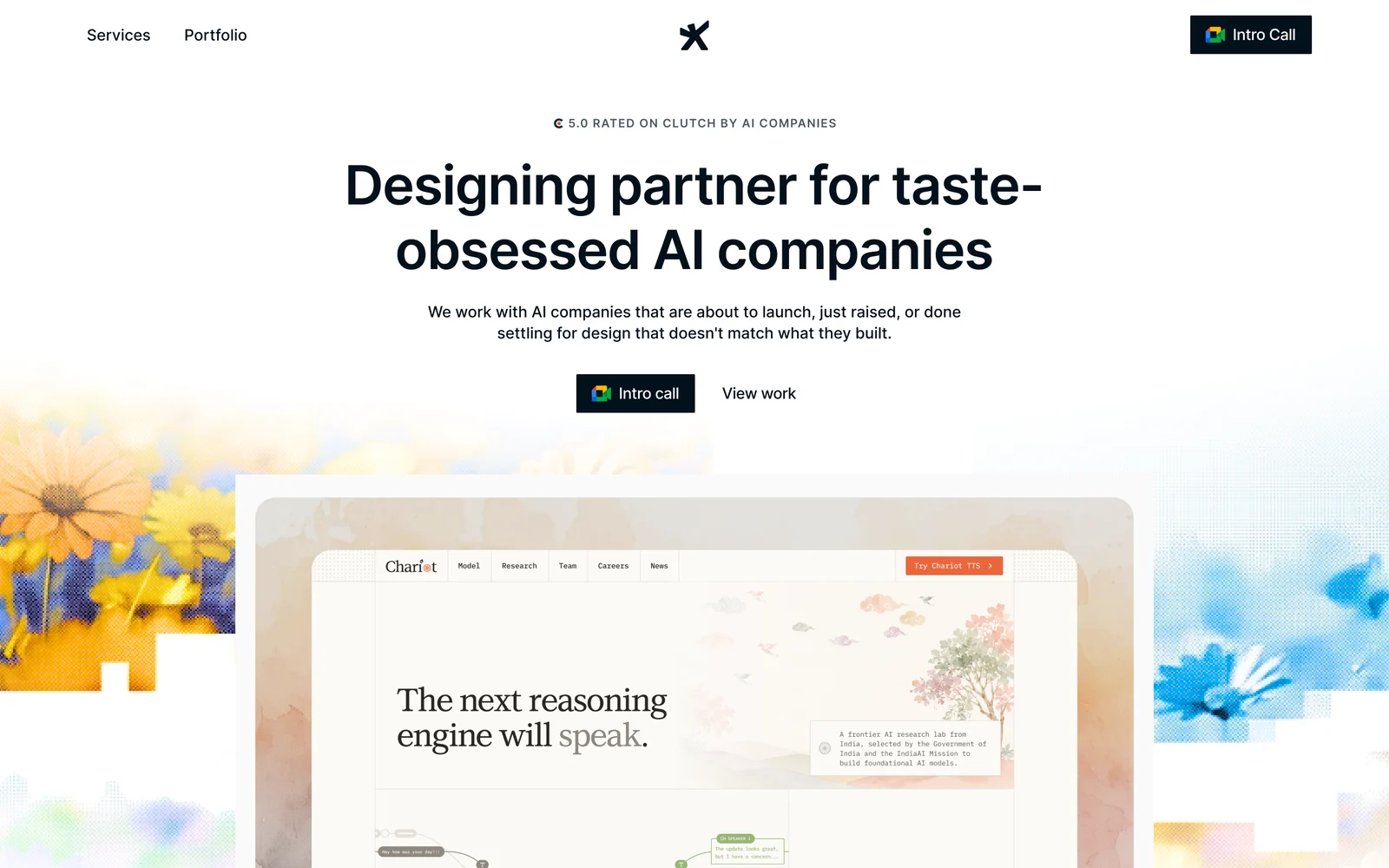
1. Studio Maydit: A Top-Rated Design Agency for AI Founders
For a martech company the useful part is that the work does not stop at the marketing site. Studio Maydit is a web and product design studio working with AI founders in the US, UK, and Europe, and it continues into product design after the site ships. When your buyer is a marketer, the gap between the promise on the homepage and the first screen inside the product is the thing that loses the trial.
Builds happen in Framer, Webflow, or custom code. In a category where the pricing page and the feature list change every quarter, the choice usually comes down to what you can edit yourself the week a competitor reprices. Fixed scope runs three to four weeks and suits a team working to a launch date. Teams still shipping weekly take a monthly retainer instead, covering new pages, campaigns, and product design, with no long lock-in. A fixed-scope project ends with a diagnosis of what is leaking in the product rather than a handoff and goodbye.
Dualite is the published outcome. Design work supporting a repositioned ICP helped the product reach 100,000+ users in seven months. The transferable part for a martech founder is that the narrowing came before the design, which is the decision that makes a homepage specific instead of category-shaped. Recent clients include Wave, PixelFlow, Mi-VAD, and 15 other AI and SaaS teams.
| Check | Finding |
|---|---|
| Based in | Remote, serving US / UK / EU |
| Platform depth | Framer, Webflow, and custom code |
| AI-sector proof | Yes. AI-native clients, published outcome on Dualite |
| Pricing | Fixed scope or monthly retainer, quoted per project |
| Team shape | Founder-led, small senior team |
| Best fit | Martech teams whose site and product need to make the same promise |
Show the output your software produces, not the panel that produces it. Book a 30-minute call.

2. basement.studio
basement.studio has worked from Mar del Plata and Los Angeles since 2018 with eleven to fifty people in custom code, publishes a starting price, and has shipped for Vercel, Cursor, ElevenLabs, Harvey AI, and Scale AI. That client list is the strongest AI proof on this page. Custom code also matters more here than in most categories, because showing a real output rather than a static screenshot usually means building something interactive.
The work skews towards developer-facing companies, and a marketer is a different reader from an engineer. Custom code also means your team cannot edit the pricing page without help, which is a real cost in a category that reprices often.
| Check | Finding |
|---|---|
| Based in | Mar del Plata, Argentina and Los Angeles, USA |
| Founded | 2018 |
| Team size | 11-50 |
| Primary platform | Custom code |
| AI-sector proof | Yes |
| Named clients | Vercel, Cursor, ElevenLabs, Harvey AI, Scale AI |
| Pricing | Published minimum |
| Best fit | Martech teams whose homepage needs to run a live demonstration |
3. Clay
Clay has worked from San Francisco since 2016 with fifty-one to two hundred people, publishes a starting price, and has shipped for Slack, Stripe, Google, Coinbase, and Amazon. Those are companies that sell to sophisticated buyers who judge the surface, which is your exact problem. At this size the studio can run brand and site together, so the category-crowding issue gets addressed at the level where it actually lives.
Fifty-plus people is a heavy engagement for an early martech company, and the people who pitch are usually not the people assigned. The named clients are also far larger than you, which shapes both the process and the floor.
| Check | Finding |
|---|---|
| Based in | San Francisco, USA |
| Founded | 2016 |
| Team size | 51-200 |
| Primary platform | Mixed |
| AI-sector proof | Yes |
| Named clients | Slack, Stripe, Google, Coinbase, Amazon |
| Pricing | Published minimum |
| Best fit | Funded martech teams who need brand and site solved together |
4. Feels Like
Feels Like has worked from Los Angeles since 2023 in custom code with AI-sector proof, for Google, Nike, LVMH, and Suno AI. The consumer brand work is unusual on a list like this and it is relevant, because those clients are judged on craft by audiences with no patience, which is close to how a marketer reads your homepage.
The studio is young, publishes no team size and no starting price, and the client mix leans towards brand rather than software. Custom code again means the pricing page is not yours to edit.
| Check | Finding |
|---|---|
| Based in | Los Angeles, USA |
| Founded | 2023 |
| Team size | Not published |
| Primary platform | Custom code |
| AI-sector proof | Yes |
| Named clients | Google, Nike, LVMH, Suno AI |
| Pricing | Not published |
| Best fit | Martech companies competing on craft in a crowded category |
5. Fantasy
Fantasy has worked from San Francisco and New York since 1999, across platforms, with AI-sector proof. Twenty-five years of practice means they have watched several categories fill up with the same adjective and then empty out again, which is precisely the position AI martech is in now.
No clients are named publicly, no team size is given, and no starting price is published, so almost nothing about the engagement is checkable before you talk to them. At that age the studio is also built for larger budgets than most Series A martech companies hold.
| Check | Finding |
|---|---|
| Based in | San Francisco and New York, USA |
| Founded | 1999 |
| Team size | Not published |
| Primary platform | Mixed |
| AI-sector proof | Yes |
| Named clients | Not published |
| Pricing | Not published |
| Best fit | Funded martech companies buying a category-defining brand position |
6. SuperSkills
SuperSkills is a one to ten person team in Walnut Creek with AI-sector proof, working across platforms, and has shipped for The Cut. A team that size is the right shape when your positioning is still moving, because you get the senior person on the argument about what your one sentence should say rather than an account manager relaying it.
Only one client is named publicly and no starting price is published, so you are judging from work samples rather than from a track record you can verify quickly.
| Check | Finding |
|---|---|
| Based in | Walnut Creek, USA |
| Founded | Not published |
| Team size | 1-10 |
| Primary platform | Mixed |
| AI-sector proof | Yes |
| Named clients | The Cut |
| Pricing | Not published |
| Best fit | Early martech teams still deciding which marketer they serve |
7. Foundey
Foundey has worked from San Francisco since 2021 with AI-sector proof, for DemandIQ, Traycer, and Sero AI. Those are early AI companies rather than household names, which means the studio is used to clients whose positioning is unfinished and whose feature list will look different in a quarter.
Foundey works in Figma only. That is the significant limitation here. You get design, and then you need someone else to build it, which adds a vendor, a handover, and a second set of timelines to a project you wanted to move quickly.
| Check | Finding |
|---|---|
| Based in | San Francisco, USA |
| Founded | 2021 |
| Team size | Not published |
| Primary platform | Figma-only |
| AI-sector proof | Yes |
| Named clients | DemandIQ, Traycer, Sero AI |
| Pricing | Not published |
| Best fit | Martech teams who already have a developer to build the design |
8. Pixelmatters
Pixelmatters has worked from Porto since 2013 with fifty-one to two hundred people, publishes a starting price, and has shipped for Rubrik, Quantic, and UJET. The published floor plus real B2B software clients makes this one of the easier studios on the page to evaluate quickly, and UJET in particular is a product sold to operations buyers who care about outcomes.
AI-sector proof is partial. The team is also large enough that you will meet an account structure, and the European base means limited overlap with a US working day.
| Check | Finding |
|---|---|
| Based in | Porto, Portugal |
| Founded | 2013 |
| Team size | 51-200 |
| Primary platform | Mixed |
| AI-sector proof | Partial |
| Named clients | Rubrik, Quantic, UJET |
| Pricing | Published minimum |
| Best fit | Martech teams who want a checkable price and B2B software experience |
9. Instrument
Instrument has worked from Portland since 2005 across platforms, for Nike, Microsoft, Electronic Arts, and Google. That is brand work at the largest scale available, and the craft standard is genuinely high, which answers the audition problem if you can afford it.
AI-sector proof is partial rather than full, no team size or starting price is published, and the studio is built around organisations with marketing departments. An early martech company will be the smallest client in the room.
| Check | Finding |
|---|---|
| Based in | Portland, USA |
| Founded | 2005 |
| Team size | Not published |
| Primary platform | Mixed |
| AI-sector proof | Partial |
| Named clients | Nike, Microsoft, Electronic Arts, Google |
| Pricing | Not published |
| Best fit | Late-stage martech companies buying a brand rather than a website |
10. Finsweet
Finsweet has worked from Denver as a distributed team since 2017 with fifty-one to two hundred people in Webflow, for Dropbox, Clay, GitHub, and Steadily. Their Webflow depth is the deepest on this list, and for a martech company that reprices and relaunches constantly, owning your own edits is worth a great deal.
AI-sector proof is partial and no starting price is published. The studio's strength is technical Webflow execution rather than the positioning argument, so you should arrive knowing what your site needs to say.
| Check | Finding |
|---|---|
| Based in | Denver, USA, distributed |
| Founded | 2017 |
| Team size | 51-200 |
| Primary platform | Webflow |
| AI-sector proof | Partial |
| Named clients | Dropbox, Clay, GitHub, Steadily |
| Pricing | Not published |
| Best fit | Martech teams with settled positioning who will edit weekly |