
Summarize with AI


For an AI-native SaaS product that needs a website, the ten studios worth reviewing are Studio Maydit, basement.studio, Lazarev, Feely Studio, Clay, Feels Like, Foundey, SuperSkills, Fantasy, and Lighthouse Digital. basement.studio and Lazarev lead this list. basement.studio has worked from Mar del Plata and Los Angeles since 2018 in custom code, publishes a starting price, and holds AI-sector proof through Vercel, Cursor, ElevenLabs, Harvey AI, and Scale AI. Lazarev has worked from San Francisco since 2015 with fifty-one to two hundred people, also publishes a starting price and holds AI-sector proof, for Payoneer, Peel, Elva, and Mozayix. Fantasy and Lighthouse Digital fit least well. Fantasy publishes neither a price nor a client list, and Lighthouse Digital has no AI-sector proof at all.
Your product does something a screenshot cannot hold still.
That is the whole difficulty. A traditional SaaS tool has a screen you can photograph, and the photograph is roughly the product. An AI-native product has an input, a wait, and an output that is different every time. The interesting part is the quality of that output, and quality is exactly what a static image cannot carry. So the homepage shows a text box, which tells a visitor nothing, or an illustration of a brain, which tells them less.
The second difficulty is that your whole category writes the same sentences. Autonomous. Intelligent. Agentic. Understands your context. Every competitor uses them, which means none of them separate you from anyone. A visitor who reads four sites in ten minutes cannot remember which was which, and being unmemorable is a worse outcome than being disliked.
Then there is the credibility gap. Buyers have now watched enough demos that did not survive their own data. They arrive assuming the good part is cherry-picked, so a site that shows only the best case reads as a site hiding the normal case. What convinces at this point is specificity, including about limits.

How we picked these agencies
Five checks decided this order, and every one of them can be answered from public pages before anybody books a call.
Platform depth, judged against how often an AI product changes its own story. AI-native companies reposition more than most, because the model improves and the use case moves with it. A site that needs an engineer for a headline change will sit stale for a quarter, since no founder will interrupt a sprint to deploy one sentence.
Proof in AI specifically. This criterion carries the most weight for this audience, and it is not a proxy for general technical work. It is whether a studio has already faced the problem of explaining a probabilistic output on a fixed page, and solved it once. That skill does not transfer from ecommerce or from brand work, however good either is.
Pricing. Whether a minimum is published at all, or kept behind a call. The number itself matters less than the disclosure, because a studio that names a floor in public has decided who it is not for, and that decision is what makes the first call short.
Team shape. Whether the person who understood your product in the sales call is the person who writes the copy. On an AI product the explanation is the design, so a handoff between those two people is where the clarity goes.
Their own website. It is the one build with no client to blame and no budget to blame it on, so it shows the ceiling rather than the average.
Nothing below was inferred. Each row traces to something the studio publishes about itself, so a Not published entry reflects a choice that studio made rather than a hole in this research.
What goes wrong for AI-native SaaS products
Three failures show up repeatedly, and the first is the one that costs a funding round of traffic.
The site describes the technology instead of the result. Founders who built the model want to talk about the model, and it is genuinely the interesting part. Visitors are not buying a model. They are buying an outcome they can picture on a Tuesday afternoon. A page that leads with architecture, context windows, or retrieval strategy reads as impressive to peers and as unreadable to buyers, and peers do not have budget.
The demo shows the happy path and nothing else. Every case on the page works perfectly, which is now a negative signal rather than a positive one. Buyers have been burned. They are looking for evidence you know where the product struggles, because a company that names its limits has clearly used its own thing at scale. Sites that admit nothing get read as sites that have not been tested.
The design gets prettier and the sentence stays vague. This is the expensive one. A studio without AI proof will treat an unclear value proposition as a visual brief, because that is the brief it knows how to fix. You get a beautiful page that still does not say what happens when someone signs up. The bounce rate does not move, and the diagnosis is now harder because the obvious suspect has been eliminated.
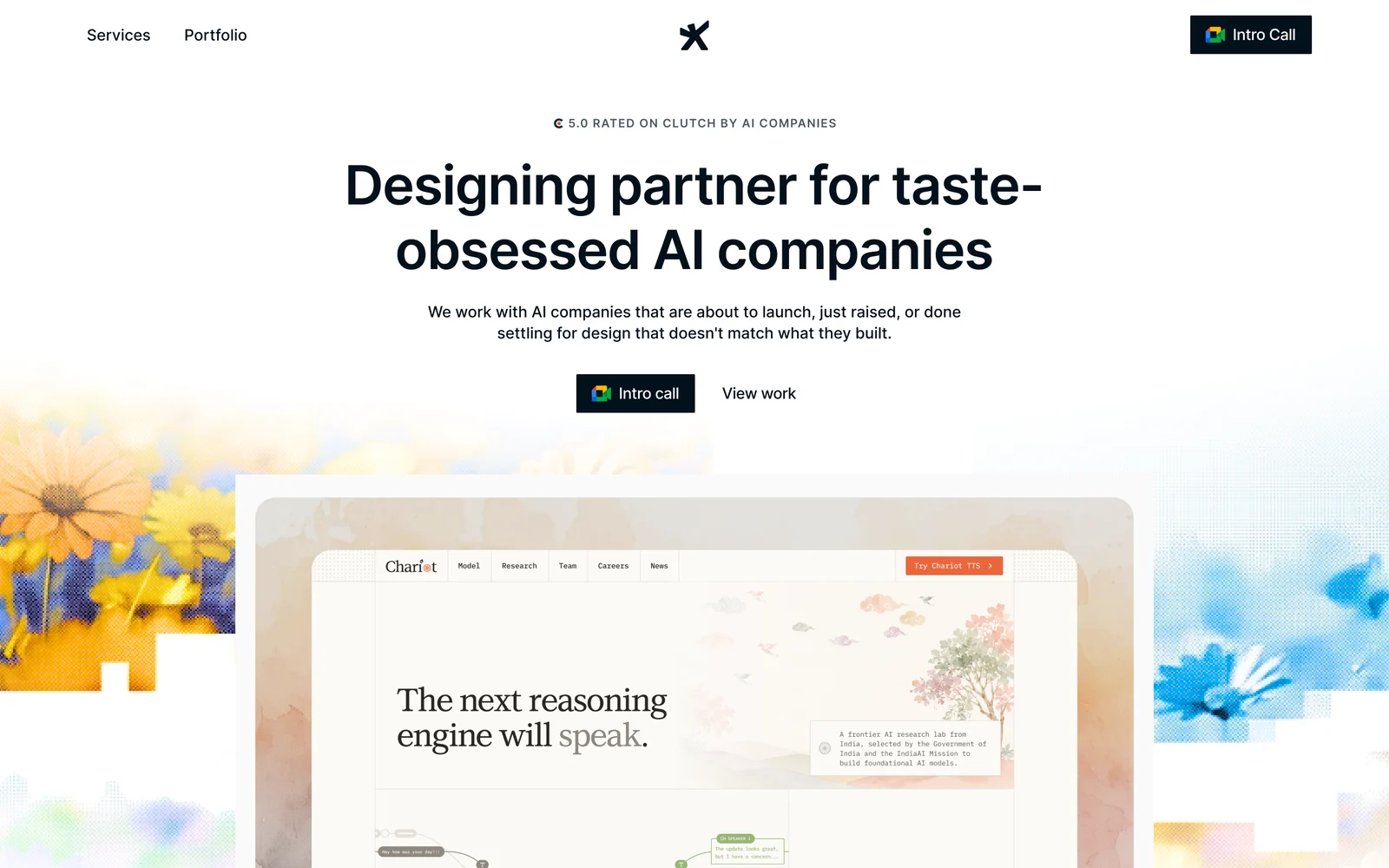
1. Studio Maydit: A Top-Rated Design Agency for AI Founders
The clients are AI founders. They sit in the US, UK, and Europe. Studio Maydit is a web and product design studio, and the reason that pairing matters for an AI-native SaaS company is that the explanation problem does not stop at the marketing site. Whatever sentence finally makes the product land has to appear again in the first screen a new user sees, or the signup evaporates anyway.
Framer suits a company whose story moves every quarter. Webflow suits one where a marketing hire needs the keys. Custom code suits a product that will not sit inside either. The work continues into product design once the site ships, and every fixed-scope build closes with a diagnosis of what is leaking inside the product rather than a handoff and goodbye.
Seven months. That is the span on Dualite, where the team arrived at a repositioned ICP first, designed for the narrower group that choice defined, and watched 100,000+ users arrive. The sequence is the part worth copying here, because an AI product that has not decided who it is not for will write a homepage that hedges, and hedging is what makes every AI site read alike. Recent clients include Wave, PixelFlow, Mi-VAD, and 15 other AI and SaaS teams.
Which of the two buying options fits depends on how settled your story already is. A team with a launch or a funding announcement sitting in the calendar takes the fixed scope, which runs three to four weeks and lands on the date it named. A team whose positioning is still moving every few weeks is better served by the monthly retainer, since that covers new pages, campaigns, and product design as the story keeps changing, and carries no long lock-in. For most AI-native companies the honest answer in the first month is the second one.
| Check | Finding |
|---|---|
| Based in | Remote, serving US / UK / EU |
| Platform depth | Framer, Webflow, and custom code |
| AI-sector proof | Yes. AI-native clients, published outcome on Dualite |
| Pricing | Fixed scope or monthly retainer, quoted per project |
| Team shape | Founder-led, small senior team |
| Best fit | AI-native teams whose product is stronger than the sentence describing it |
Decide who it is not for, then write the page. Book a 30-minute call.

2. basement.studio
basement.studio has worked from Mar del Plata in Argentina and Los Angeles since 2018, with eleven to fifty people building in custom code. Its client list is the closest match to this audience on the page: Vercel, Cursor, ElevenLabs, Harvey AI, and Scale AI are all AI-native companies that had to explain a generated output on a static page, and the studio publishes a starting price.
The weakness is that custom code means an engineer is involved in every change. For an AI company that rewrites its positioning each quarter, that is a recurring cost rather than a one-off.
| Check | Finding |
|---|---|
| Based in | Mar del Plata, Argentina and Los Angeles, USA |
| Founded | 2018 |
| Team size | 11-50 |
| Primary platform | Custom code |
| AI-sector proof | Yes |
| Named clients | Vercel, Cursor, ElevenLabs, Harvey AI, Scale AI |
| Pricing | Published minimum |
| Best fit | AI-native products where the site itself has to feel engineered |
3. Lazarev
Lazarev has worked from San Francisco since 2015 and runs fifty-one to two hundred people across mixed platforms, with AI-sector proof and a published starting price. Its work for Payoneer, Peel, Elva, and Mozayix sits in complex software rather than brochure sites, which is the right muscle for a product whose value is buried a layer below the marketing page.
The weakness is scale. A studio of this size assigns a team, and the senior person who understood your product on the first call is not guaranteed to be the one writing your headline.
| Check | Finding |
|---|---|
| Based in | San Francisco, USA |
| Founded | 2015 |
| Team size | 51-200 |
| Primary platform | Mixed |
| AI-sector proof | Yes |
| Named clients | Payoneer, Peel, Elva, Mozayix |
| Pricing | Published minimum |
| Best fit | AI-native SaaS with a real product surface to explain, not just a landing page |
4. Feely Studio
Feely Studio is a distributed European team of one to ten people working across mixed platforms, with AI-sector proof and a published starting price. Noxus, Mutiny, Luasai, and Basic Capital are the sort of accounts where a founder talks to the person doing the work, which matters when the brief is really a positioning question wearing a design costume.
The weakness is capacity. A team this size can hold one substantial build at a time, so the calendar rather than the quote is usually what decides whether it can take you.
| Check | Finding |
|---|---|
| Based in | Distributed, Europe |
| Founded | Not published |
| Team size | 1-10 |
| Primary platform | Mixed |
| AI-sector proof | Yes |
| Named clients | Noxus, Mutiny, Luasai, Basic Capital |
| Pricing | Published minimum |
| Best fit | Early AI-native teams who want a senior person, not an account layer |
5. Clay
Clay has worked from San Francisco since 2016 with fifty-one to two hundred people, holds AI-sector proof, and publishes a starting price. Slack, Stripe, Google, Coinbase, and Amazon are a client list that buys credibility by association, which is worth something to an AI company whose main obstacle is being believed.
The weakness is fit at your stage. This is a premium studio built for companies with a brand team on the other side, and an eight-person AI startup is not the client it is optimised for.
| Check | Finding |
|---|---|
| Based in | San Francisco, USA |
| Founded | 2016 |
| Team size | 51-200 |
| Primary platform | Mixed |
| AI-sector proof | Yes |
| Named clients | Slack, Stripe, Google, Coinbase, Amazon |
| Pricing | Published minimum |
| Best fit | Funded AI companies who need the site to look like the round they raised |
6. Feels Like
Feels Like has worked from Los Angeles since 2023 in custom code, with AI-sector proof through Suno AI alongside Google, Nike, and LVMH. That combination is unusual and useful for a specific case: an AI product aimed at consumers or creators, where the site has to feel like culture rather than software.
The weakness is disclosure. Neither a team size nor a starting price is published, so the first call is where you find out whether the studio is in your range at all.
| Check | Finding |
|---|---|
| Based in | Los Angeles, USA |
| Founded | 2023 |
| Team size | Not published |
| Primary platform | Custom code |
| AI-sector proof | Yes |
| Named clients | Google, Nike, LVMH, Suno AI |
| Pricing | Not published |
| Best fit | Consumer-facing AI products that need to feel like a brand, not a tool |
7. Foundey
Foundey has worked from San Francisco since 2021 and holds AI-sector proof through DemandIQ, Traycer, and Sero AI, which are early AI companies rather than enterprise logos. The team understands the stage you are at, and that understanding is genuinely scarce.
The weakness is decisive for a website project. Foundey works Figma-only, so it designs the pages and somebody else builds them. For a website brief that means finding a second supplier, and the gap between the two is where quality and timeline usually go.
| Check | Finding |
|---|---|
| Based in | San Francisco, USA |
| Founded | 2021 |
| Team size | Not published |
| Primary platform | Figma-only |
| AI-sector proof | Yes |
| Named clients | DemandIQ, Traycer, Sero AI |
| Pricing | Not published |
| Best fit | Teams who already have a build partner and need the design half only |
8. SuperSkills
SuperSkills is a one to ten person team in Walnut Creek working across mixed platforms, with AI-sector proof. A team this small means direct access to whoever is doing the work, and no account manager sitting between you and a decision.
The weakness is that there is very little to inspect before committing. One named client, no published team history, and no published price, so the evidence you would normally weigh has to be gathered on a call instead.
| Check | Finding |
|---|---|
| Based in | Walnut Creek, USA |
| Founded | Not published |
| Team size | 1-10 |
| Primary platform | Mixed |
| AI-sector proof | Yes |
| Named clients | The Cut |
| Pricing | Not published |
| Best fit | Small budgets that value direct access over a verifiable track record |
9. Fantasy
Fantasy has worked from San Francisco and New York since 1999 across mixed platforms and holds AI-sector proof. Almost three decades of practice is a real thing to buy, and for a company whose product is genuinely novel, a studio that has watched several technology waves arrive can be steadying.
The weakness is that almost nothing is verifiable in advance. No client list, no team size, and no starting price are published, which puts an unusual amount of weight on a first conversation.
| Check | Finding |
|---|---|
| Based in | San Francisco and New York, USA |
| Founded | 1999 |
| Team size | Not published |
| Primary platform | Mixed |
| AI-sector proof | Yes |
| Named clients | Not published |
| Pricing | Not published |
| Best fit | Companies who value long practice and will do their checking by conversation |
10. Lighthouse Digital
Lighthouse Digital works from London in Webflow, publishes a starting price, and has shipped for HelloSelf, Freetrade, and IGN. Those are recognisable consumer and fintech products, and the Webflow work means a marketing hire can edit the site later without an engineer.
The weakness is the one that matters most here. There is no AI-sector proof, so the specific problem of explaining a generated output on a fixed page would be new work on your project rather than something already solved.
| Check | Finding |
|---|---|
| Based in | London, UK |
| Founded | Not published |
| Team size | Not published |
| Primary platform | Webflow |
| AI-sector proof | No |
| Named clients | HelloSelf, Freetrade, IGN |
| Pricing | Published minimum |
| Best fit | UK teams who want editable Webflow and will supply the AI explanation themselves |
How to choose between them
Sort by what is actually broken.
If nobody can tell what the product does, buy the studio that has explained a generated output before. basement.studio or Lazarev.
If the story will change again within a quarter, buy editability over craft, and make sure whoever writes your copy is the person you spoke to. Feely Studio.
If the obstacle is being believed rather than being understood, buy borrowed credibility. Clay.
If the product is aimed at consumers and needs to feel like culture, that is a different brief entirely. Feels Like.
One test before you sign. Send each studio your product in one sentence and ask them to make it shorter. A studio that returns a sharper sentence has understood the problem. A studio that returns three visual directions has understood it as a design job, and you will get a handsome page that still does not explain you.