

Summarize with AI


For an AI salestech startup building a website, the ten studios worth reviewing are Studio Maydit, Clay, Feely Studio, Lazarev, Trueform, Feels Like, Fantasy, Phantom, basement.studio, and Foundey. Clay and Feely Studio lead this list. Clay has worked from San Francisco since 2016 with fifty-one to two hundred people, publishes a starting price, holds AI-sector proof, and has shipped for Slack, Stripe, Google, Coinbase, and Amazon. Feely Studio is a distributed European team of one to ten people, also publishing a starting price and holding AI-sector proof, for Noxus, Mutiny, Luasai, and Basic Capital. basement.studio and Foundey fit least well. basement.studio's portfolio is developer tools, which is a different buyer entirely, and Foundey works in Figma only, so you would need a second vendor to build whatever it designs.
You are selling to the only buyer in software who does your job for a living.
A VP of Sales has run outbound campaigns. A RevOps lead has built the funnel your site is trying to be. They recognise the exit-intent modal because they configured one. They know why the demo form has four fields instead of nine. Every technique on your homepage is one they have deployed, so it does not persuade them. It tells them which playbook you are running.
Your category has also spent its credibility. Three times your pipeline. Ten hours back per rep. Meetings booked on autopilot. Those claims worked three years ago. Now every salestech site carries a version, and a number with no method attached reads as decoration. Your buyer bought one of these before, watched the number not happen, and had to explain it to their boss.
Which points at the third thing. Whoever champions your product internally is staking their own credibility. They do not need to be impressed. They need enough evidence to survive the meeting where someone asks whether this is another tool nobody uses by spring. Most salestech sites excite a browser. The ones that convert arm an advocate.

How we picked these agencies
Five checks produced this order, and each is answerable from public pages before a call.
Platform depth, measured against how often you will change the site. Salestech pricing and packaging move constantly because the category is still finding what a seat is worth. A site that needs a developer for a pricing change will describe last quarter's offer for most of the year.
Proof with revenue-facing products. This criterion carries the most weight here, and it is narrower than general AI experience. What matters is whether a studio has built for a company whose own product is judged on conversion, because those studios have been held to a number rather than to a design opinion. A portfolio of beautiful brand work proves craft. It does not prove anyone measured the outcome.
Pricing. Whether a starting figure is public. Your buyer scrutinises pricing pages professionally, and a studio that will not publish a floor is worth noticing for that reason alone before you consider the budget question.
Team shape. Small studios put a senior person on the hard argument, which here is which claim you can actually defend. Larger studios can run brand and site together, which matters if you are trying to move upmarket into enterprise accounts.
Their own site. The one project with no client to blame. For this list, read their pricing page and their call to action specifically. If a studio selling to businesses cannot convert its own traffic, that is your ceiling.
Every figure below traces to something the studio published itself. Nothing was inferred from a comparable company, which is why several rows read Not published instead of carrying an estimate.
What goes wrong for AI salestech startups
Three failures, and the first is unique to selling to sellers.
Your buyer recognises the technique, so the technique stops working. Social proof placement, urgency, the two-step form, the comparison table framed to flatter you. A marketing manager at a manufacturer notices none of it. A RevOps lead notices all of it, and each recognition costs you credibility. That does not mean writing a boring site. It means the persuasion has to come from substance, because the mechanics are transparent to this reader alone.
The headline number has been spent by your competitors. Three times more pipeline, half the prospecting time, more meetings per rep. These are not lies, but the category has used them so heavily that they carry no information. What still lands is a number with its method attached: which customer, over what period, measured how, and what they were doing before. That is a harder sentence to write and it is the only kind your buyer has not learned to discount.
The site excites a visitor when it should equip a champion. Your actual buying process runs through someone who has to defend the purchase internally against a finance question and a fatigue question, because the team has already bought tools that went unused. That person needs a security page, an integration list covering the systems they run, a real implementation timeline, and one customer story close enough to quote. Most salestech sites offer a demo button and a wall of logos, which is everything the browser wanted and nothing the advocate needed.
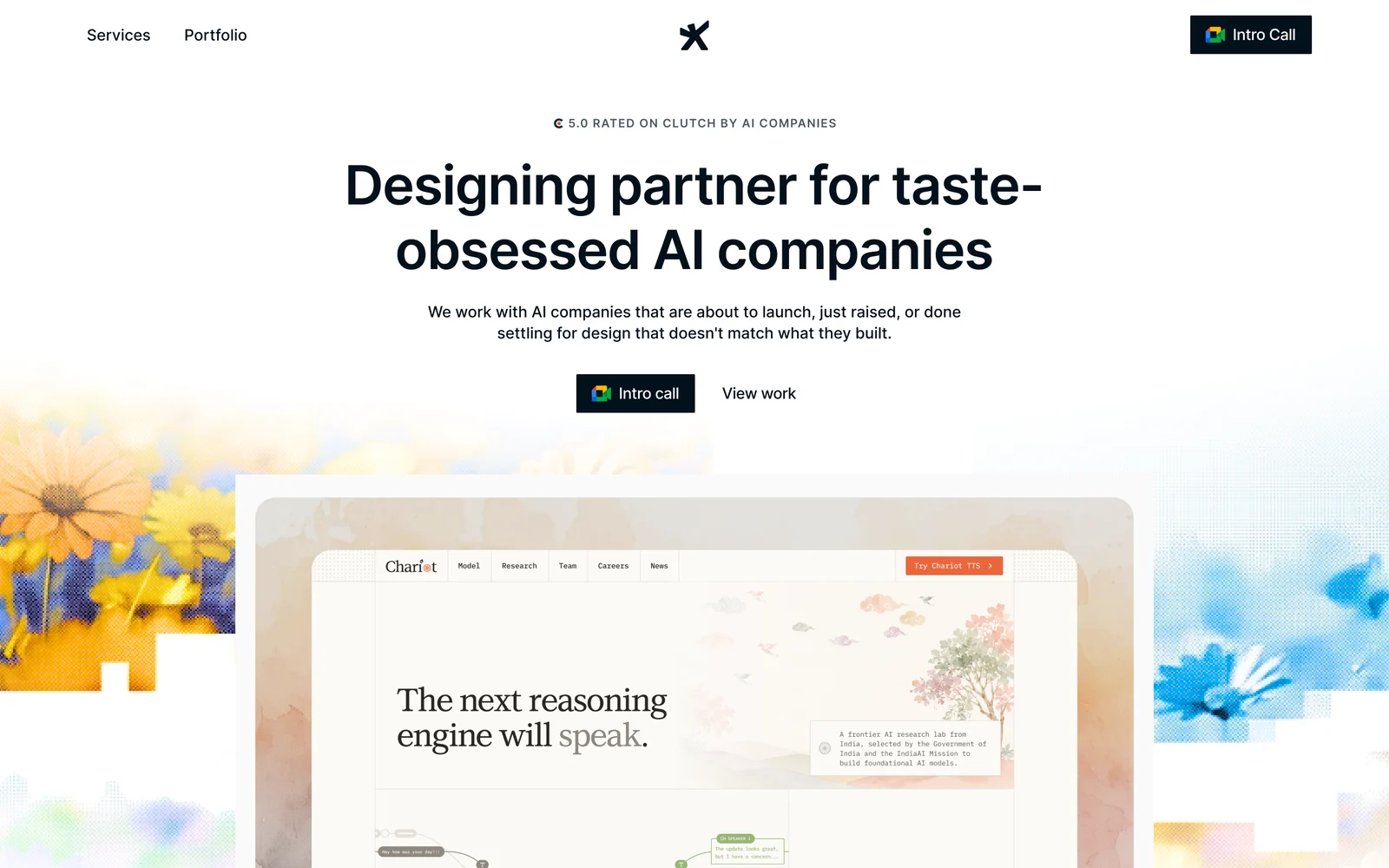
1. Studio Maydit: A Top-Rated Design Agency for AI Founders
For a salestech company the useful part is that the engagement does not end at the marketing site. Studio Maydit is a web and product design studio working with AI founders in the US, UK, and Europe, and it continues into product design after the site ships. That matters here because your buyer's real objection is adoption. A tool their reps abandon in six weeks is the failure they are guarding against, and that risk lives inside the product, not on the homepage.
Buying happens two ways. Fixed scope runs three to four weeks, which fits a team working to a launch or a quarter end. A monthly retainer fits teams who keep shipping and covers new pages, campaigns, and product design, with no long lock-in, which suits a category that reprices and repackages several times a year. The build sits in Framer, Webflow, or custom code, chosen by how often the pages will change. Fixed-scope work closes with a diagnosis of what is leaking in the product rather than a handoff and goodbye.
Dualite is the published outcome, where design work supporting a repositioned ICP helped the product reach 100,000+ users in seven months. The sequencing is the transferable part: the decision about which customer to serve came before any screens. Salestech companies delay that decision longer than most, because the product plausibly helps every sales team, and a site written for every sales team persuades none of them. Recent clients include Wave, PixelFlow, Mi-VAD, and 15 other AI and SaaS teams.
| Check | Finding |
|---|---|
| Based in | Remote, serving US / UK / EU |
| Platform depth | Framer, Webflow, and custom code |
| AI-sector proof | Yes. AI-native clients, published outcome on Dualite |
| Pricing | Fixed scope or monthly retainer, quoted per project |
| Team shape | Founder-led, small senior team |
| Best fit | Salestech teams whose real risk is adoption rather than interest |
Arm the person who has to defend the purchase. Book a 30-minute call.

2. Clay
Clay has worked from San Francisco since 2016 with fifty-one to two hundred people, publishes a starting price, holds AI-sector proof, and has shipped for Slack, Stripe, Google, Coinbase, and Amazon. Stripe is the relevant one. Its pages are studied by exactly the kind of operator you are selling to, and they persuade through specificity rather than through technique, which is the only register that survives a sceptical revenue buyer.
Fifty-plus people means account layers and a floor shaped by clients much larger than you. The portfolio also sells to technology buyers, and a VP of Sales at a mid-market company responds to different evidence than an engineering leader does.
| Check | Finding |
|---|---|
| Based in | San Francisco, USA |
| Founded | 2016 |
| Team size | 51-200 |
| Primary platform | Mixed |
| AI-sector proof | Yes |
| Named clients | Slack, Stripe, Google, Coinbase, Amazon |
| Pricing | Published minimum |
| Best fit | Funded salestech teams moving upmarket into enterprise accounts |
3. Feely Studio
Feely Studio is a distributed European team of one to ten people working across platforms, with a published starting price and AI-sector proof, for Noxus, Mutiny, Luasai, and Basic Capital. Mutiny is the closest match on this entire page. It is a product sold to revenue teams, judged on conversion, and marketed to buyers who evaluate marketing for a living, which is your exact set of constraints.
A one to ten person team cannot run parallel workstreams, so your timeline follows their queue. The named clients are early-stage rather than recognisable, which is a problem only if your board wants logos it can identify.
| Check | Finding |
|---|---|
| Based in | Distributed, Europe |
| Founded | Not published |
| Team size | 1-10 |
| Primary platform | Mixed |
| AI-sector proof | Yes |
| Named clients | Noxus, Mutiny, Luasai, Basic Capital |
| Pricing | Published minimum |
| Best fit | Salestech teams selling to buyers who evaluate marketing for a living |
4. Lazarev
Lazarev has worked from San Francisco since 2015 with fifty-one to two hundred people, publishes a starting price, holds AI-sector proof, and has shipped for Payoneer, Peel, Elva, and Mozayix. Payoneer is a regulated financial product where trust has to be established before anyone transacts, which is close to the credibility problem a salestech company faces with a buyer who has been disappointed before.
AI proof aside, the work is weighted towards fintech rather than revenue tooling, so the vocabulary of pipeline and quota is something you would be supplying. The team size also brings the usual gap between who pitches and who delivers.
| Check | Finding |
|---|---|
| Based in | San Francisco, USA |
| Founded | 2015 |
| Team size | 51-200 |
| Primary platform | Mixed |
| AI-sector proof | Yes |
| Named clients | Payoneer, Peel, Elva, Mozayix |
| Pricing | Published minimum |
| Best fit | Salestech teams rebuilding trust with a burned buyer |
5. Trueform
Trueform has worked from Wil in Switzerland since 2022 in Framer, publishes a starting price, holds AI-sector proof, and has shipped for Miro, Morning Brew, Bilt Rewards, and Gather. Framer is genuinely well matched to this category, because salestech pricing changes more often than almost any other software segment, and a founder being able to update a plan table the same afternoon is worth real money.
No team size is published and the studio is young. Framer also constrains you if the site needs an interactive calculator showing pipeline impact, which is the one page many salestech companies eventually want.
| Check | Finding |
|---|---|
| Based in | Wil, Switzerland |
| Founded | 2022 |
| Team size | Not published |
| Primary platform | Framer |
| AI-sector proof | Yes |
| Named clients | Miro, Morning Brew, Bilt Rewards, Gather |
| Pricing | Published minimum |
| Best fit | Salestech teams whose pricing and packaging keep changing |
6. Feels Like
Feels Like has worked from Los Angeles since 2023 in custom code with AI-sector proof, for Google, Nike, LVMH, and Suno AI. The craft standard is high, and there is a real argument for it here: when every competitor is running the same persuasion playbook, looking materially more considered than them is one of the few remaining differentiators.
The studio is young, publishes no team size and no starting price, and the client mix is brand rather than revenue software. Custom code also leaves your team unable to change the pricing page, which is the wrong constraint in this category.
| Check | Finding |
|---|---|
| Based in | Los Angeles, USA |
| Founded | 2023 |
| Team size | Not published |
| Primary platform | Custom code |
| AI-sector proof | Yes |
| Named clients | Google, Nike, LVMH, Suno AI |
| Pricing | Not published |
| Best fit | Salestech teams competing on craft in a saturated category |
7. Fantasy
Fantasy has worked from San Francisco and New York since 1999 across platforms with AI-sector proof. Twenty-five years means having watched several categories fill with identical claims and then sort themselves out, which is the transition salestech is in the middle of now.
Very little is checkable in advance. No clients are named publicly, no team size is given, and no starting price is published. At that vintage the studio is also built for budgets beyond most early salestech companies, and every fit question has to be resolved on a call.
| Check | Finding |
|---|---|
| Based in | San Francisco and New York, USA |
| Founded | 1999 |
| Team size | Not published |
| Primary platform | Mixed |
| AI-sector proof | Yes |
| Named clients | Not published |
| Pricing | Not published |
| Best fit | Funded salestech companies buying a category position |
8. Phantom
Phantom has worked from London and Auckland since 2013 with fifty-one to two hundred people in custom code, holds AI-sector proof, and has shipped for Diageo, SAP, Financial Times, and Zendesk. Zendesk and SAP are both sold through procurement into large organisations, so this studio understands the internal-champion problem that decides most salestech deals above a certain size.
No starting price is published. Custom code means engineering time for every edit, which is a poor fit for a category that reprices quarterly, and at this scale the engagement is heavier than an early company needs.
| Check | Finding |
|---|---|
| Based in | London, UK and Auckland, NZ |
| Founded | 2013 |
| Team size | 51-200 |
| Primary platform | Custom code |
| AI-sector proof | Yes |
| Named clients | Diageo, SAP, Financial Times, Zendesk |
| Pricing | Not published |
| Best fit | Salestech teams selling into enterprise procurement |
9. basement.studio
basement.studio has worked from Mar del Plata and Los Angeles since 2018 with eleven to fifty people in custom code, publishes a starting price, holds AI-sector proof, and has shipped for Vercel, Cursor, ElevenLabs, Harvey AI, and Scale AI. The technical execution is among the best available, so if your site needs a live interactive demo running against real data, the capability is genuine.
The portfolio is almost entirely developer tools, and an engineer is close to the opposite of a sales buyer in what they find persuasive. Custom code also removes your ability to edit pricing without help, which this category needs more than most.
| Check | Finding |
|---|---|
| Based in | Mar del Plata, Argentina and Los Angeles, USA |
| Founded | 2018 |
| Team size | 11-50 |
| Primary platform | Custom code |
| AI-sector proof | Yes |
| Named clients | Vercel, Cursor, ElevenLabs, Harvey AI, Scale AI |
| Pricing | Published minimum |
| Best fit | Salestech teams whose homepage runs a live technical demo |
10. Foundey
Foundey has worked from San Francisco since 2021 with AI-sector proof, for DemandIQ, Traycer, and Sero AI. These are early AI companies, so the studio is used to clients whose positioning is unfinished, which describes most salestech startups before their first real segment decision.
Foundey works in Figma only, and that is the deciding limitation. You get design and then need a separate vendor to build it, adding a handover and a second schedule to a project where speed to a new pricing page is often the point. No team size or starting price is published either.
| Check | Finding |
|---|---|
| Based in | San Francisco, USA |
| Founded | 2021 |
| Team size | Not published |
| Primary platform | Figma-only |
| AI-sector proof | Yes |
| Named clients | DemandIQ, Traycer, Sero AI |
| Pricing | Not published |
| Best fit | Salestech teams with engineering already in place to build it |
How to choose between them
Sort by what is actually broken rather than by portfolio quality.
Your buyer sees through the site because they run the same plays. Feely Studio.
You are moving upmarket and need to look inevitable. Clay.
Pricing and packaging change every quarter. Trueform.
Deals stall inside the customer's own approval process. Phantom.
One test before you sign. Ask a candidate who inside your customer's company has to defend buying you, and what that person needs from your site. A studio that answers with a champion, a finance objection, and a page that does not exist yet has understood how salestech is actually bought. A studio that talks about the hero section and the demo form is designing for the visitor, and the visitor was never the person who decides.