Summarize with AI


A B2B AI SaaS company shopping for a website studio should review these ten: Studio Maydit, basement.studio, Clay, BX Studio, Feely Studio, Feels Like, Phantom, SuperSkills, Fantasy, and Lighthouse Digital. Two of them lead. basement.studio, eleven to fifty people spread across Mar del Plata and Los Angeles since 2018, builds in custom code for Vercel, Cursor, ElevenLabs, Harvey AI, and Scale AI, and states a starting figure in public. Clay, fifty-one to two hundred people in San Francisco since 2016, counts Slack, Stripe, Google, Coinbase, and Amazon among its clients and also names a floor. Both carry AI-sector proof. The two that fit least well are Fantasy, which keeps its client list and its pricing private, and Lighthouse Digital, which has no AI-sector proof to show.
Nobody buys your product. A committee does, and most of them never speak to you.
That is what makes a B2B site different from a product-led one. One person finds you, gets excited, and then has to carry you through a room you are not in. Their manager asks what it costs. Security asks where the data goes. Finance asks who else uses it. Your champion answers from memory, or from whatever page they can forward, and the deal is usually decided in that meeting rather than in your demo.
The second problem is the review nobody warns you about. Enterprise buyers screen for compliance early and silently. If a visitor cannot find how you handle their data, whether the model trains on it, and what certifications you hold, you do not get an objection. You get removed from the list, and nobody tells you why.
Then there is the objection unique to selling AI into a business. Somewhere in that room, one person hears your pitch as a plan to make their team smaller. They will not say so. They will raise a process concern instead, and it will sound reasonable, and it will slow the deal by a quarter. Sites that handle this well address it directly, on the page, before it becomes a private worry.

How we picked these agencies
Five checks produced this order, and every one is answerable from public pages before you spend an hour on a call.
Platform depth, judged against how many pages a B2B motion actually needs. This is not one homepage. It is a use-case page for each buyer role, a security page, a comparison page, and a steady flow of campaign landing pages. If publishing one of those requires engineering time, marketing will stop asking and start improvising in a slide deck instead.
Proof selling AI into businesses rather than to consumers. That is the criterion doing the work here, and it is narrower than general AI experience. A consumer AI product has to feel magical. A B2B AI product has to feel safe, auditable, and boring in the specific places where boring is reassuring. A studio that has only done the first will design you something delightful that procurement quietly kills.
Pricing. Whether a floor is published at all, not what the floor is. It tells you whether the studio has decided who it turns away, which is the same discipline you are trying to apply to your own buyers.
Team shape. Whether the person who understood your buying committee stays through the copy. On a B2B site the sentences carry the argument, and every handoff softens them.
Their own site. It is the one build with nobody else to blame, so it shows what the studio does with full control.
Every figure here comes from what each studio has chosen to make public about itself. Nothing was estimated, so a Not published row records a choice rather than an unanswered question.
What goes wrong for B2B AI SaaS companies
Three failures repeat, and the first one costs deals you never learn about.
The site is built for the champion and abandons everyone else. The pages are excellent for the practitioner who found you and empty for the four people they have to convince. There is no page about cost, no page about security, no page that a director could read in ninety seconds and forward with a sentence of their own. Your champion is doing the hardest sales work you have, unsupported, from memory.
Compliance is treated as a footer link. Data handling, model training, retention, and certifications get pushed to a trust page nobody links to, or into a PDF behind a form. Buyers screening ten vendors will not fill in a form to find out whether you are disqualified. They will assume the worst and move on, and this failure is completely silent, which is what makes it expensive.
The design borrows a consumer AI aesthetic that undermines the sale. Gradients, floating orbs, and a headline about magic. It photographs well and it is exactly wrong for a buyer whose main private worry is whether this thing is stable enough to put in front of customers. The studio delivered what the category currently looks like, and the category is mostly selling to a different room than you are.
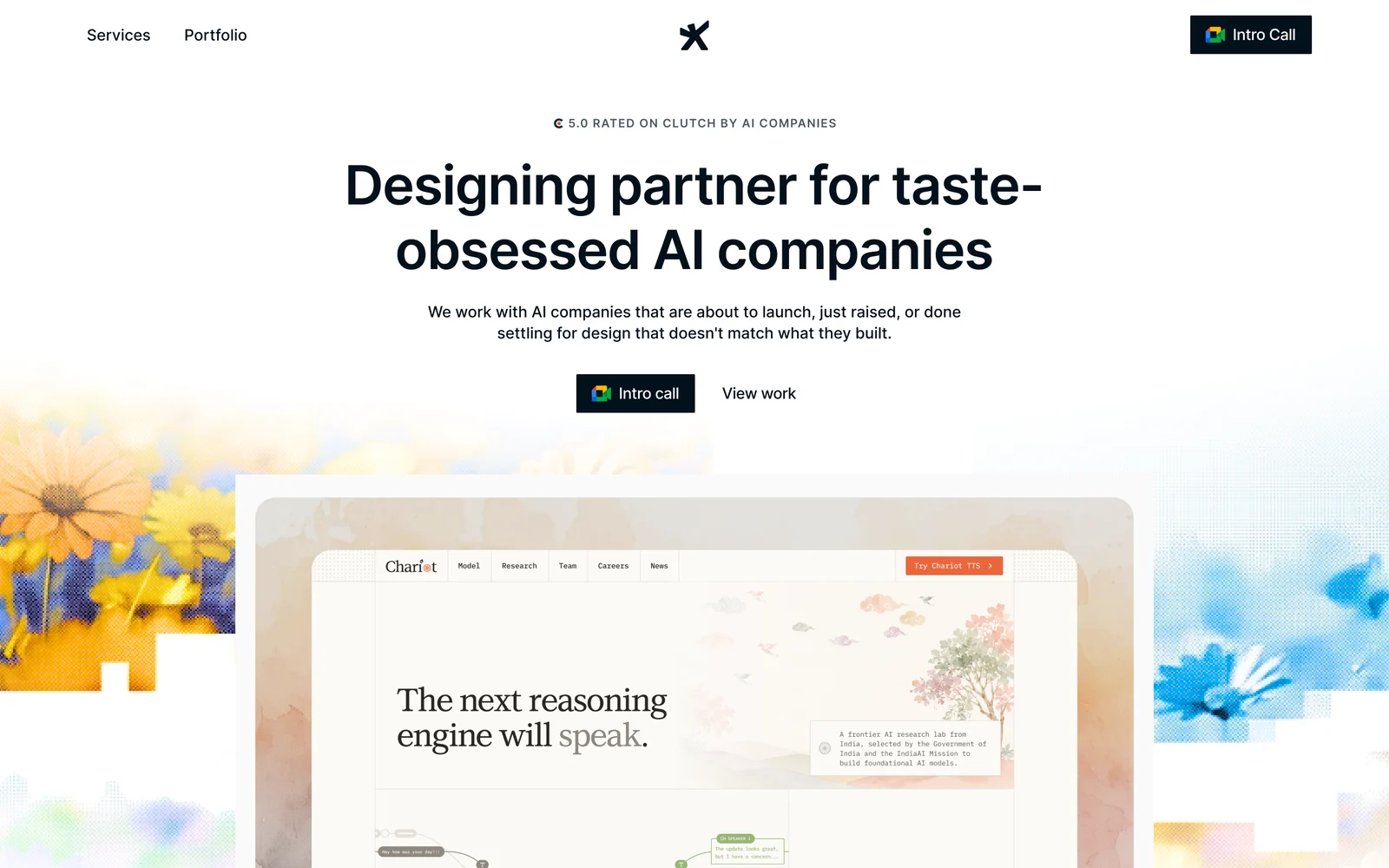
1. Studio Maydit: A Top-Rated Design Agency for AI Founders
Studio Maydit is a web and product design studio. Its clients are AI founders, working across the US, UK, and Europe, and for a B2B company the useful detail is that the engagement does not stop at the marketing site. It continues into product design after launch, which matters when your buyer signs on the strength of a page and then meets a first screen that promises something narrower.
The build sits in Framer where a marketing team needs to publish weekly without engineering, in Webflow where several editors and a real content operation are involved, and in custom code where a B2B site has interaction requirements neither will carry. The choice follows the motion rather than the fashion.
Seven months, 100,000+ users. That is the published Dualite outcome, and the sequence behind it was a repositioned ICP first, then design built for the smaller group that decision defined. For a B2B AI company the lesson is about the committee rather than the count: a site written to be acceptable to every role in the room persuades none of them, and narrowing to the one person who has to carry you internally is what makes the other pages easy to write.
Two buying shapes exist, and the deciding factor is usually your pipeline. A team with a launch, a conference, or a funding announcement fixed in the calendar takes the fixed scope, which runs three to four weeks. A team building a steady campaign motion takes the monthly retainer, which covers new pages, campaigns, and product design at whatever pace sales demands, with no long lock-in. Fixed-scope engagements close with a diagnosis of what is leaking in the product rather than a handoff and goodbye. Recent clients include Wave, PixelFlow, Mi-VAD, and 15 other AI and SaaS teams.
| Check | Finding |
|---|---|
| Based in | Remote, serving US / UK / EU |
| Platform depth | Framer, Webflow, and custom code |
| AI-sector proof | Yes. AI-native clients, published outcome on Dualite |
| Pricing | Fixed scope or monthly retainer, quoted per project |
| Team shape | Founder-led, small senior team |
| Best fit | B2B AI teams whose champion has nothing good to forward internally |
Build the page your champion can send. Book a 30-minute call.

2. basement.studio
basement.studio has worked from Mar del Plata in Argentina and Los Angeles since 2018, with eleven to fifty people in custom code, and publishes a starting price. Vercel, Cursor, ElevenLabs, Harvey AI, and Scale AI are AI companies selling into businesses, and Harvey in particular sells into an audience that screens hard on trust, which is the closest analogue on this page to your buying committee.
The weakness is publishing speed. Custom code means marketing cannot ship a campaign landing page without an engineer, and a B2B motion generates a lot of those.
| Check | Finding |
|---|---|
| Based in | Mar del Plata, Argentina and Los Angeles, USA |
| Founded | 2018 |
| Team size | 11-50 |
| Primary platform | Custom code |
| AI-sector proof | Yes |
| Named clients | Vercel, Cursor, ElevenLabs, Harvey AI, Scale AI |
| Pricing | Published minimum |
| Best fit | B2B AI companies whose buyers judge the site as an engineering artefact |
3. Clay
Clay has worked from San Francisco since 2016 with fifty-one to two hundred people across mixed platforms, publishes a starting price, and holds AI-sector proof. Slack, Stripe, Google, Coinbase, and Amazon are exactly the logos that make a security reviewer relax, and borrowed credibility is worth real money in a room where nobody has heard of you.
The weakness is stage fit. This is a premium practice built for clients with a brand team on the other side, and a fifteen-person AI company will be its smallest account rather than its typical one.
| Check | Finding |
|---|---|
| Based in | San Francisco, USA |
| Founded | 2016 |
| Team size | 51-200 |
| Primary platform | Mixed |
| AI-sector proof | Yes |
| Named clients | Slack, Stripe, Google, Coinbase, Amazon |
| Pricing | Published minimum |
| Best fit | Funded B2B companies who need to look established to a committee |
4. BX Studio
BX Studio runs eleven to fifty people from New York in Webflow, publishes a starting price, and holds AI-sector proof. ASAPP is an AI company selling into large enterprise operations, and Reddit, Headspace, and Verifone show the studio can build at scale rather than only for launch.
The weakness is that Webflow, while ideal for a marketing motion, sets a ceiling on unusual interaction work, and the portfolio leans consumer, so a security-heavy B2B register would be adapted rather than repeated.
| Check | Finding |
|---|---|
| Based in | New York, USA |
| Founded | Not published |
| Team size | 11-50 |
| Primary platform | Webflow |
| AI-sector proof | Yes |
| Named clients | Reddit, Headspace, ASAPP, Verifone |
| Pricing | Published minimum |
| Best fit | B2B teams who need marketing to publish campaign pages without engineering |
5. Feely Studio
Feely Studio is a distributed European team of one to ten people working across mixed platforms, with AI-sector proof and a published starting price. Mutiny on its client list is a B2B software product built around conversion, and a team this small means the person who understands your committee is the person writing the pages for it.
The weakness is throughput. A B2B site is many pages rather than one, and a one to ten person studio will deliver them in sequence, so a large page set takes real calendar time.
| Check | Finding |
|---|---|
| Based in | Distributed, Europe |
| Founded | Not published |
| Team size | 1-10 |
| Primary platform | Mixed |
| AI-sector proof | Yes |
| Named clients | Noxus, Mutiny, Luasai, Basic Capital |
| Pricing | Published minimum |
| Best fit | Early B2B teams who want senior thinking on the argument itself |
6. Feels Like
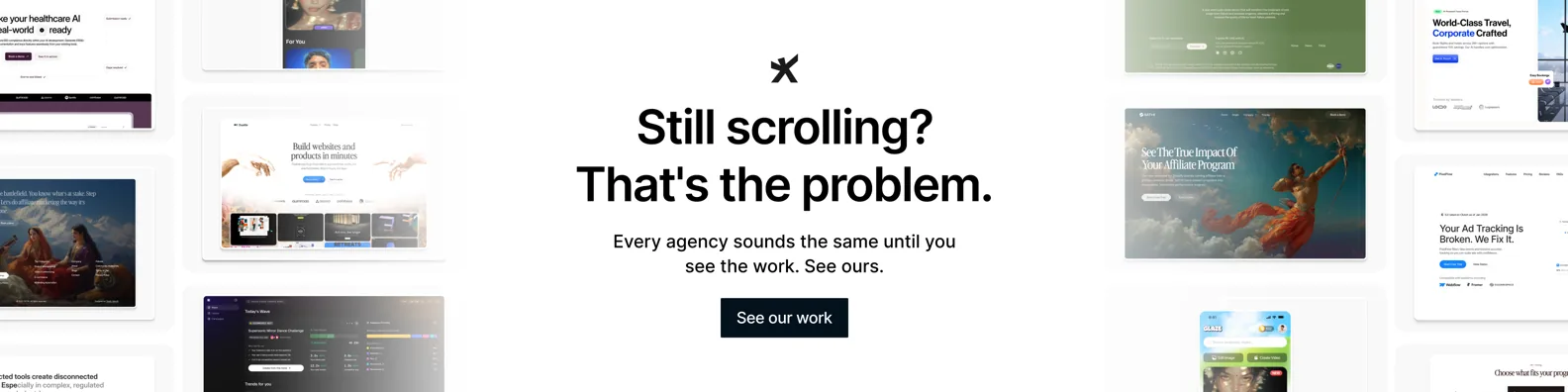
Feels Like has worked from Los Angeles since 2023 in custom code, with AI-sector proof through Suno AI and brand work for Google, Nike, and LVMH. If your category is crowded and every competitor site looks the same, this is the studio on the page most likely to make you look unlike the others.
The weakness is direction. That craft is aimed at brand and culture rather than at a procurement review, and with neither team size nor a starting price published, you would be buying distinctiveness without knowing the cost in advance.
| Check | Finding |
|---|---|
| Based in | Los Angeles, USA |
| Founded | 2023 |
| Team size | Not published |
| Primary platform | Custom code |
| AI-sector proof | Yes |
| Named clients | Google, Nike, LVMH, Suno AI |
| Pricing | Not published |
| Best fit | B2B companies whose problem is looking identical to every competitor |
7. Phantom
Phantom has worked from London and Auckland since 2013 in custom code with fifty-one to two hundred people, and holds AI-sector proof. SAP, Zendesk, Diageo, and the Financial Times are enterprise accounts, so this is a studio genuinely used to work that has to pass legal, security, and brand review before it ships.
The weakness is the shape of that engagement. No starting price is published, custom code slows routine publishing, and a practice built for enterprise clients runs a process an early B2B team has to staff on its side.
| Check | Finding |
|---|---|
| Based in | London, UK and Auckland, NZ |
| Founded | 2013 |
| Team size | 51-200 |
| Primary platform | Custom code |
| AI-sector proof | Yes |
| Named clients | Diageo, SAP, Financial Times, Zendesk |
| Pricing | Not published |
| Best fit | B2B companies already selling into enterprise and reviewed like one |
8. SuperSkills
SuperSkills is a one to ten person team in Walnut Creek working across mixed platforms, with AI-sector proof. The advantage is directness: no account layer, and the person you brief is the person who builds.
The weakness is evidence. One named client, no published founding date, team history, or price, which is an awkward combination when the thing you are buying is help persuading sceptical buyers with a thin public record of its own.
| Check | Finding |
|---|---|
| Based in | Walnut Creek, USA |
| Founded | Not published |
| Team size | 1-10 |
| Primary platform | Mixed |
| AI-sector proof | Yes |
| Named clients | The Cut |
| Pricing | Not published |
| Best fit | Small budgets prioritising direct senior access over a track record |
9. Fantasy
Fantasy has worked from San Francisco and New York since 1999 across mixed platforms and holds AI-sector proof. Nearly three decades of continuous practice is unusual, and a studio that has seen several technology cycles will not be surprised by a category that reinvents its vocabulary twice a year.
The weakness is verifiability. No client list, no team size, and no starting price are published, so a B2B buyer who values evidence is being asked to proceed on conversation alone.
| Check | Finding |
|---|---|
| Based in | San Francisco and New York, USA |
| Founded | 1999 |
| Team size | Not published |
| Primary platform | Mixed |
| AI-sector proof | Yes |
| Named clients | Not published |
| Pricing | Not published |
| Best fit | Companies comfortable assessing a studio entirely by conversation |
10. Lighthouse Digital
Lighthouse Digital works from London in Webflow, publishes a starting price, and has shipped for HelloSelf, Freetrade, and IGN. Freetrade is a regulated fintech, which means the studio has worked somewhere compliance language had to sit on the page rather than hide behind a form.
The weakness is the one this list is sorted by. There is no AI-sector proof, so the specific objections your buyers raise about models, data, and training would be encountered for the first time on your project.
| Check | Finding |
|---|---|
| Based in | London, UK |
| Founded | Not published |
| Team size | Not published |
| Primary platform | Webflow |
| AI-sector proof | No |
| Named clients | HelloSelf, Freetrade, IGN |
| Pricing | Published minimum |
| Best fit | UK B2B teams who will write the AI argument themselves |
How to choose between them
Sort by what is actually broken.
If deals stall in security review, buy a studio that has put compliance on the page for a company like yours. basement.studio.
If nobody in the room has heard of you, buy borrowed credibility and accept the price that comes with it. Clay.
If marketing cannot ship a landing page without filing a ticket, that is a platform problem, not a design one. BX Studio.
If every competitor site looks the same and yours is one of them, buy distinctiveness. Feels Like.
One test before you sign. Ask each studio which page your champion would forward to their CFO, and what it says. A studio that answers with a specific page and a specific sentence has understood that you sell to a room. A studio that talks about the homepage has understood it as a brochure, and your champion will still be working from memory.