
Summarize with AI


The best website design agencies for EU-based SaaS companies in 2026 are Studio Maydit, Pixelmatters, Push Refresh, Ramotion, Instrument, Feely Studio, Trueform, Clay, Lighthouse Digital, and Digidop. Studio Maydit and Pixelmatters lead for this brief. Pixelmatters has worked from Porto since 2013 at fifty-one to two hundred people, publishes a starting figure, and names Rubrik, Quantic, and UJET, which is a European practice at real scale with software clients who sell internationally, and that combination is rarer than it sounds. Instrument and Push Refresh fit this brief least well. One is a two-decade American brand agency working for Nike and Microsoft, the other is a one to ten person Dallas studio with regional US clients, and neither has published anything showing they understand what a European buyer checks first.
Your homepage has a proof problem, not a positioning problem.
The default SaaS homepage was designed in America and copied everywhere. It opens with a claim, follows with a row of recognisable logos, and puts everything about hosting and data in the footer. That structure works when your buyer shares the assumptions it was built on. A procurement lead in Milan or Lyon or Utrecht does not.
What they want first is somebody like them. A logo wall of American companies is not neutral in that conversation. It signals that your customers are elsewhere, that support will be in a different time zone, and that you will treat their market as an experiment. One recognisable name from their own country outperforms five from San Francisco, and most EU SaaS sites do not have one visible.
The second thing they check is where the data lives and who owns the company. This is a genuine commercial advantage for a European vendor and most European vendors bury it. Being hosted in the EU and answerable to European law is a reason to buy, and it belongs on a page a buyer can find rather than in a paragraph under the fold.
The third is price. European mid-market buyers are used to seeing a number, and a contact us button on the pricing page lengthens a cycle that is already long. It also filters out exactly the self-serve buyer that makes European SaaS efficient in the first place.
Read the ten below with a procurement questionnaire in mind rather than a design award.

How we picked these agencies
Five checks, all answerable from public material without a call.
- Platform depth. What do they build in, and who runs it afterwards? A European SaaS company usually has a small marketing team and a long list of pages that need to exist for different markets, so a site that requires a developer for each one does not scale with you.
- Proof inside Europe. Have they worked with European companies, or are they applying an imported playbook? This is specific rather than sentimental. It means knowing what a buyer in a procurement-led market reads, and in what order.
- Pricing. Is a starting figure published? European studios publish more often than American ones, and it is the fastest way to build a shortlist when the practices are spread across several countries.
- Team shape. How many people, how senior, and which hours do they work? Within Europe this is usually a non-issue. Across the Atlantic it decides how many decisions you can make in a day.
- Their own site. The one page nobody commissioned.
For this brief, look at whether a studio's own site would convince a cautious buyer rather than an enthusiastic one. European purchasing is slower and more evidential, and a studio whose own site relies entirely on atmosphere has never had to satisfy that reader.
The tables record only what each studio publishes about itself. Nothing taken from directories, nothing from rankings, and no missing detail replaced by an assumption. Where a studio has published nothing, that silence is the entry.
What goes wrong on EU SaaS websites
Three failures, and each one costs deals rather than traffic.
The proof is imported. The site shows the most impressive logos available, which are usually American, because that is what the growth playbook says to do. A German or French buyer reads a list with nobody from their market on it and quietly concludes you are not established where they are. The fix is not more logos. It is different ones, placed where the doubt occurs.
The strongest argument is hidden. European hosting, European ownership, and a clear line on data handling get treated as compliance content and pushed to a legal page. Meanwhile the buyer who would have chosen you specifically for those reasons never finds them, and picks an American vendor with a better-organised trust page.
Pricing hides behind a form. The company copies an enterprise motion it has not earned, and every mid-market buyer who would have signed up alone now has to book a call instead. Most of them do not. The pipeline looks qualified and is simply smaller.
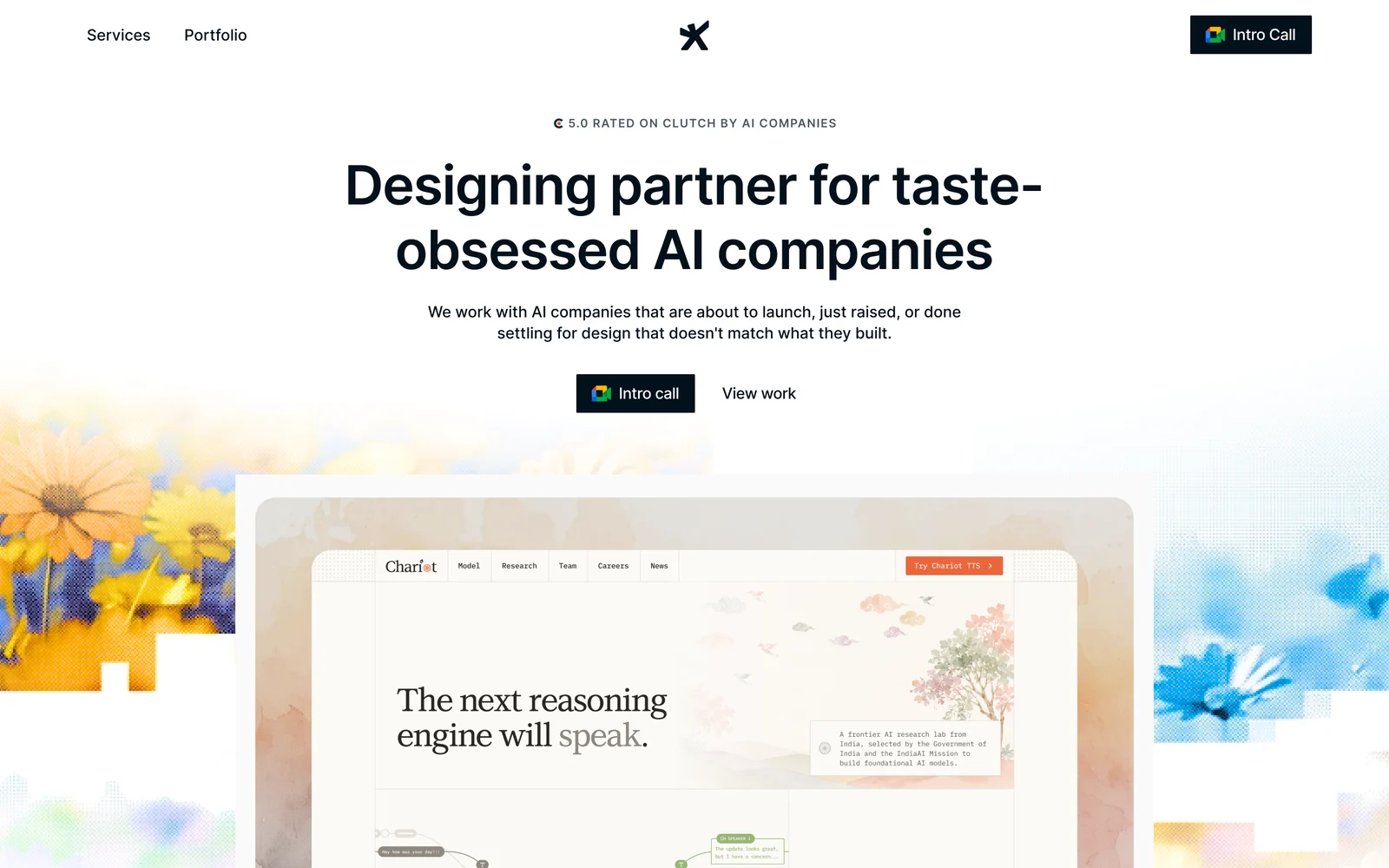
1. Studio Maydit: A Top-Rated Design Agency for AI Founders
Studio Maydit is a web and product design studio working with AI founders in the US, UK, and Europe. Working on both sides is the normal condition here rather than an occasional project, which is the relevant qualification for a European company that has to convince a buyer at home and a buyer across the Atlantic without maintaining two personalities.
The build platform follows the team rather than a preference: Framer where a marketer will be publishing weekly, Webflow where a larger content operation will own it, custom code only where the site cannot work otherwise. After launch the engagement carries on into product design. The published outcome is Dualite, in which design work supporting a repositioned ICP helped the product reach 100,000+ users in seven months, and the decisive move was narrowing who the product spoke to rather than widening it. Recent clients include Wave, PixelFlow, Mi-VAD, and 15 other AI and SaaS teams.
For a company that adds market-specific pages steadily, the monthly retainer usually fits best, covering new pages, campaigns, and product design with no long lock-in. Where a date is already set, a fixed scope runs three to four weeks and ends with a written diagnosis of what is leaking in the product.
| Check | Finding |
|---|---|
| Based in | Remote, serving US / UK / EU |
| Platform depth | Framer, Webflow, and custom code |
| AI-sector proof | Yes. AI-native clients, published outcome on Dualite |
| Pricing | Fixed scope or monthly retainer, quoted per project |
| Team shape | Founder-led, small senior team |
| Best fit | EU SaaS teams selling at home and into the US at the same time |
Worth a call if your best argument is currently on your legal page. Book a 30-minute call.

2. Pixelmatters
Pixelmatters has worked from Porto since 2013 at fifty-one to two hundred people, across platforms, publishing a starting figure and naming Rubrik, Quantic, and UJET. It is one of the few genuinely large European product practices, and its clients sell internationally, so the studio has had to make European work legible to buyers who are not European.
Their AI-sector proof is partial with no published AI case study. The headcount also brings a process and a minimum engagement scaled for programmes rather than for a single marketing site refresh.
| Check | Finding |
|---|---|
| Based in | Porto, Portugal |
| Founded | 2013 |
| Team size | 51-200 |
| Primary platform | Mixed |
| AI-sector proof | Partial. Enterprise and SaaS clients, no AI case study |
| Named clients | Rubrik, Quantic, UJET |
| Pricing | Published minimum |
| Best fit | EU SaaS companies who want design and build from one European team |
3. Push Refresh
Push Refresh is a Dallas studio of one to ten people working in Framer, publishing a starting figure and naming SmithRx, Synonym, and Northern National. Framer is a good answer for a small marketing team maintaining many pages, and a published figure makes the comparison easy.
The mismatch is location and reference set. All the named clients are American and regional, there is no European work in the record, and Dallas leaves a European team the last hour or two of the day. Their AI-sector proof is partial with no case study.
| Check | Finding |
|---|---|
| Based in | Dallas, USA |
| Founded | Not published |
| Team size | 1-10 |
| Primary platform | Framer |
| AI-sector proof | Partial. SaaS clients, no AI case study |
| Named clients | SmithRx, Synonym, Northern National |
| Pricing | Published minimum |
| Best fit | EU companies whose entire pipeline is already in the United States |
4. Ramotion
Ramotion has worked from San Francisco since 2009 at eleven to fifty people, across platforms, publishing a starting figure and naming Mozilla, Okta, Netflix, Adobe, and Xero. Xero is a non-American company that succeeded internationally, which is the closest thing on this list to a template for what a European SaaS company is trying to do.
Their AI-sector proof is partial with no AI case study. A San Francisco base gives European teams a narrow late-afternoon window, and a practice of that age prices for engagements longer than one site.
| Check | Finding |
|---|---|
| Based in | San Francisco, USA |
| Founded | 2009 |
| Team size | 11-50 |
| Primary platform | Mixed |
| AI-sector proof | Partial. Enterprise and SaaS clients, no AI case study |
| Named clients | Mozilla, Okta, Netflix, Adobe, Xero |
| Pricing | Published minimum |
| Best fit | EU SaaS teams whose next market is the US rather than the next country |
5. Instrument
This Portland agency has run since 2005, works across platforms, and names Nike, Microsoft, Electronic Arts, and Google. Twenty years at that level is real craft, and a company planning a genuine brand programme rather than a website would get something from the conversation.
For this brief it is the wrong shape and the wrong continent. No team size or starting figure is published, the AI-sector proof is partial, and an agency built around American brand work will reach for exactly the imported playbook a European buyer discounts.
| Check | Finding |
|---|---|
| Based in | Portland, USA |
| Founded | 2005 |
| Team size | Not published |
| Primary platform | Mixed |
| AI-sector proof | Partial. Enterprise clients, no AI case study |
| Named clients | Nike, Microsoft, Electronic Arts, Google |
| Pricing | Not published |
| Best fit | Companies running a brand programme with an internal team |
6. Feely Studio
Feely Studio is a distributed European team of one to ten people, publishing a starting figure and AI client work, and naming Noxus, Mutiny, Luasai, and Basic Capital. A European studio working with AI-native software companies matches both halves of this brief, and at that size you get the people rather than an account structure.
No founding year is published, and a team that small has real capacity limits for a site that will keep growing pages as you add markets. A distributed team also means the working hours depend on who is assigned, which is worth confirming.
| Check | Finding |
|---|---|
| Based in | Distributed, Europe |
| Founded | Not published |
| Team size | 1-10 |
| Primary platform | Mixed |
| AI-sector proof | Yes. Published AI client work |
| Named clients | Noxus, Mutiny, Luasai, Basic Capital |
| Pricing | Published minimum |
| Best fit | EU SaaS teams who want senior European attention on a focused scope |
7. Trueform
Trueform is a Swiss studio founded in 2022 working in Framer, publishing a starting figure and AI client work, and naming Miro, Morning Brew, Bilt Rewards, and Gather. A European studio with references an American buyer recognises is unusual, and Framer means your marketing team can add a market page without booking developer time.
The studio is young and the record is short. No team size is published, so capacity is unknown, and Framer keeps the engagement on the marketing surface rather than reaching into the product.
| Check | Finding |
|---|---|
| Based in | Wil, Switzerland |
| Founded | 2022 |
| Team size | Not published |
| Primary platform | Framer |
| AI-sector proof | Yes. Published AI client work |
| Named clients | Miro, Morning Brew, Bilt Rewards, Gather |
| Pricing | Published minimum |
| Best fit | EU SaaS teams adding market pages continuously without developers |
8. Clay
Clay has designed from San Francisco since 2016 at fifty-one to two hundred people, across platforms, publishing a starting figure and AI client work, and naming Slack, Stripe, Google, Coinbase, and Amazon. Stripe in particular built a business selling the same product into dozens of countries, and a studio near that work has seen how a single site handles many markets.
The size means an account layer and a rate for larger engagements, and a San Francisco base gives Europe a short shared afternoon. The reference set is also entirely American, which is the specific gap this brief is about.
| Check | Finding |
|---|---|
| Based in | San Francisco, USA |
| Founded | 2016 |
| Team size | 51-200 |
| Primary platform | Mixed |
| AI-sector proof | Yes. Published AI client work |
| Named clients | Slack, Stripe, Google, Coinbase, Amazon |
| Pricing | Published minimum |
| Best fit | Larger EU SaaS companies selling primarily into the US |
9. Lighthouse Digital
Lighthouse Digital is a London Webflow studio publishing a starting figure and naming HelloSelf, Freetrade, and IGN. Freetrade sells a regulated product to ordinary people in a European market, so the studio has written pages where trust had to be established rather than assumed, which is the reading behaviour European buyers bring.
They publish no AI client work at all, which is a real gap if your product is AI-led. No founding year and no team size are published either, so the scale of the practice is unclear before a conversation.
| Check | Finding |
|---|---|
| Based in | London, UK |
| Founded | Not published |
| Team size | Not published |
| Primary platform | Webflow |
| AI-sector proof | No. No published AI client work |
| Named clients | HelloSelf, Freetrade, IGN |
| Pricing | Published minimum |
| Best fit | EU SaaS teams whose buyers need convincing rather than exciting |
10. Digidop
Digidop has worked from Paris since 2021 at one to ten people, in Webflow, publishing a starting figure and naming TSE Energy, Ramify, and StreamNative. All three are European companies, which is the most on-brief reference set here, and Webflow means a small marketing team can add and edit market pages without help.
Their AI-sector proof is partial with no AI case study. A one to ten person team also has limited capacity for a site that will keep expanding, so it is worth asking what happens when you need two things in the same week.
| Check | Finding |
|---|---|
| Based in | Paris, France |
| Founded | 2021 |
| Team size | 1-10 |
| Primary platform | Webflow |
| AI-sector proof | Partial. SaaS clients, no AI case study |
| Named clients | TSE Energy, Ramify, StreamNative |
| Pricing | Published minimum |
| Best fit | EU SaaS teams selling mainly within Europe |
How to choose between them
Sort by which buyer you are losing, not by which portfolio you enjoyed.
Buyers in your own market do not recognise anyone on your site. Digidop or Feely Studio.
Your hosting and ownership story is buried on a legal page. Studio Maydit or Lighthouse Digital.
Mid-market buyers hit a contact form and disappear. Studio Maydit or Trueform.
Your next market is the United States. Ramotion or Clay.
One test before you sign. Send three studios your homepage and ask each which single element they would change to win a procurement-led buyer in your largest European market. A studio that understands this brief will point at the proof section or the trust page and explain what belongs there instead. A studio that does not will suggest a stronger headline, which is a fair answer to a different question. It takes an hour of their time and it sorts the list quickly.