Summarize with AI


The best website design agencies for first-time founders in 2026 are Studio Maydit, Refokus, Lighthouse Digital, Pixelmatters, Flowout, Digidop, Finsweet, Instrument, Engine Digital, and 8020. Studio Maydit and Digidop lead for this brief. Digidop has worked from Paris since 2021 at one to ten people, publishes a starting figure, and names TSE Energy, Ramify, and StreamNative, which is the combination a first-time buyer needs most, a number you can compare before you know how to compare anything else and a team small enough that the person selling is the person building. Instrument and Engine Digital fit this brief least well. Both are long-established agencies whose named clients are Nike, Microsoft, Adidas, and Goldman Sachs, neither publishes a figure, and an agency shaped for that work will quote a first-time founder a number and a timeline that assume a marketing department.
The first website you buy is not a design purchase.
It is a positioning purchase, and nobody tells you that at the start. A studio will ask what you do, who it is for, and what makes you different, and those three questions turn out to be the entire project. If you cannot answer them in one sentence each, no amount of layout will hide it. The page will be handsome and vague, and vague reads as small.
The second thing nobody warns you about is that you cannot judge the proposal. You have never bought this before, so you have no scale. Two studios quote numbers four times apart and both sound reasonable. Most first-time founders then use price as the signal, and either buy the cheapest and get a template, or buy the dearest and pay for a process built for someone else.
The third is ownership, and it costs the most later. You get a site, it looks right, and then you want to change a headline. If the answer is a support ticket and a two-week wait, you have bought something you cannot use. Founders find this out about six weeks in, usually the day before a launch of their own.
None of this is a reason to wait. It is a reason to ask three specific questions before you sign, and the studios below are worth reading with those questions in hand.

How we picked these agencies
Five checks. Each is answerable from a studio's public material without booking anything.
- Platform depth. What do they build in, and can you change it afterwards without them? This is the single most useful question a first-time founder can ask, because the honest answer predicts your next twelve months better than the portfolio does.
- Proof with companies at the start. Have they built for a business with no traffic, no brand, and no existing pages to preserve? That is a different job from refreshing an established company, and a studio that only does the second will assume inputs you do not have.
- Pricing. Is a starting figure published? For a first-time buyer this matters more than it does for anyone else, because a public number is the only scale you have before you have spoken to five studios.
- Team shape. How many people are there and which of them turns up? A small team means the person who understood your idea is the person building it. A large one means a process, which is protective in some ways and slow in others.
- Their own site. The one page nobody briefed them on.
That last check is the cheapest research available to you. Read a studio's own homepage as if you were a customer. If you cannot tell what they do or who they are for, they will not solve that problem for you, because they have not solved it for themselves.
Every table below reports only what each studio publishes about itself. Nothing from directories, nothing from rankings, and no blank filled in with a plausible guess. Where a studio publishes nothing, the row says so, which is itself a finding.
What goes wrong on a first-time founder's first website
Three failures, and the design is rarely the cause of any of them.
The site is built before the sentence exists. Work starts while the positioning is still moving, so the studio designs around placeholder copy and the founder approves layouts rather than claims. The result looks finished and says nothing, and everyone finds out at launch when visitors cannot repeat back what the company does.
Feedback comes from the wrong people. A first-time founder shows the drafts to friends, co-founders, and an investor, all of whom already know what the product is. They comment on colour and typography because that is what is visible to someone who understands the rest. The one reader who matters, a stranger with a problem and thirty seconds, is never in the room.
Nobody agrees who can change what. The handover happens, the studio moves on, and the founder finds that adding a page means hiring someone. This is not usually a trick. It is a question nobody asked at the start, and it turns a good site into a frozen one within two months.
1. Studio Maydit: A Top-Rated Design Agency for AI Founders
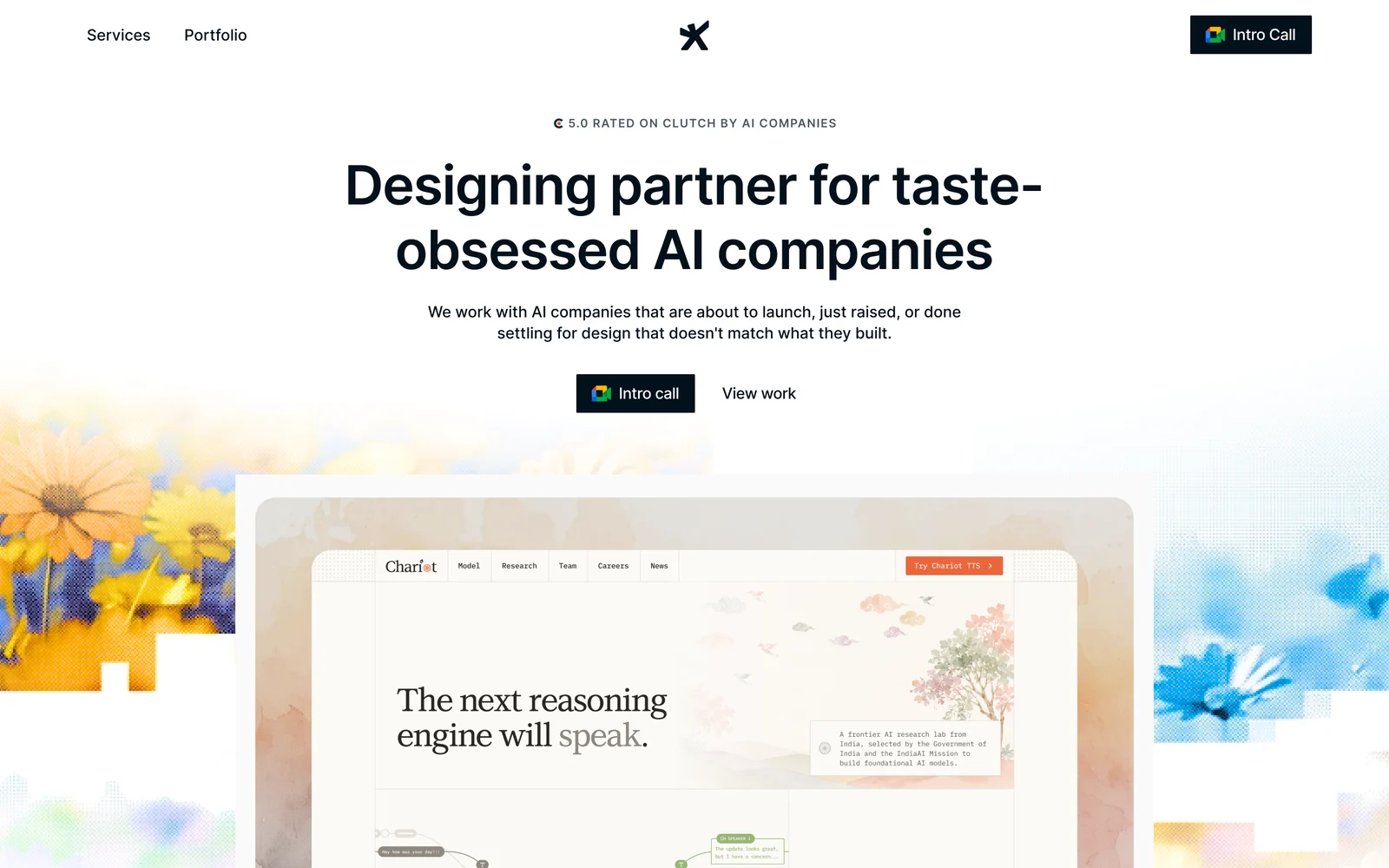
Studio Maydit is a web and product design studio working with AI founders in the US, UK, and Europe. The platform choice is made for you rather than sold to you: Framer when the page will change often and you want to change it, Webflow when a team will eventually run it, custom code only when the site genuinely needs it. The engagement then continues into product design once the site is live, which matters because a first site usually reveals what is wrong inside the product.
The clearest published outcome is Dualite. The work began with a repositioned ICP, meaning a decision about who to stop addressing, and the design followed that decision rather than trying to please everyone. 100,000+ users arrived in seven months. For a first-time founder the transferable part is the order of operations, since the sentence comes before the layout. Recent clients include Wave, PixelFlow, Mi-VAD, and 15 other AI and SaaS teams.
There are two ways to buy, and both are quoted per project rather than left vague. A fixed scope runs three to four weeks and suits a founder with a launch date. A monthly retainer covers new pages, campaigns, and product design with no long lock-in, and tends to fit better once the first version is live and everything starts changing weekly. Fixed-scope work ends with a written diagnosis of what is leaking in the product.
| Check | Finding |
|---|---|
| Based in | Remote, serving US / UK / EU |
| Platform depth | Framer, Webflow, and custom code |
| AI-sector proof | Yes. AI-native clients, published outcome on Dualite |
| Pricing | Fixed scope or monthly retainer, quoted per project |
| Team shape | Founder-led, small senior team |
| Best fit | First-time founders who want to own and edit the site afterwards |
Worth a call if you are not yet sure what the homepage is supposed to claim. Book a 30-minute call.

2. Refokus
Refokus is a remote German practice founded in 2021 at eleven to fifty people, working in Webflow, and naming Mural, BASF, Spotify, Yahoo, and BCG. That client list is unusually senior for a Webflow studio, and Webflow itself is the point for a first-time founder, since it is a platform your future marketing hire will already know how to use.
No starting figure is published, so you cannot place them on a scale before a call. Their AI-sector proof is partial with no AI case study, and a client list of that size suggests engagements sized for organisations with a brief already written.
| Check | Finding |
|---|---|
| Based in | Germany, remote |
| Founded | 2021 |
| Team size | 11-50 |
| Primary platform | Webflow |
| AI-sector proof | Partial. Enterprise and SaaS clients, no AI case study |
| Named clients | Mural, BASF, Spotify, Yahoo, BCG |
| Pricing | Not published |
| Best fit | First-time founders who already know exactly what they are selling |
3. Lighthouse Digital
Lighthouse Digital is a London studio working in Webflow, publishing a starting figure and naming HelloSelf, Freetrade, and IGN. Freetrade and HelloSelf are consumer products that had to explain an unfamiliar idea to people in a hurry, which is the same problem a first-time founder has, and the published figure gives you something to compare before you have anything else.
No founding year and no team size are published, so the length and depth of the record are unclear. They publish no AI client work at all, which is a real gap if your product is an AI product and you want a studio that understands the category.
| Check | Finding |
|---|---|
| Based in | London, UK |
| Founded | Not published |
| Team size | Not published |
| Primary platform | Webflow |
| AI-sector proof | No. No published AI client work |
| Named clients | HelloSelf, Freetrade, IGN |
| Pricing | Published minimum |
| Best fit | First-time founders explaining a new idea to a general audience |
4. Pixelmatters
Pixelmatters has worked from Porto since 2013 at fifty-one to two hundred people, across platforms, publishing a starting figure and naming Rubrik, Quantic, and UJET. A practice that spans design and build means one team can take you from an idea to a live site without you having to coordinate two suppliers, which is a coordination job a first-time founder is badly placed to do.
Their AI-sector proof is partial with no AI case study. The headcount also implies a process, a schedule, and a minimum engagement that a founder buying their first site may find larger than the problem.
| Check | Finding |
|---|---|
| Based in | Porto, Portugal |
| Founded | 2013 |
| Team size | 51-200 |
| Primary platform | Mixed |
| AI-sector proof | Partial. Enterprise and SaaS clients, no AI case study |
| Named clients | Rubrik, Quantic, UJET |
| Pricing | Published minimum |
| Best fit | First-time founders who want design and build from one supplier |
5. Flowout
Flowout is a distributed Webflow practice publishing a starting figure and naming Jasper, Kajabi, Riverside, and Sendlane. It runs on a subscription rather than a project, which is an unusually good match for a first-time founder, because the first three months after launch are when you discover what the site actually needs and a project has already ended by then.
No founding year, no team size, and no location are published, so there is very little to verify. Their AI-sector proof is partial, and a subscription model means you are buying capacity rather than a defined outcome, which requires you to know what to ask for each month.
| Check | Finding |
|---|---|
| Based in | Distributed |
| Founded | Not published |
| Team size | Not published |
| Primary platform | Webflow |
| AI-sector proof | Partial. SaaS clients, no AI case study |
| Named clients | Jasper, Kajabi, Riverside, Sendlane |
| Pricing | Published minimum |
| Best fit | First-time founders who expect the site to change every week |
6. Digidop
Digidop has worked from Paris since 2021 at one to ten people, in Webflow, publishing a starting figure and naming TSE Energy, Ramify, and StreamNative. For a first-time buyer this is close to the ideal shape. A published number gives you a scale, a team of that size means no account layer between you and the work, and Webflow means you can change a headline yourself afterwards.
Their AI-sector proof is partial with no AI case study. A one to ten person team also has limited capacity, and a Paris base gives a US founder a short afternoon window, which is worth checking against how often you expect to need a live conversation.
| Check | Finding |
|---|---|
| Based in | Paris, France |
| Founded | 2021 |
| Team size | 1-10 |
| Primary platform | Webflow |
| AI-sector proof | Partial. SaaS clients, no AI case study |
| Named clients | TSE Energy, Ramify, StreamNative |
| Pricing | Published minimum |
| Best fit | First-time founders who want a small team and a published number |
7. Finsweet
Finsweet is a distributed practice based in Denver, founded in 2017 at fifty-one to two hundred people, working in Webflow, and naming Dropbox, Clay, GitHub, and Steadily. They are known for building the Webflow tooling other studios rely on, which means the site you get will be technically sound in ways you will not be able to evaluate yourself but will benefit from anyway.
No starting figure is published. Their AI-sector proof is partial, and a studio of that size and reputation is unlikely to treat a first site as its most interesting work, so ask directly who will be on it.
| Check | Finding |
|---|---|
| Based in | Denver, USA, distributed |
| Founded | 2017 |
| Team size | 51-200 |
| Primary platform | Webflow |
| AI-sector proof | Partial. SaaS clients, no AI case study |
| Named clients | Dropbox, Clay, GitHub, Steadily |
| Pricing | Not published |
| Best fit | First-time founders who want the build to be technically excellent |
8. Instrument
This Portland agency has run since 2005, works across platforms, and names Nike, Microsoft, Electronic Arts, and Google. Twenty years of that work means real craft and a deep understanding of how a brand holds together across many surfaces, which most studios here do not have.
It is also the wrong shape for a first site. No team size and no starting figure are published, the AI-sector proof is partial, and an agency whose clients are that large plans, staffs, and prices for a brief written by a marketing department you do not have.
| Check | Finding |
|---|---|
| Based in | Portland, USA |
| Founded | 2005 |
| Team size | Not published |
| Primary platform | Mixed |
| AI-sector proof | Partial. Enterprise clients, no AI case study |
| Named clients | Nike, Microsoft, Electronic Arts, Google |
| Pricing | Not published |
| Best fit | Companies with an internal brand team and a long horizon |
9. Engine Digital
Engine Digital has worked from Vancouver and New York since 2002, in custom code, naming Adidas, Autodesk, Goldman Sachs, and HP. Two decades of enterprise work brings rigour around accessibility, performance, and governance that a first-time founder never thinks to ask for and quietly benefits from.
The mismatch is the same as above and slightly sharper. No team size or starting figure is published, the AI-sector proof is partial, and custom code hands you a site that needs a developer every time you want to change it, which is the specific outcome a first-time founder should avoid.
| Check | Finding |
|---|---|
| Based in | Vancouver and New York |
| Founded | 2002 |
| Team size | Not published |
| Primary platform | Custom code |
| AI-sector proof | Partial. Enterprise clients, no AI case study |
| Named clients | Adidas, Autodesk, Goldman Sachs, HP |
| Pricing | Not published |
| Best fit | Established companies with engineering capacity in house |
10. 8020
8020 has worked from San Francisco and New York since 2014, in Webflow, naming Wave, Superlist, Pilot.com, Vanta, and Circle. That is a list of software companies at roughly the stage where a founder buys a first serious site, so the studio has seen the problem in the same shape you have it.
No team size and no starting figure are published. Their AI-sector proof is partial with no AI case study, and a US base at that client level suggests a price point a founder before revenue should check early rather than late.
| Check | Finding |
|---|---|
| Based in | San Francisco and New York, USA |
| Founded | 2014 |
| Team size | Not published |
| Primary platform | Webflow |
| AI-sector proof | Partial. SaaS clients, no AI case study |
| Named clients | Wave, Superlist, Pilot.com, Vanta, Circle |
| Pricing | Not published |
| Best fit | First-time founders with revenue who want a US-based studio |
How to choose between them
Sort by what you are actually missing, not by whose work you like most.
You cannot say what you do in one sentence. Studio Maydit or Lighthouse Digital.
You need a number before you can plan anything. Digidop or Flowout.
You want to change the site yourself afterwards. Studio Maydit or Refokus.
You have revenue and want a US team in your hours. 8020 or Finsweet.
One test before you sign. Send three studios your current homepage or your pitch deck and ask each to write the one sentence they think belongs at the top of your site. A studio worth hiring sends back a sentence, says what it is leaving out, and asks one hard question. A studio that is not sends a proposal with a timeline. It costs them under an hour and you nothing.