Summarize with AI


For a generative AI startup choosing a website studio, ten are worth reviewing: Studio Maydit, basement.studio, Feels Like, Lazarev, BX Studio, Kvalifik, Feely Studio, Phantom, Pixelmatters, and SuperSkills. The two strongest are basement.studio and Feels Like. basement.studio builds in custom code from Mar del Plata and Los Angeles, has since 2018, runs eleven to fifty people, publishes a starting price, and works for Vercel, Cursor, ElevenLabs, Harvey AI, and Scale AI. Feels Like is a Los Angeles studio founded 2023, also in custom code, working for Google, Nike, LVMH, and Suno AI. Pixelmatters and SuperSkills are the weakest fit, the first because its AI proof is only partial on a list where almost everyone else has direct experience, the second because it names one client and publishes no price.
Everything on your homepage is assumed to be your best result, and your best result is not the one that matters.
That assumption is correct and it is the whole problem. Your gallery is curated, because of course it is, and your visitor knows it. What they are actually trying to work out is the median. Not the beautiful output you chose but the fourth attempt on a Thursday when the prompt was rushed and the input was messy. No gallery answers that question, and the more polished the gallery, the more strongly the question gets asked.
Then there is the sentence every generative company hears in a sales call. Why would I not just use the big model directly. It is a fair question, it is asked more every quarter, and the answer is never about output quality alone. It is about the workflow around the model, the constraints you enforce, the things you refuse to generate, the format your output arrives in, and the fact that a non-specialist can get a usable result on the first try. Almost none of that is visual, so almost none of it ends up on the page.
Third, visitors to a generative product expect to try it. That expectation is reasonable and it quietly turns your website into a product surface. Now you are paying for inference on anonymous traffic, and the page has to handle a queue, a rate limit, and someone typing something you would rather not generate. Teams discover this after launch, usually on the day something gets screenshotted.

How we picked these agencies
Five questions decided this order, and each is answerable from public pages before you commit an hour to a call.
First, platform depth, judged against whether your homepage is a page or a product. If visitors will generate something, you need real engineering: a queue, a rate limit, a moderation path, and a graceful message when capacity runs out. A studio that only produces marketing sites will design that flow beautifully and leave you to build it.
Second, direct experience with generative products specifically, rather than AI in general. This is the criterion doing the most work here. Selling generation means managing an expectation about variance, and the studios that have done it know the answer is a wider sample, visible constraints, and honest statements about what the model will not do well. A studio that has not done it will build a gallery, which is the thing your visitor already discounts.
Third, pricing disclosure. Not the number, only whether one is public. It is a small test of whether a studio will be concrete, which is what your workflow argument needs.
Fourth, team shape, meaning whether the person who understood why your fine-tune beats the base model is the person writing that sentence. This claim in particular collapses into marketing language when it changes hands.
Fifth, the studio's own site. No client and no brief, which for a generative company is a useful mirror, since taste is most of what you are selling.
Nothing in the tables below is inferred. Each row is drawn from what the studio states publicly about itself, so where a cell reads Not published, the studio decided not to say.
What goes wrong
The gallery is read as cherry-picking, because it is. Twelve perfect outputs prove you can produce twelve perfect outputs. Show range instead. A grid of twenty unedited results from one prompt, including the two that went wrong, tells a buyer more about the median than any curated set, and it is the only version they will believe.
The website turns into the product and the argument disappears. A try-it box gets pride of place, swallows the build budget, and pushes the reason to pay below the fold. If you offer a trial on the page, decide first what a visitor should understand before they touch it, because most of them will type one thing, get one result, and leave.
Nobody answers the base model question. The page compares you to competitors when the real competitor is the general purpose model your buyer already pays for. Answer it directly and early. Name what you enforce, what you refuse, what format the output arrives in, and how much less prompting is required. That is your product, and it is almost never on the homepage.
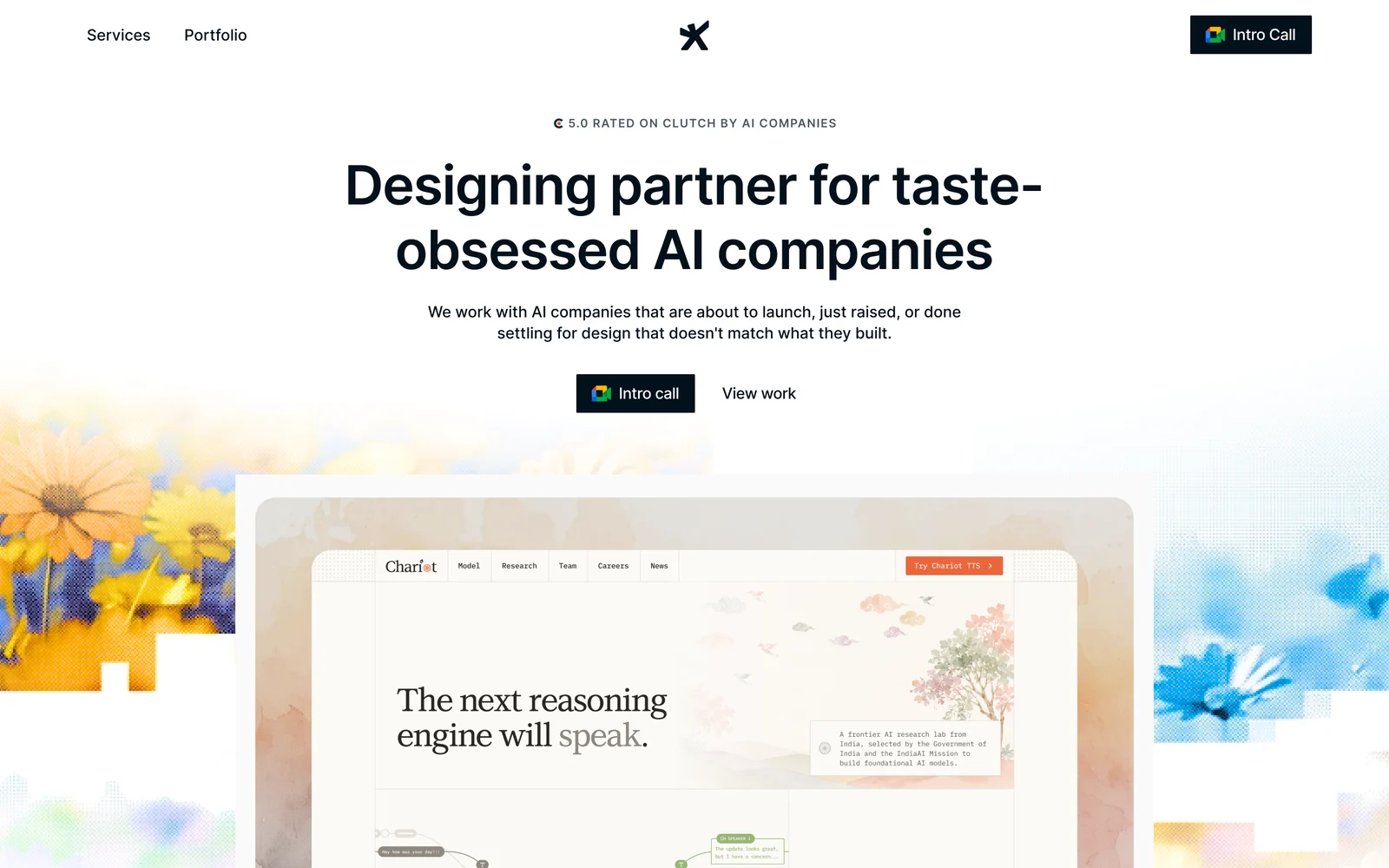
1. Studio Maydit: A Top-Rated Design Agency for AI Founders
Generative teams usually have taste in the product and a page that argues from the wrong evidence. Studio Maydit is a web and product design studio working with AI founders in the US, UK, and Europe, and the work here begins with what a visitor needs to believe about the median result rather than the best one. Sites get built in Framer, Webflow, or custom code, chosen by whether the page has to generate anything, which is the decision that determines the budget.
The design work continues past the site into the product, which for generative software is where the interesting problems are. How a prompt is scaffolded so a non-expert succeeds first time, what the interface does during a slow generation, how a bad result is regenerated without feeling like failure, and how refusals are worded are product design decisions handled by the same team rather than passed on. The clearest published outcome is Dualite, where design work supporting a repositioned ICP helped the product reach 100,000+ users in seven months. Recent clients include Wave, PixelFlow, Mi-VAD, and 15 other AI and SaaS teams.
Buying happens two ways. A fixed scope runs three to four weeks and suits a team with a launch already dated, which is most generative companies shipping against a model release. A monthly retainer suits teams shipping constantly, covering new pages, campaigns, and product design, with no long lock-in. Fixed-scope work ends with a written diagnosis of what is leaking in the product rather than a handoff and goodbye.
| Check | Finding |
|---|---|
| Based in | Remote, serving US / UK / EU |
| Platform depth | Framer, Webflow, and custom code |
| AI-sector proof | Yes. AI-native clients, published outcome on Dualite |
| Pricing | Fixed scope or monthly retainer, quoted per project |
| Team shape | Founder-led, small senior team |
| Best fit | Generative teams whose output is good and whose page argues badly |
If people like your results and still ask why they cannot get them elsewhere, the page is losing the argument. Book a 30-minute call.

2. basement.studio
basement.studio builds in custom code from Mar del Plata and Los Angeles, has done since 2018, runs eleven to fifty people, and publishes a starting price. The client list is the single strongest AI record on this list: Vercel, Cursor, ElevenLabs, Harvey AI, and Scale AI. ElevenLabs is generative audio and Cursor is generative code, so this team has twice had to make output variance credible to technical buyers who test claims. Custom code also means an interactive generation surface on the page is a real option rather than a mockup.
The weakness is that a studio in this much demand books out, and its work leans heavily technical. If your buyers are non-technical creatives, ask to see that side of the portfolio.
| Check | Finding |
|---|---|
| Based in | Mar del Plata, Argentina and Los Angeles, USA |
| Founded | 2018 |
| Team size | 11-50 |
| Primary platform | Custom code |
| AI-sector proof | Yes |
| Named clients | Vercel, Cursor, ElevenLabs, Harvey AI, Scale AI |
| Pricing | Published minimum |
| Best fit | Generative products with a technical audience and a live demo |
3. Feels Like
Feels Like is a Los Angeles studio founded in 2023, working in custom code for Google, Nike, LVMH, and Suno AI. Suno is generative music, which makes this one of very few studios on any list with direct generative product experience, and LVMH means the team can carry a brand that has to feel considered rather than technical. For a generative company selling to creative professionals, that pairing is unusually well matched.
The weakness is youth and opacity. Founded 2023, it publishes neither team size nor pricing, so both capacity and cost are unknowns you have to resolve on a call.
| Check | Finding |
|---|---|
| Based in | Los Angeles, USA |
| Founded | 2023 |
| Team size | Not published |
| Primary platform | Custom code |
| AI-sector proof | Yes |
| Named clients | Google, Nike, LVMH, Suno AI |
| Pricing | Not published |
| Best fit | Generative products sold to creative and consumer audiences |
4. Lazarev
Lazarev is a San Francisco studio founded in 2015 with fifty-one to two hundred people, works across platforms, publishes a starting price, and carries AI-sector proof. The scale matters for a generative company, because if your homepage runs real inference you need design and engineering staffed together, and a team this size can do that. Payoneer, Peel, Elva, and Mozayix show a habit of explaining products that are more complicated than they look.
The weakness is that it is a premium studio, and even with a published minimum the engagement is shaped for a funded team rather than one still finding its market.
| Check | Finding |
|---|---|
| Based in | San Francisco, USA |
| Founded | 2015 |
| Team size | 51-200 |
| Primary platform | Mixed |
| AI-sector proof | Yes |
| Named clients | Payoneer, Peel, Elva, Mozayix |
| Pricing | Published minimum |
| Best fit | Funded generative teams needing design and engineering together |
5. BX Studio
BX Studio is a New York team of eleven to fifty working in Webflow, with AI-sector proof and a published starting price. Reddit, Headspace, ASAPP, and Verifone are named, and ASAPP is conversational AI, so the team has met machine output before. Reddit and Headspace are both consumer products at scale, which is the right instinct if your generative tool is going to be used by many people who will not read documentation.
The weakness is the platform ceiling. Webflow is a fine choice for a marketing site and a poor one for a page running live generation with a queue, so decide which you are building before you brief them.
| Check | Finding |
|---|---|
| Based in | New York, USA |
| Founded | Not published |
| Team size | 11-50 |
| Primary platform | Webflow |
| AI-sector proof | Yes |
| Named clients | Reddit, Headspace, ASAPP, Verifone |
| Pricing | Published minimum |
| Best fit | Consumer generative products whose demo lives inside the app |
6. Kvalifik
Kvalifik is a Copenhagen studio founded 2015, eleven to fifty people, working in Webflow with AI-sector proof. Veo, Maersk, and Relesys are named, and Veo is automated sports capture, so the team has handled a product whose output is machine-produced and judged by eye. Being Danish is useful if your buyers are European and asking where generation happens and what it was trained on.
The weakness is that it publishes no pricing, and Webflow limits how much of a live generation experience can sit on the marketing page itself.
| Check | Finding |
|---|---|
| Based in | Copenhagen, Denmark |
| Founded | 2015 |
| Team size | 11-50 |
| Primary platform | Webflow |
| AI-sector proof | Yes |
| Named clients | Veo, Maersk, Relesys |
| Pricing | Not published |
| Best fit | European generative teams facing questions about provenance |
7. Feely Studio
Feely Studio is a distributed European team of one to ten, working across platforms with AI-sector proof and a published starting price. Noxus, Mutiny, Luasai, and Basic Capital are named, and Mutiny is a personalisation product, so the studio has worked on software that generates variations and has to prove they are good ones. At this size you deal with the people building, which keeps a subtle claim about your fine-tune intact.
The weakness is capacity and tenure. One to ten people means a queue, and it publishes no founding date, so the track record is harder to size up from outside.
| Check | Finding |
|---|---|
| Based in | Distributed, Europe |
| Founded | Not published |
| Team size | 1-10 |
| Primary platform | Mixed |
| AI-sector proof | Yes |
| Named clients | Noxus, Mutiny, Luasai, Basic Capital |
| Pricing | Published minimum |
| Best fit | Early generative teams who want senior attention at a known price |
8. Phantom
Phantom builds in custom code from London and Auckland, has done since 2013, runs fifty-one to two hundred people, and carries AI-sector proof. It is the most capable engineering option here after basement.studio, which matters if your page has to run generation at unpredictable volume. Diageo, SAP, Financial Times, and Zendesk are organisations with strict standards, useful if your generative product is heading into enterprise procurement.
The weakness is money and shape. Phantom publishes no starting price, and a studio of that size with that client list is built around larger engagements than most generative startups are ready for.
| Check | Finding |
|---|---|
| Based in | London, UK and Auckland, NZ |
| Founded | 2013 |
| Team size | 51-200 |
| Primary platform | Custom code |
| AI-sector proof | Yes |
| Named clients | Diageo, SAP, Financial Times, Zendesk |
| Pricing | Not published |
| Best fit | Generative products entering enterprise procurement |
9. Pixelmatters
Pixelmatters is a Porto studio founded 2013, fifty-one to two hundred people, working across website and product design with a published starting price. The continuity is the appeal. Decisions about how variance is presented on the marketing page should carry into the product, and a studio doing both can carry them. Rubrik, Quantic, and UJET are named.
The weakness stands out on this particular list. Its AI-sector proof is partial where nearly every other studio here has direct generative or AI experience, so you would be bringing the category knowledge yourself.
| Check | Finding |
|---|---|
| Based in | Porto, Portugal |
| Founded | 2013 |
| Team size | 51-200 |
| Primary platform | Mixed |
| AI-sector proof | Partial |
| Named clients | Rubrik, Quantic, UJET |
| Pricing | Published minimum |
| Best fit | Generative teams who want site and product from one studio |
10. SuperSkills
SuperSkills is a one-to-ten person studio in Walnut Creek working across platforms, and it does carry AI-sector proof. A very small team means senior attention throughout, and there are generative companies for which a single sharp collaborator is a better fit than a studio with a process.
The weakness is that there is almost nothing to evaluate from outside. One named client, The Cut, no founding date, and no published pricing, on a list where most competitors show four or five relevant names. For a category where taste is the product, being unable to see much of the work is a real obstacle.
| Check | Finding |
|---|---|
| Based in | Walnut Creek, USA |
| Founded | Not published |
| Team size | 1-10 |
| Primary platform | Mixed |
| AI-sector proof | Yes |
| Named clients | The Cut |
| Pricing | Not published |
| Best fit | Teams happy to judge a studio from a private portfolio |
How to choose between them
Sort by which part is actually blocked.
The homepage has to run real generation. basement.studio or Phantom.
Your buyers are creatives who judge on feel. Feels Like or SuperSkills.
A funded team needs design and engineering in one place. Lazarev or Pixelmatters.
European buyers are asking about provenance. Kvalifik or Feely Studio.
One test before you sign. Show a candidate twenty unedited outputs, including the poor ones, and ask what they would put on the page. A studio that understands generative products will want the range visible and the limits stated, because that is what makes the good results credible. A studio that does not will pick the best four and ask for higher resolution versions.