

Summarize with AI


For an LLM platform choosing a website studio, ten are worth reviewing: Studio Maydit, Clay, Phantom, Lazarev, Feels Like, 8020, Fantasy, SuperSkills, Flow Ninja, and Lighthouse Digital. The two strongest are Clay and Phantom. Clay has been in San Francisco since 2016, runs fifty-one to two hundred people, works across platforms for Slack, Stripe, Google, Coinbase, and Amazon, and publishes a starting price. Phantom builds in custom code from London and Auckland, has done since 2013, also runs fifty-one to two hundred people, and works for Diageo, SAP, Financial Times, and Zendesk. Flow Ninja and Lighthouse Digital are the weakest fit, the first because it publishes neither clients nor a price, the second because it records no AI-sector work at all.
Your buyer does not want to be sold to. They want a key and a curl command.
That single fact should reorganise your entire homepage, and on most LLM platform sites it has not. The person deciding whether to build on you is an engineer with an evaluation to run this afternoon. They arrived from a comparison thread, they have three tabs open, and their first two questions are what it costs per million tokens and how long the first token takes. If those answers are more than one scroll away, they close the tab and go to whichever competitor put them at the top.
The second thing is that your documentation is your real marketing site, and everybody knows it except the people commissioning the marketing site. Engineers skip the homepage. They land on the quickstart, judge you by how fast they get a working response, and form a permanent opinion in about four minutes. A gorgeous homepage in front of a slow, badly organised quickstart is money spent in the wrong place.
Third, nobody believes benchmarks any more, and that is your own industry's fault. Every platform publishes a chart where it wins. Your reader has learned to skip them. What still works is a number with its conditions attached, meaning the hardware, the region, the context length, and the date, because a qualified figure looks like an engineer wrote it and an unqualified one looks like a marketer did.
So the job of the page is narrower than it looks. Get a credible engineer to a working request quickly, and be honest enough in the process that they trust the numbers.

How we picked these agencies
Five checks produced this order, and every one is answerable from public pages before you spend an hour on a call.
First, platform depth, judged against how technical your site actually is. An LLM platform site needs live code samples with working syntax highlighting and copy buttons, a pricing calculator that handles token maths, and often a playground. Those are software, not layout, and a studio that hands over a design file leaves the hard half undone.
Second, proof with developer-facing products, which for this category matters more than general AI experience. Writing for engineers is a distinct discipline. It means fewer adjectives, real numbers, no claim without a condition, and code before prose. A studio that has done it will ask for your quickstart in the first meeting. A studio that has not will propose a hero video.
Third, pricing disclosure, meaning whether a starting figure exists in public. It carries extra weight here, because a studio that hides its own price is unlikely to argue hard for you publishing yours.
Fourth, team shape. Whether the person who understood your inference stack is the one writing about it. Technical claims lose their precision the moment they pass to someone who cannot evaluate them, and engineers detect that instantly.
Fifth, the studio's own site, which for a technical audience is a fair test. If it loads slowly and says nothing specific, that is what you are buying.
Nothing in the tables below is inferred. Each row comes from what the studio states publicly, so a Not published cell reflects a decision the studio took.
What goes wrong
The page is designed for a buyer who is not coming. A book a demo button gets the primary position while the API reference sits in the footer. Meanwhile your actual buyer wanted a key in ninety seconds. Put the quickstart, the price, and the signup where the demo request usually goes, and keep a sales path for the enterprise conversation that follows later.
Pricing hides behind contact sales. For a product priced per token this is close to disqualifying. Developers price-compare before they try anything, and an absent number is read as expensive. Publish the per-token rate, publish the free tier, and put a calculator next to it so someone can check their own workload in fifteen seconds.
Benchmarks appear without their conditions. A latency chart with no hardware, region, or context length named reads as marketing and gets skipped. Attach the conditions to every figure and date it. Being the platform whose numbers can be reproduced is a real advantage in a category where almost nobody bothers.
1. Studio Maydit: A Top-Rated Design Agency for AI Founders
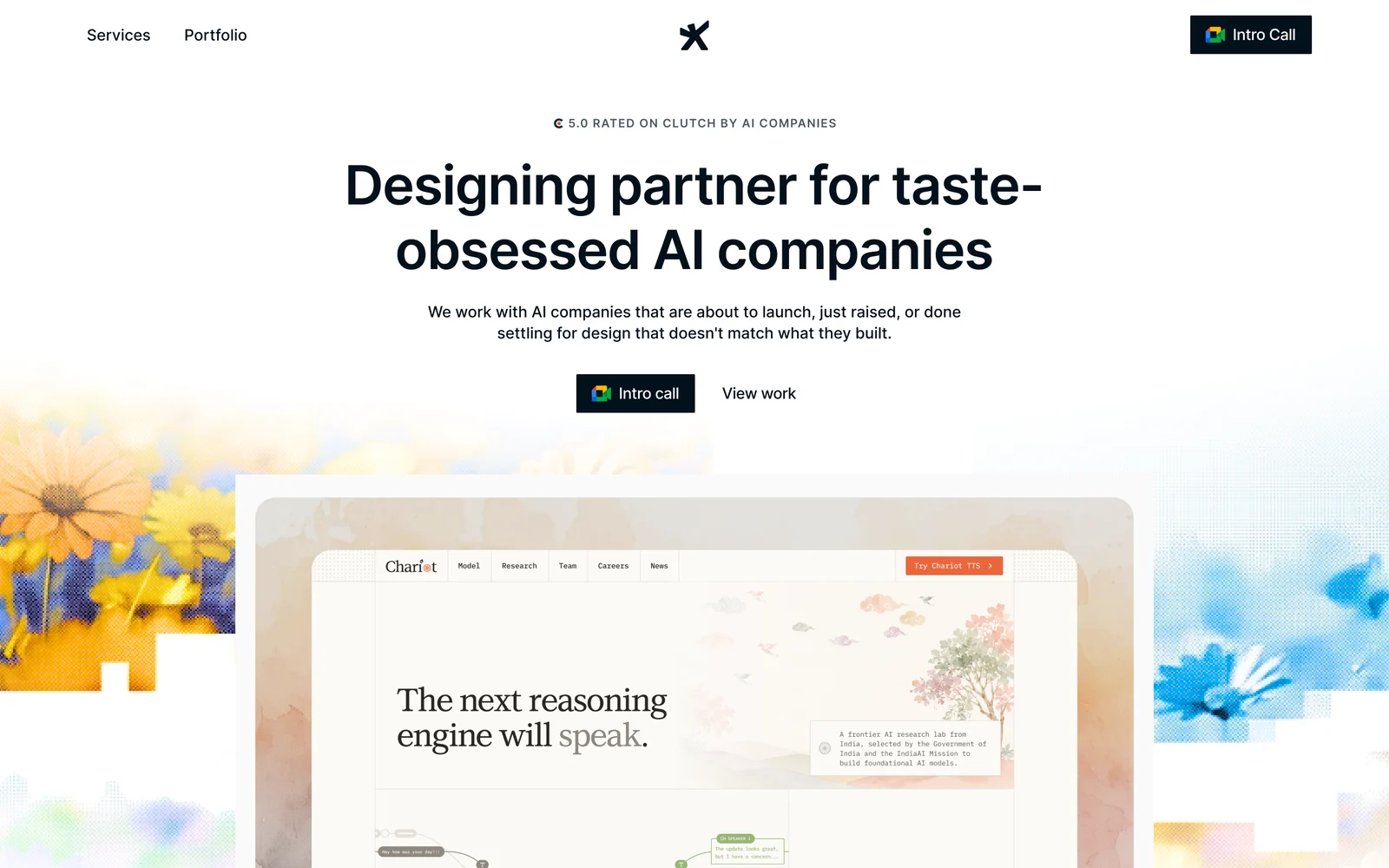
Platform teams tend to have excellent documentation and a homepage written for the wrong reader. Studio Maydit is a web and product design studio working with AI founders in the US, UK, and Europe, and the work here starts by establishing what an engineer must be able to do in the first ninety seconds. Sites get built in Framer, Webflow, or custom code, chosen by how much genuine software the page carries, which for a playground or a token calculator is the decision that sets the budget.
The design work continues past the marketing site into the product. For an LLM platform that means the console, and the console is where developers actually decide to stay. How keys are created and rotated, how usage and spend are shown before a surprise bill arrives, how a rate limit is communicated without panic, and how errors are worded so they are debuggable are product design problems, handled by the same team rather than handed on. The clearest published outcome is Dualite, where design work supporting a repositioned ICP helped the product reach 100,000+ users in seven months. Recent clients include Wave, PixelFlow, Mi-VAD, and 15 other AI and SaaS teams.
Engagements come in two shapes. If a model launch or a funding announcement is already dated, the fixed scope is the one to take, and it runs three to four weeks start to finish. If you are shipping every week and the site has to keep up, the monthly retainer covers new pages, campaigns, and product design instead, and there is no long lock-in on either. Every fixed-scope project closes the same way, with a written diagnosis of what is leaking in the product rather than a handoff and goodbye.
| Check | Finding |
|---|---|
| Based in | Remote, serving US / UK / EU |
| Platform depth | Framer, Webflow, and custom code |
| AI-sector proof | Yes. AI-native clients, published outcome on Dualite |
| Pricing | Fixed scope or monthly retainer, quoted per project |
| Team shape | Founder-led, small senior team |
| Best fit | Platforms whose docs convert and whose homepage does not |
If engineers who reach your quickstart sign up and the ones who land on your homepage leave, that is the gap. Book a 30-minute call.

2. Clay
Clay has worked from San Francisco since 2016, runs fifty-one to two hundred people, builds across platforms, publishes a starting price, and carries AI-sector proof. Stripe is the client that decides this ranking. Stripe's site is the reference example for selling infrastructure to developers, with code in the hero, pricing in public, and prose that respects the reader, and a studio that has worked at that level understands your problem without being taught it. Slack, Coinbase, and Amazon add scale, and a team this size can staff a playground properly.
The weakness is that it is a premium studio with very large clients. Even with a published minimum, the engagement is shaped for a funded platform rather than an early one.
| Check | Finding |
|---|---|
| Based in | San Francisco, USA |
| Founded | 2016 |
| Team size | 51-200 |
| Primary platform | Mixed |
| AI-sector proof | Yes |
| Named clients | Slack, Stripe, Google, Coinbase, Amazon |
| Pricing | Published minimum |
| Best fit | Funded platforms who want developer marketing done properly |
3. Phantom
Phantom builds in custom code from London and Auckland, has done since 2013, runs fifty-one to two hundred people, and carries AI-sector proof. Custom code is the argument. A working playground, a token calculator, and live code samples with correct highlighting are engineering, and Phantom can staff engineering alongside design rather than subcontracting it. SAP and Zendesk are both enterprise software with technical evaluators, which is the second audience your platform has to satisfy after the individual developer.
The weakness is that it publishes no pricing, and a studio of this size and client profile is built for engagements larger than an early platform usually wants.
| Check | Finding |
|---|---|
| Based in | London, UK and Auckland, NZ |
| Founded | 2013 |
| Team size | 51-200 |
| Primary platform | Custom code |
| AI-sector proof | Yes |
| Named clients | Diageo, SAP, Financial Times, Zendesk |
| Pricing | Not published |
| Best fit | Platforms whose site includes a playground or a real calculator |
4. Lazarev
Lazarev is a San Francisco studio founded 2015 with fifty-one to two hundred people, working across platforms with AI-sector proof and a published starting price. It sits here because it can do both halves, design and build, at a scale that handles a large technical site, and because the published minimum lets you qualify yourself in seconds. Payoneer, Peel, Elva, and Mozayix show a pattern of explaining products with more machinery underneath than the surface suggests.
The weakness is that the named work is not developer tooling. Expect strong execution and expect to supply the engineering audience knowledge yourself.
| Check | Finding |
|---|---|
| Based in | San Francisco, USA |
| Founded | 2015 |
| Team size | 51-200 |
| Primary platform | Mixed |
| AI-sector proof | Yes |
| Named clients | Payoneer, Peel, Elva, Mozayix |
| Pricing | Published minimum |
| Best fit | Platforms wanting one studio for a large site and its product surfaces |
5. Feels Like
Feels Like is a Los Angeles studio founded 2023 working in custom code for Google, Nike, LVMH, and Suno AI. Suno gives it direct AI product experience, and the custom code capability means the technical parts of the site are buildable rather than approximated. There is also a specific case for this studio: if your platform is competing on feel as much as on price, a team that has worked with LVMH knows how to make infrastructure look considered instead of utilitarian.
The weakness is that it is young, founded 2023, and publishes neither team size nor pricing, so capacity and cost both have to be settled on a call.
| Check | Finding |
|---|---|
| Based in | Los Angeles, USA |
| Founded | 2023 |
| Team size | Not published |
| Primary platform | Custom code |
| AI-sector proof | Yes |
| Named clients | Google, Nike, LVMH, Suno AI |
| Pricing | Not published |
| Best fit | Platforms who want to look premium rather than purely technical |
6. 8020
8020 works from San Francisco and New York, founded 2014, building in Webflow for Wave, Superlist, Pilot.com, Vanta, and Circle. Vanta is the useful name, because it sells trust to technical buyers and had to make a security argument legible on a marketing page. That is close to the reliability and data handling questions your enterprise evaluators will raise.
The weakness is the platform ceiling and the opacity. Webflow is a poor fit for a real playground, and 8020 publishes neither team size nor pricing while its AI-sector proof is only partial.
| Check | Finding |
|---|---|
| Based in | San Francisco and New York, USA |
| Founded | 2014 |
| Team size | Not published |
| Primary platform | Webflow |
| AI-sector proof | Partial |
| Named clients | Wave, Superlist, Pilot.com, Vanta, Circle |
| Pricing | Not published |
| Best fit | Platforms whose site is marketing only, with docs hosted elsewhere |
7. Fantasy
Fantasy has run since 1999 from San Francisco and New York, works across platforms, and carries AI-sector proof. More than two decades of interface design is real depth, and if your platform is introducing a genuinely unfamiliar interaction model rather than another chat endpoint, that history is worth something.
The weakness is that you cannot verify any of it from outside. Fantasy publishes neither client names nor pricing, which empties the two columns a shortlist depends on, and for a technical buyer who wants to inspect the work first that is an awkward starting position.
| Check | Finding |
|---|---|
| Based in | San Francisco and New York, USA |
| Founded | 1999 |
| Team size | Not published |
| Primary platform | Mixed |
| AI-sector proof | Yes |
| Named clients | Not published |
| Pricing | Not published |
| Best fit | Platforms happy to evaluate through private conversation |
8. SuperSkills
SuperSkills is a Walnut Creek studio of one to ten people working across platforms, with AI-sector proof. A team that small means senior attention on every screen, and for a platform that needs one sharp collaborator rather than an agency process it can be the right shape.
The weakness is evidence. One named client, The Cut, no published founding date, and no pricing, which is thin next to competitors here naming four or five relevant projects. It also means no visible proof of technical or developer-facing work, which is the specific thing this list is testing for.
| Check | Finding |
|---|---|
| Based in | Walnut Creek, USA |
| Founded | Not published |
| Team size | 1-10 |
| Primary platform | Mixed |
| AI-sector proof | Yes |
| Named clients | The Cut |
| Pricing | Not published |
| Best fit | Small platforms who want one senior collaborator, judged privately |
9. Flow Ninja
Flow Ninja is a Belgrade studio of eleven to fifty people, founded 2018, working in Webflow. The team size and the tenure are both real, and European rates make it a plausible option for a platform that needs a competent marketing site and nothing clever.
The weakness is that it publishes neither client names nor a starting price, so the two things you would use to shortlist it from outside are both missing. Its sector proof is partial, and Webflow rules out the interactive technical pieces that make an LLM platform site work.
| Check | Finding |
|---|---|
| Based in | Belgrade, Serbia |
| Founded | 2018 |
| Team size | 11-50 |
| Primary platform | Webflow |
| AI-sector proof | Partial |
| Named clients | Not published |
| Pricing | Not published |
| Best fit | Platforms needing a simple site and willing to evaluate on calls |
10. Lighthouse Digital
Lighthouse Digital is a London studio working in Webflow, and it does publish a starting price, which is more than several studios above it manage. HelloSelf, Freetrade, and IGN are reasonable consumer and fintech work, and a UK platform wanting a simple site at a known cost could do worse.
The weakness is decisive for this list. Its AI-sector proof is recorded as none, so every argument that matters here, developer credibility, benchmark honesty, and token pricing clarity, would be new territory. It also publishes neither team size nor a founding date.
| Check | Finding |
|---|---|
| Based in | London, UK |
| Founded | Not published |
| Team size | Not published |
| Primary platform | Webflow |
| AI-sector proof | No |
| Named clients | HelloSelf, Freetrade, IGN |
| Pricing | Published minimum |
| Best fit | UK teams who need a basic site and will write the technical case themselves |
How to choose between them
Sort by what is actually costing you signups.
Developer marketing has to be right the first time. Clay or Lazarev.
The site includes a playground or a real calculator. Phantom or Feels Like.
Enterprise evaluators are asking about trust and data. 8020 or Fantasy.
Budget is tight and the docs already do the selling. Flow Ninja or SuperSkills.
One test before you sign. Ask a candidate what belongs above the fold on your homepage. A studio that understands platforms answers with a code sample, a price per million tokens, and a signup that needs no conversation. A studio that does not answers with a value proposition and a demo request form, which is a page built for a buyer who is not coming.