
Summarize with AI


For a machine learning platform choosing a website studio, ten are worth reviewing: Studio Maydit, basement.studio, Trueform, BX Studio, Kvalifik, Feely Studio, Refokus, Foundey, Pixelmatters, and Push Refresh. The two strongest are basement.studio and Trueform. basement.studio builds in custom code from Mar del Plata and Los Angeles, has since 2018, runs eleven to fifty people, publishes a starting price, and works for Vercel, Cursor, ElevenLabs, Harvey AI, and Scale AI. Trueform is a Swiss studio in Wil, founded 2022, building in Framer for Miro, Morning Brew, Bilt Rewards, and Gather, and it publishes a price too. Pixelmatters and Push Refresh are the weakest fit, both carrying only partial AI-sector proof on a list where most competitors have direct experience.
You are not competing with another platform. You are competing with a script that already works.
Every ML platform eventually discovers this. Your buyer is a platform engineer or a lead data scientist, and they have already solved eighty percent of what you sell using a Makefile, a scheduler, a bucket, and a notebook that somebody keeps meaning to clean up. It runs. It has run for two years. Nobody is unhappy enough to file a ticket about it. Your page is written as though the alternative is nothing, when the alternative is a working system with a sunk cost and a maintainer who is quietly proud of it.
The second difficulty is that what you actually sell is the absence of events. Reproducible runs, lineage that survives a personnel change, an experiment somebody can rerun in eleven months, a model that can be rolled back on a bad Friday. These are enormously valuable and completely undramatic. There is no screenshot of a disaster that did not happen, so this section of the page usually collapses into one bullet that says lineage tracking and moves on.
Third, there are two readers and most sites serve neither properly. The data scientist wants to know whether the workflow feels natural and whether it fights their notebook. The platform lead wants to know what it costs, how it fits their existing stack, who owns it at three in the morning, and whether it will still be supported in three years. Those are different pages. One homepage that averages them convinces nobody, because the averaged version is vague, and vague is exactly what a build-it-ourselves team is looking for permission to ignore.

How we picked these agencies
Five checks produced this order, and each one can be settled from public pages before you give up an hour to a call.
First, platform depth, judged against how technical the site has to be. ML platform sites carry real code samples, architecture diagrams that have to stay legible on a phone, comparison tables against building it yourself, and often a cost calculator. Whether a studio can build those or only draw them decides whether launch day arrives on time.
Second, proof with products bought by engineers rather than managers. This does most of the work here. Selling to an ML team means writing without adjectives, showing the code, and admitting what your platform will not do, because the reader can catch you out and enjoys doing it. A studio that has sold developer infrastructure knows this. One that has not proposes a hero video and the word seamless.
Third, pricing disclosure, meaning only whether a starting figure exists in public. It matters more here than usual, since a studio unwilling to name its own price will not fight for you to publish yours.
Fourth, team shape. Whether the person who understood your lineage model is the one writing the paragraph about it. A reproducibility claim written by somebody who does not understand reproducibility reads exactly as it sounds.
Fifth, the studio's own website. For this audience it is a fair proxy: if it loads slowly and says nothing checkable, that is the standard on offer.
Nothing in the tables is inferred. Every row comes from what the studio publishes about itself, so a Not published cell records a decision rather than a research failure.
What goes wrong
The page argues capability against a team that already has capability. A feature list lands on someone whose pipeline runs fine. The argument that works is the cost of continuing: the days per quarter their best engineer spends on plumbing, the experiment nobody can reproduce, the person who left with the only working knowledge of the scheduler. Put a number on the status quo and the comparison becomes real.
Reproducibility gets one bullet and no evidence. It is your most valuable property and the hardest to dramatise, so it gets abbreviated. Show it instead. One concrete example of an experiment rerun months later with identical output, with the artefacts named, does more than a paragraph of nouns. Specificity is the only route to credibility for a promise about the future.
One page tries to serve the data scientist and the platform lead at once. The result is copy vague enough to satisfy neither, which is the exact condition under which a team decides to keep building their own. Split it. Give the practitioner a quickstart, a notebook, and honest words about what it will not do. Give the lead an architecture diagram, a price, a security page, and a support commitment.
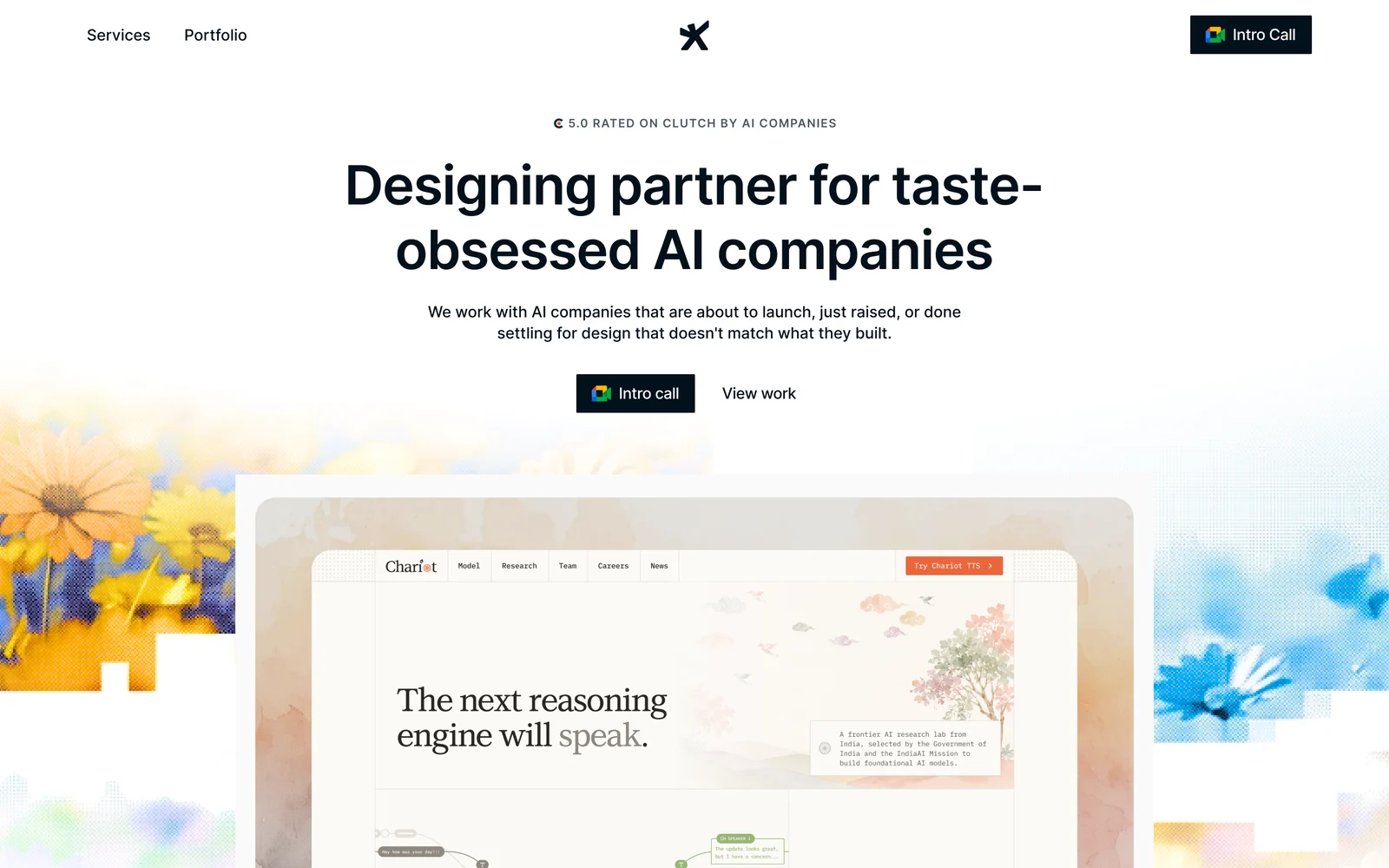
1. Studio Maydit: A Top-Rated Design Agency for AI Founders
ML platform teams usually have the harder engineering finished and a page that argues against the wrong competitor. Studio Maydit is a web and product design studio working with AI founders in the US, UK, and Europe, and the first job here is naming the real alternative, which is almost always the buyer's own working setup. Sites get built in Framer, Webflow, or custom code depending on how much genuine software the page carries, and a comparison calculator or an interactive architecture view pushes that decision toward code.
Design does not stop at the marketing site. The studio continues into the product, and for an ML platform that is the console, where the decision to stay actually gets made. How a run's lineage is shown without becoming a wall of metadata, how a failed job explains itself well enough to debug, how experiments are compared side by side, and how spend is surfaced before month end are product design problems, handled by the same team rather than passed to somebody new. The clearest published outcome is Dualite, where design work supporting a repositioned ICP helped the product reach 100,000+ users in seven months. Recent clients include Wave, PixelFlow, Mi-VAD, and 15 other AI and SaaS teams.
There are two ways in. A fixed scope, three to four weeks, fits a platform with a launch or a conference already in the calendar. A monthly retainer fits a team shipping continuously, covering new pages, campaigns, and product design, and there is no long lock-in either way. A fixed-scope engagement ends with a written diagnosis of what is leaking in the product instead of a handoff and goodbye.
| Check | Finding |
|---|---|
| Based in | Remote, serving US / UK / EU |
| Platform depth | Framer, Webflow, and custom code |
| AI-sector proof | Yes. AI-native clients, published outcome on Dualite |
| Pricing | Fixed scope or monthly retainer, quoted per project |
| Team shape | Founder-led, small senior team |
| Best fit | Platforms losing to build-it-ourselves rather than to a competitor |
If your losses go to internal tooling rather than to another vendor, the page is arguing the wrong case. Book a 30-minute call.

2. basement.studio
basement.studio builds in custom code from Mar del Plata and Los Angeles, has done since 2018, runs eleven to fifty people, and publishes a starting price. Scale AI is the client that settles this ranking, since data infrastructure for machine learning is your neighbourhood, and Vercel and Cursor mean the team writes for engineers as a matter of routine. Custom code also matters, because a real comparison calculator or an interactive pipeline diagram is software and this studio builds software.
The weakness is availability and register. That client list means it books ahead, and the portfolio leans technical, so if your second buyer is a non-technical executive, ask to see work aimed at them.
| Check | Finding |
|---|---|
| Based in | Mar del Plata, Argentina and Los Angeles, USA |
| Founded | 2018 |
| Team size | 11-50 |
| Primary platform | Custom code |
| AI-sector proof | Yes |
| Named clients | Vercel, Cursor, ElevenLabs, Harvey AI, Scale AI |
| Pricing | Published minimum |
| Best fit | Platforms whose primary buyer is an engineer who tests claims |
3. Trueform
Trueform is a Swiss studio in Wil, founded 2022, building in Framer with AI-sector proof and a published starting price. The appeal for an ML platform is speed at a known cost. Framer gets a genuinely polished, interactive page live in weeks rather than months, which suits a team that needs to look credible before a conference and cannot spare engineering time. Miro, Morning Brew, Bilt Rewards, and Gather are products where the interface carries the argument. Being Swiss also helps when European buyers ask where training data sits.
The weakness is the platform ceiling. A cost calculator with real arithmetic or a deep interactive diagram will eventually want application code, so ask what happens at that point.
| Check | Finding |
|---|---|
| Based in | Wil, Switzerland |
| Founded | 2022 |
| Team size | Not published |
| Primary platform | Framer |
| AI-sector proof | Yes |
| Named clients | Miro, Morning Brew, Bilt Rewards, Gather |
| Pricing | Published minimum |
| Best fit | Platforms who need a strong page quickly at a published price |
4. BX Studio
BX Studio is a New York team of eleven to fifty working in Webflow, with AI-sector proof and a published starting price. ASAPP is the relevant name, being a machine learning company selling into large enterprises, which is the two-reader problem you have. Reddit and Headspace show it can build for scale and for people who will not read a manual, useful for the practitioner half of your audience.
The weakness is that Webflow limits the interactive pieces an ML platform site benefits from, and its named work is applications rather than infrastructure, so the platform lead's questions about architecture and support are less familiar ground.
| Check | Finding |
|---|---|
| Based in | New York, USA |
| Founded | Not published |
| Team size | 11-50 |
| Primary platform | Webflow |
| AI-sector proof | Yes |
| Named clients | Reddit, Headspace, ASAPP, Verifone |
| Pricing | Published minimum |
| Best fit | Platforms with a marketing site separate from their docs |
5. Kvalifik
Kvalifik is a Copenhagen studio founded 2015, eleven to fifty people, working in Webflow with AI-sector proof. Maersk is the useful name here, since shipping logistics runs on operational data at a scale where reproducibility genuinely matters, and Veo is automated capture, so machine output is not new to this team. For a European ML platform whose buyers ask where data is processed, a Danish studio removes friction.
The weakness is that it publishes no pricing, and Webflow constrains the technical parts of the site, so a calculator or a live pipeline view will need another arrangement.
| Check | Finding |
|---|---|
| Based in | Copenhagen, Denmark |
| Founded | 2015 |
| Team size | 11-50 |
| Primary platform | Webflow |
| AI-sector proof | Yes |
| Named clients | Veo, Maersk, Relesys |
| Pricing | Not published |
| Best fit | European platforms selling into operations-heavy industries |
6. Feely Studio
Feely Studio is a distributed European team of one to ten working across platforms, with AI-sector proof and a published starting price. Noxus, Mutiny, Luasai, and Basic Capital are named, and Mutiny is a data-driven personalisation product, so the studio has written about pipelines producing outputs that have to be trusted. At this size you deal directly with whoever builds, which keeps a lineage claim precise.
The weakness is capacity and visibility. One to ten people means a queue, and no published founding date makes the track record hard to weigh from outside.
| Check | Finding |
|---|---|
| Based in | Distributed, Europe |
| Founded | Not published |
| Team size | 1-10 |
| Primary platform | Mixed |
| AI-sector proof | Yes |
| Named clients | Noxus, Mutiny, Luasai, Basic Capital |
| Pricing | Published minimum |
| Best fit | Early platforms wanting senior attention at a stated price |
7. Refokus
Refokus is a remote German studio of eleven to fifty, founded 2021, working mainly in Webflow for Mural, BASF, Spotify, Yahoo, and BCG. BASF is the name that earns its place, because industrial process companies are exactly the sort of organisation that runs models on operational data and needs to explain the arrangement internally. BCG adds experience of writing for a sceptical executive audience, which is your platform lead.
The weakness is that its AI-sector proof is partial, it publishes no pricing, and Webflow again limits how technical the page can get without extra help.
| Check | Finding |
|---|---|
| Based in | Germany, remote |
| Founded | 2021 |
| Team size | 11-50 |
| Primary platform | Webflow |
| AI-sector proof | Partial |
| Named clients | Mural, BASF, Spotify, Yahoo, BCG |
| Pricing | Not published |
| Best fit | Platforms whose buyer has to justify the purchase upward |
8. Foundey
Foundey is a San Francisco studio founded 2021 with AI-sector proof, working for DemandIQ, Traycer, and Sero AI. Traycer is an AI coding agent, which means the studio has explained machine-produced work to engineers who will not accept vagueness. That is the right instinct for the practitioner half of your audience.
The weakness is structural. Foundey works in Figma and does not build, so you receive design files and then need a separate party to produce the site, which adds a vendor, a handoff, and usually two weeks. It also publishes no pricing and no team size.
| Check | Finding |
|---|---|
| Based in | San Francisco, USA |
| Founded | 2021 |
| Team size | Not published |
| Primary platform | Figma-only |
| AI-sector proof | Yes |
| Named clients | DemandIQ, Traycer, Sero AI |
| Pricing | Not published |
| Best fit | Platforms with in-house engineers who only need the design |
9. Pixelmatters
Pixelmatters is a Porto studio founded 2013, fifty-one to two hundred people, covering website and product design with a published starting price. The continuity argument is genuine for an ML platform, because the way a run is represented on the marketing page should match how the console shows it, and one studio can hold both. Rubrik is a data management company, which is adjacent to your world.
The weakness stands out on this list. Its AI-sector proof is partial where most competitors here have direct experience, so the technical argument would be yours to supply, and a studio of that size runs a process that a small platform team may find slow.
| Check | Finding |
|---|---|
| Based in | Porto, Portugal |
| Founded | 2013 |
| Team size | 51-200 |
| Primary platform | Mixed |
| AI-sector proof | Partial |
| Named clients | Rubrik, Quantic, UJET |
| Pricing | Published minimum |
| Best fit | Platforms wanting site and console designed by one studio |
10. Push Refresh
Push Refresh is a Dallas studio of one to ten people building in Framer, and it publishes a starting price. Direct access to the builder is real value, and Framer produces a first version fast, so for a platform that needs a simple credible page before a fundraise it is a workable choice.
The weakness is that it is the least suited brief here. SmithRx, Synonym, and Northern National are competent work with no infrastructure or AI weight, its sector proof is partial, and a one-to-ten person Framer studio is a poor match for a site carrying code samples, architecture diagrams, and a calculator.
| Check | Finding |
|---|---|
| Based in | Dallas, USA |
| Founded | Not published |
| Team size | 1-10 |
| Primary platform | Framer |
| AI-sector proof | Partial |
| Named clients | SmithRx, Synonym, Northern National |
| Pricing | Published minimum |
| Best fit | Platforms needing a simple page with the technical case elsewhere |
How to choose between them
Sort by which reader you keep losing.
Engineers test your claims and find them thin. basement.studio or Foundey.
A conference is close and nothing is ready. Trueform or Push Refresh.
The platform lead has to justify it upward. Refokus or BX Studio.
European buyers ask where the data is processed. Kvalifik or Feely Studio.
One test before you sign. Describe your buyer's existing homemade pipeline to a candidate and ask how they would argue against it. A studio that understands this category will reach for the maintenance cost, the reproducibility gap, and the person who leaves with the knowledge. A studio that does not will list your features again, which is the argument that has already failed.