
Summarize with AI


For a New York AI startup, the ten studios worth a conversation are Studio Maydit, Phantom, Trueform, Feels Like, Clay, Foundey, Lazarev, Feely Studio, SuperSkills, and Fantasy. Studio Maydit and Clay lead this list because both have real AI-sector work and both are used to pages that have to satisfy a serious buyer. SuperSkills and Foundey are the wrong fit for most teams here. SuperSkills publishes almost nothing you can verify, and Foundey hands over design files without a build, which is a second vendor a New York team usually does not want.
New York AI companies sell to institutions, and institutions buy differently.
In San Francisco the audience is often other technical people, and a site can lean on being early, clever, and unfinished. Here your buyer is a bank, a law firm, a hospital network, or a media group. Somebody in procurement will open your site, and somebody in risk will open it after that. The page is being assessed as evidence that you are a real company, not as a demo.
That changes what the site has to carry. Security posture, data handling, and who is accountable when the model is wrong all move forward. They stop being footer links and start being the reason a deal advances or stalls.
There is a second thing worth naming. Almost none of the studios on this list are actually in New York. That is not a gap in the research, it is the market. Website design has been remote for years, and the studios doing the strongest AI work sit in San Francisco, London, and across Europe. If sitting in a room together matters to you, that narrows the list quickly, and it is worth deciding early rather than late.
So the checks below weight AI-sector evidence and published pricing, then ask whether the studio has ever built for a buyer with a compliance team.

How we picked these agencies
Five checks, all answerable from public material before you give anyone an hour.
Platform depth. What gets handed over, and who maintains it? A New York team selling into enterprises will keep adding security pages, case studies, and event content. The question is whether that work needs the agency every time or whether a marketer can do it.
Proof in the AI sector. Has the studio built for a company whose product is a model? Applied AI is the New York pattern, meaning AI pointed at an existing industry, and explaining that to an incumbent buyer is a specific and uncommon skill.
Pricing. Is a starting figure public? Teams here are often raising and spending on a compressed schedule, and a studio that will not indicate cost before a discovery call consumes time that a launch window does not have.
Team shape. Size and seniority determine who is actually writing and designing. On an enterprise-facing site the copy does most of the work, so a studio that staffs writing juniorly is a weaker choice than its portfolio suggests.
Their own site. The one project with no client, no brief, and nobody chasing it.
For this brief, one additional read. Look for a case study where the client sold to a large, conservative organisation. A studio that has only launched consumer products or developer tools has not had to make a page survive a risk review, and that is the review your site has to survive.
Every entry in the tables comes from a studio's own published material. Nothing is sourced from directories or ranking sites, and no unknown is filled in with an educated guess. Where a studio publishes nothing on a point, the row records exactly that.
What goes wrong on New York AI sites
Three failures, each caused by writing for the wrong room.
The site is built for the demo, not the diligence. Founders design the page around the moment that impresses: the animation, the live output, the clever explanation. Then a procurement officer opens it looking for a security page, a company address, and something resembling a customer list, and finds none of them. The deal does not die on the page, it just slows down for a reason nobody reports back.
The product is described in model terms instead of industry terms. Teams write about retrieval, agents, and context windows because that is the internal vocabulary. The buyer at a bank is trying to work out whether this replaces a process their team runs on Thursdays. Every sentence spent on architecture is a sentence not spent on the workflow being replaced, and incumbents win those comparisons by default.
Nobody plans for the second audience. The site gets built for buyers, then has to work for recruiting three months later, when the whole New York AI market is competing for the same forty engineers. A careers page bolted on afterwards, with no sense of what the company is like, converts nobody. Designing for both readers from the start costs almost nothing extra and is almost never done.
1. Studio Maydit: A Top-Rated Design Agency for AI Founders
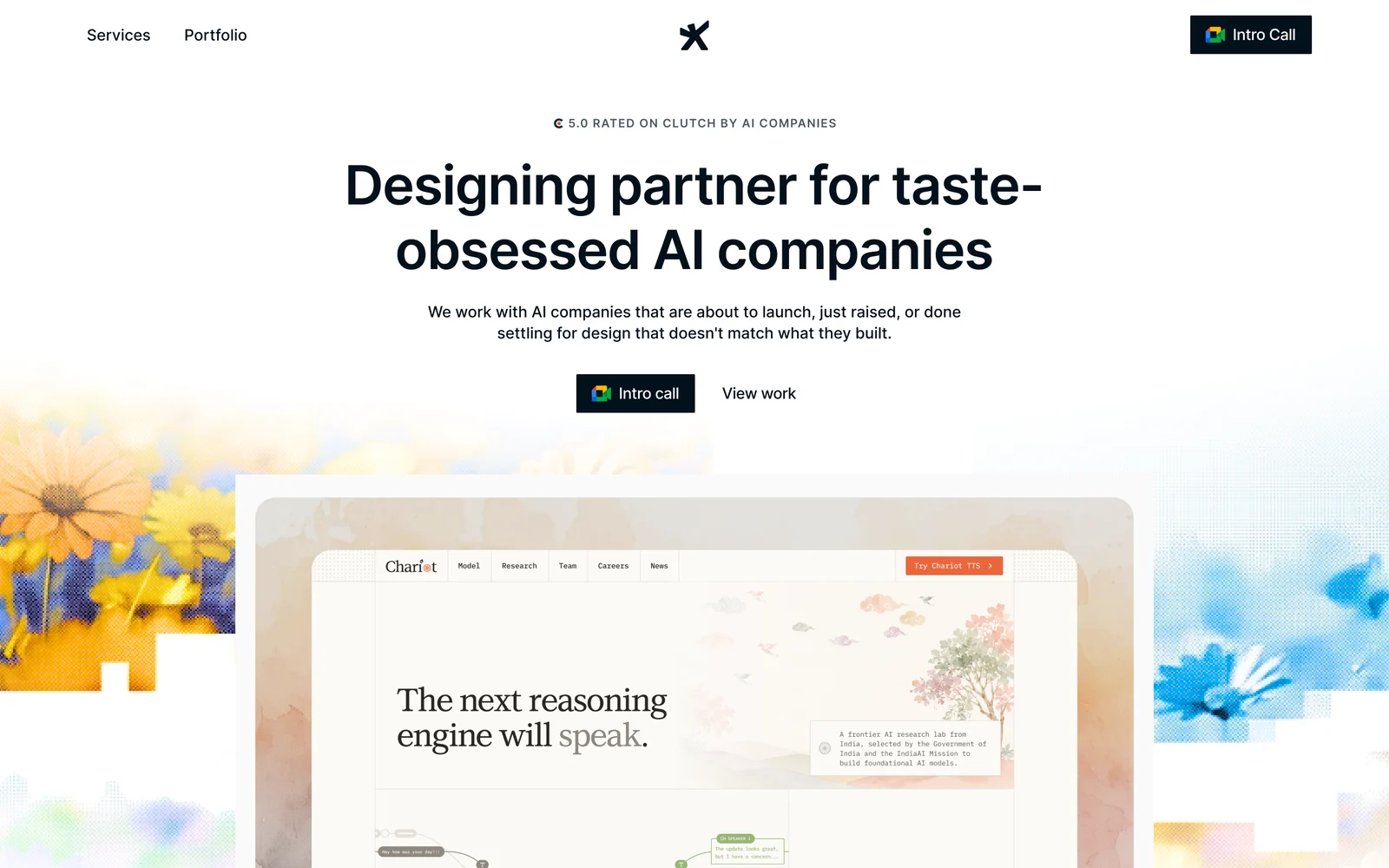
Recent clients include Wave, PixelFlow, Mi-VAD, and 15 other AI and SaaS teams. The published outcome is Dualite, where design work supporting a repositioned ICP helped the product reach 100,000+ users in seven months, and the work there was mostly deciding who the product was for and making every page say it. That decision is the one a New York team has to make between the technical buyer and the institutional one.
Studio Maydit is a web and product design studio working with AI founders in the US, UK, and Europe. Builds happen in Framer, Webflow, and custom code, chosen around who will edit the site later, and the engagement continues into product design once the marketing site is live.
Two ways to buy. Fixed scope runs three to four weeks for a team with a launch or a raise already dated, ending with a written diagnosis of what is leaking in the product rather than a handover email. A monthly retainer suits teams shipping continuously and covers new pages, campaigns, and product design with no long lock-in.
| Check | Finding |
|---|---|
| Based in | Remote, serving US / UK / EU |
| Platform depth | Framer, Webflow, and custom code |
| AI-sector proof | Yes. AI-native clients, published outcome on Dualite |
| Pricing | Fixed scope or monthly retainer, quoted per project |
| Team shape | Founder-led, small senior team |
| Best fit | New York teams selling AI into industries that buy slowly |
If your demos land and procurement stalls, the site is usually where that gap shows. Book a 30-minute call.

2. Phantom
Phantom operates from London and Auckland, founded in 2013, fifty-one to two hundred people, building in custom code, with Diageo, SAP, Financial Times, and Zendesk among its clients. That list is the most institution-friendly on this page. SAP and the Financial Times are exactly the kind of organisations your buyers work at, and the studio has produced work those companies signed off.
They have real AI-sector proof too. The trade-offs are that they publish no pricing and a custom-code build leaves a New York team needing developer time for changes.
| Check | Finding |
|---|---|
| Based in | London, UK and Auckland, NZ |
| Founded | 2013 |
| Team size | 51-200 |
| Primary platform | Custom code |
| AI-sector proof | Yes |
| Named clients | Diageo, SAP, Financial Times, Zendesk |
| Pricing | Not published |
| Best fit | Teams selling into large enterprises who want matching credibility |
3. Trueform
Trueform is a Swiss studio founded in 2022, working in Framer, with Miro, Morning Brew, Bilt Rewards, and Gather among its clients. Morning Brew and Bilt are New York companies, so the studio has already built for this market and this pace.
They publish a starting price and they work in Framer, which means the site stays editable by a marketer afterwards. The limitation is that they do not publish team size, and a studio founded in 2022 has a shorter track record than several others here.
| Check | Finding |
|---|---|
| Based in | Wil, Switzerland |
| Founded | 2022 |
| Team size | Not published |
| Primary platform | Framer |
| AI-sector proof | Yes |
| Named clients | Miro, Morning Brew, Bilt Rewards, Gather |
| Pricing | Published minimum |
| Best fit | New York teams wanting an editable site and a published price |
4. Feels Like
Feels Like is a Los Angeles studio founded in 2023 working in custom code, with Google, Nike, LVMH, and Suno AI as clients. The craft standard is very high, and LVMH in particular signals work that survives a conservative brand review, which is closer to a procurement review than most agency portfolios get.
The weaknesses are transparency and age. No published pricing, no published team size, and a studio founded in 2023 is still building its record.
| Check | Finding |
|---|---|
| Based in | Los Angeles, USA |
| Founded | 2023 |
| Team size | Not published |
| Primary platform | Custom code |
| AI-sector proof | Yes |
| Named clients | Google, Nike, LVMH, Suno AI |
| Pricing | Not published |
| Best fit | Teams that need a very high craft bar and have budget for it |
5. Clay
Clay is a San Francisco studio founded in 2016, fifty-one to two hundred people, working across platforms, with Slack, Stripe, Google, Coinbase, and Amazon among its clients. They publish a starting price, which is rare at this level of recognition, and their AI-sector work is genuine.
For a New York team selling to institutions, a portfolio containing Stripe and Coinbase does useful work in a diligence conversation. The caveat is scale. Their published minimum is aimed at funded companies, and a studio this size brings process a small team may find heavy.
| Check | Finding |
|---|---|
| Based in | San Francisco, USA |
| Founded | 2016 |
| Team size | 51-200 |
| Primary platform | Mixed |
| AI-sector proof | Yes |
| Named clients | Slack, Stripe, Google, Coinbase, Amazon |
| Pricing | Published minimum |
| Best fit | Funded teams that want a recognised name behind the site |
6. Foundey
Foundey is a San Francisco studio founded in 2021 working almost entirely with AI companies, including DemandIQ, Traycer, and Sero AI. For explaining a model-driven product, the sector familiarity is as strong as anything on this list and saves a great deal of early conversation.
The problem for this brief is scope. Foundey works in Figma and hands over design files, so a New York team without spare front-end capacity has to find a second vendor to build and host, which adds cost and a coordination burden.
| Check | Finding |
|---|---|
| Based in | San Francisco, USA |
| Founded | 2021 |
| Team size | Not published |
| Primary platform | Figma-only |
| AI-sector proof | Yes |
| Named clients | DemandIQ, Traycer, Sero AI |
| Pricing | Not published |
| Best fit | Teams with in-house engineers who only need the design |
7. Lazarev
Lazarev is a San Francisco studio founded in 2015, fifty-one to two hundred people, working across platforms, with Payoneer, Peel, Elva, and Mozayix as clients. Payoneer is a regulated payments business, which is useful evidence for a team selling into financial institutions.
They publish a starting price and have genuine AI-sector work. The trade-off is the usual one at this size: more people between your feedback and the file, and a cadence built around scheduled reviews rather than same-day changes.
| Check | Finding |
|---|---|
| Based in | San Francisco, USA |
| Founded | 2015 |
| Team size | 51-200 |
| Primary platform | Mixed |
| AI-sector proof | Yes |
| Named clients | Payoneer, Peel, Elva, Mozayix |
| Pricing | Published minimum |
| Best fit | Teams needing several surfaces built at once with fintech references |
8. Feely Studio
Feely Studio is a distributed European team of one to ten people working across platforms, with Noxus, Mutiny, Luasai, and Basic Capital among its clients. They publish a starting figure and they have AI-sector work, and at this size a founder deals directly with the people designing.
The constraints are capacity and timezone. A team this small takes few projects at once, and a European team supporting a New York schedule means a shorter overlap window than a US studio would offer.
| Check | Finding |
|---|---|
| Based in | Distributed, Europe |
| Founded | Not published |
| Team size | 1-10 |
| Primary platform | Mixed |
| AI-sector proof | Yes |
| Named clients | Noxus, Mutiny, Luasai, Basic Capital |
| Pricing | Published minimum |
| Best fit | Smaller budgets that still want senior attention |
9. SuperSkills
SuperSkills is a team of one to ten in Walnut Creek working across platforms, with AI-sector work and The Cut among its published clients. A team this size can start quickly and without a heavy process, which suits a contained first project.
For a New York company selling to institutions the evidence is too thin. One named client, no published pricing, and no founding date means almost nothing can be verified before you commit, and that is the opposite of what this brief needs.
| Check | Finding |
|---|---|
| Based in | Walnut Creek, USA |
| Founded | Not published |
| Team size | 1-10 |
| Primary platform | Mixed |
| AI-sector proof | Yes |
| Named clients | The Cut |
| Pricing | Not published |
| Best fit | A small trial project where little is at stake |
10. Fantasy
Fantasy has run since 1999 from San Francisco and New York, works across platforms, and has genuine AI-sector experience. They are the only studio on this page with a New York office, which matters if you want people in a room.
They sit last on evidence rather than ability. No published clients, no published pricing, and no published team size means a New York founder is buying almost entirely on reputation and on a private meeting.
| Check | Finding |
|---|---|
| Based in | San Francisco and New York, USA |
| Founded | 1999 |
| Team size | Not published |
| Primary platform | Mixed |
| AI-sector proof | Yes |
| Named clients | Not published |
| Pricing | Not published |
| Best fit | Teams who want a local office and can run a long procurement |
How to choose between them
Sort by what is actually broken.
If demos go well and deals stall in review, the site is failing the diligence read rather than the first impression. Buy a studio whose portfolio contains large, conservative organisations, and spend the budget on security, accountability, and proof pages.
If buyers do not understand what you replace, the problem is vocabulary. You need a studio that will rewrite the product in the language of the industry you sell into, which is a copy engagement more than a design one.
If you need to be in the room, your list is short and Fantasy is the obvious starting point. Decide that early, because it removes most of this page.
If the site will keep changing as you add customers and content, buy on editability. Framer or a similar platform that a marketer can update beats a custom build you cannot touch without an engineer.
One test before you sign. Ask each studio how they would design the page for a reader in procurement who has never heard of you and is looking for reasons to say no. A studio that sells to institutions will answer with structure and evidence. A studio that sells to consumers will answer with tone.