
Summarize with AI


The best website design agencies for non-technical founders in 2026 are Studio Maydit, Flow Ninja, Refokus, Finsweet, Push Refresh, Engine Digital, Lighthouse Digital, basement.studio, Phantom, and Feels Like. Studio Maydit and Lighthouse Digital lead for this brief. Lighthouse Digital is a London studio working in Webflow, publishing a starting figure and naming HelloSelf, Freetrade, and IGN, which is the right pairing for a founder who cannot evaluate a technical proposal, a public number to anchor on and a platform you can change yourself the day after handover. Engine Digital and basement.studio fit this brief least well. Both build in custom code, and custom code hands a non-technical founder a site that needs a developer every time a sentence changes, which is the single most expensive thing you can accidentally agree to.
The risk here is not that you will choose an ugly website.
You can judge whether something looks right. Most founders can, and the studios below are all competent. The risk is that during the build you will be asked to approve four or five technical decisions you have no way to evaluate, and each of them quietly sets how much your own website will cost you to run for the next three years.
The clearest example is the platform. Someone will say they build in a particular way and give you a reason. You cannot test the reason. Six months later you want to add a page, and the answer is either fifteen minutes of your own time or a quote and a two-week wait. Nobody lied to you. You just approved something you could not read.
The second is scope language. Terms like custom development, integration work, and content migration all sound like specifics and cover very different amounts of money depending on who is saying them. Without a technical reference point, you cannot tell an honest estimate from an optimistic one, and both look identical in a proposal.
The third is quieter and matters most in this sector. If you are building an AI company and you are not the technical founder, your website is doing credibility work that a technical founder does in person. It has to sound like it was written by someone who understands the product, because a lot of readers will be checking exactly that.
Read the ten below with one question first. What will you be able to change yourself in month two?

How we picked these agencies
Five checks, all of which you can complete from a studio's website before speaking to anyone.
- Platform depth. What do they build in, and what does changing a headline cost you afterwards? For a non-technical founder this is not a preference. It is the difference between owning a website and renting access to one.
- Proof of handing something over. Have they built for a client who then ran the site without them? Look for published work with companies that clearly have no in-house developer. It is a different skill from building well, and much rarer.
- Pricing. Is a starting figure public? This matters most for the buyer with the least reference points. A published number lets you place three studios on a scale before you have learned how any of them works.
- Team shape. How many people, and who explains things to you? You will need someone patient enough to say why, not just what, and small teams tend to be better at this than large ones.
- Their own site. The only page they built for themselves.
For this brief, read their site for whether it explains anything. A studio that describes its process in plain words will describe your options in plain words. One that writes in the trade's shorthand will hand you decisions you cannot make.
The tables below contain only what each studio has published about itself. Not a directory entry, not a ranking, and never a guess dressed up as a finding. When a studio does not publish something, that absence is the entry.
What goes wrong when a non-technical founder buys a website
Three failures, and none of them are about the design work being poor.
You end up unable to edit your own site. The build finishes, the handover happens, and the first small change turns out to require someone technical. What was a project becomes a subscription you did not agree to, and it arrives at exactly the moment you have no budget for it.
Nobody translated the trade-offs. A studio offers two approaches and explains them accurately. Accurately is not the same as understandably. You pick one because it sounds more thorough, and you find out what you actually chose when you try to do something ordinary and cannot.
The copy sounds like a founder who is not you. Technical content gets written by the studio, checked by nobody who could check it, and reads as approximately right to anyone outside the field. Your buyers are frequently inside the field, and approximately right is the thing they notice first.
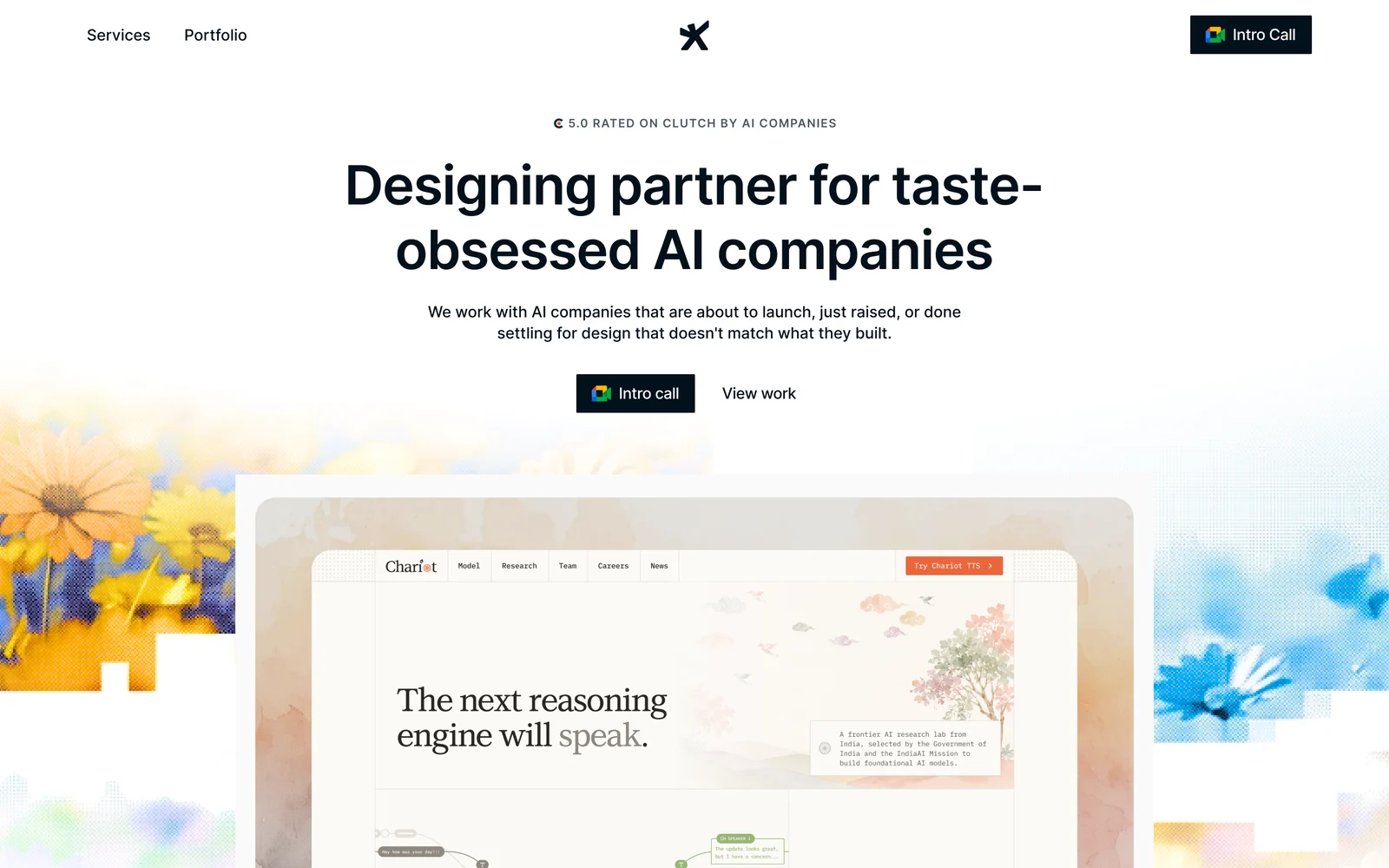
1. Studio Maydit: A Top-Rated Design Agency for AI Founders
Studio Maydit is a web and product design studio working with AI founders in the US, UK, and Europe. The platform is treated as a decision about you rather than a house preference. Framer when you will be changing pages yourself and want that to be quick, Webflow when someone you hire later will run it, custom code only when the site genuinely cannot work otherwise. After the site is live the work continues into product design.
Dualite is the published outcome, and it is a useful example for a founder who is not technical. The work began with a repositioned ICP, meaning a decision about which customers to stop addressing, and everything visual followed from that choice. The product reached 100,000+ users in seven months. The decision that mattered was one a non-technical founder is well placed to make, since it is about customers rather than code. Recent clients include Wave, PixelFlow, Mi-VAD, and 15 other AI and SaaS teams.
Two ways to buy, both quoted per project rather than described vaguely. A fixed scope of three to four weeks suits a founder with a date, and finishes with a written diagnosis of what is leaking in the product. A monthly retainer covers new pages, campaigns, and product design with no long lock-in, which is often the better fit once you know what you will actually need each month.
| Check | Finding |
|---|---|
| Based in | Remote, serving US / UK / EU |
| Platform depth | Framer, Webflow, and custom code |
| AI-sector proof | Yes. AI-native clients, published outcome on Dualite |
| Pricing | Fixed scope or monthly retainer, quoted per project |
| Team shape | Founder-led, small senior team |
| Best fit | Non-technical founders who need to run the site without help |
Worth a call if you want the platform decision explained rather than recommended. Book a 30-minute call.

2. Flow Ninja
Flow Ninja is a Belgrade studio founded in 2018 at eleven to fifty people, working in Webflow. Webflow is the friendliest outcome for a founder who is not technical, because the editing interface is designed for people who write rather than people who deploy, and a studio of that size builds consistently enough that the site will not surprise you later.
The public record is the weakness. No client names are published at all, no starting figure appears, and the AI-sector proof is partial with no case study, so you would be relying entirely on what they tell you in a call.
| Check | Finding |
|---|---|
| Based in | Belgrade, Serbia |
| Founded | 2018 |
| Team size | 11-50 |
| Primary platform | Webflow |
| AI-sector proof | Partial. No published AI case study |
| Named clients | Not published |
| Pricing | Not published |
| Best fit | Founders who want a Webflow site and will judge on the conversation |
3. Refokus
Refokus is a remote German practice founded in 2021 at eleven to fifty people, working in Webflow, and naming Mural, BASF, Spotify, Yahoo, and BCG. Working with organisations of that size means they are used to handing a site to a marketing team that will run it, and that handover discipline is exactly what a founder without a developer needs.
No starting figure is published, which removes your easiest comparison. Their AI-sector proof is partial with no AI case study, and clients of that scale usually arrive with a written brief, which you will be producing for the first time.
| Check | Finding |
|---|---|
| Based in | Germany, remote |
| Founded | 2021 |
| Team size | 11-50 |
| Primary platform | Webflow |
| AI-sector proof | Partial. Enterprise and SaaS clients, no AI case study |
| Named clients | Mural, BASF, Spotify, Yahoo, BCG |
| Pricing | Not published |
| Best fit | Founders who will hire a marketer to run the site next year |
4. Finsweet
Finsweet is a distributed practice based in Denver, founded in 2017 at fifty-one to two hundred people, in Webflow, naming Dropbox, Clay, GitHub, and Steadily. They build much of the tooling other Webflow studios depend on, which means the technical quality you cannot assess yourself is likely to be there anyway.
No starting figure is published. Their AI-sector proof is partial, and a practice of that size and standing is unlikely to give a small first site their closest attention, so ask early who will actually be on it.
| Check | Finding |
|---|---|
| Based in | Denver, USA, distributed |
| Founded | 2017 |
| Team size | 51-200 |
| Primary platform | Webflow |
| AI-sector proof | Partial. SaaS clients, no AI case study |
| Named clients | Dropbox, Clay, GitHub, Steadily |
| Pricing | Not published |
| Best fit | Founders who want the technical quality handled without oversight |
5. Push Refresh
Push Refresh is a Dallas studio of one to ten people working in Framer, publishing a starting figure and naming SmithRx, Synonym, and Northern National. A small team plus a public number plus a platform you can edit is close to the ideal arrangement for this brief, and SmithRx is a regulated product, so they have written carefully where accuracy was not optional.
No founding year is published and the team is small, so capacity is limited and the record is short. Their AI-sector proof is partial with no AI case study, which matters if your product needs someone who already understands the category.
| Check | Finding |
|---|---|
| Based in | Dallas, USA |
| Founded | Not published |
| Team size | 1-10 |
| Primary platform | Framer |
| AI-sector proof | Partial. SaaS clients, no AI case study |
| Named clients | SmithRx, Synonym, Northern National |
| Pricing | Published minimum |
| Best fit | Founders who want a small team, a clear number, and an editable site |
6. Engine Digital
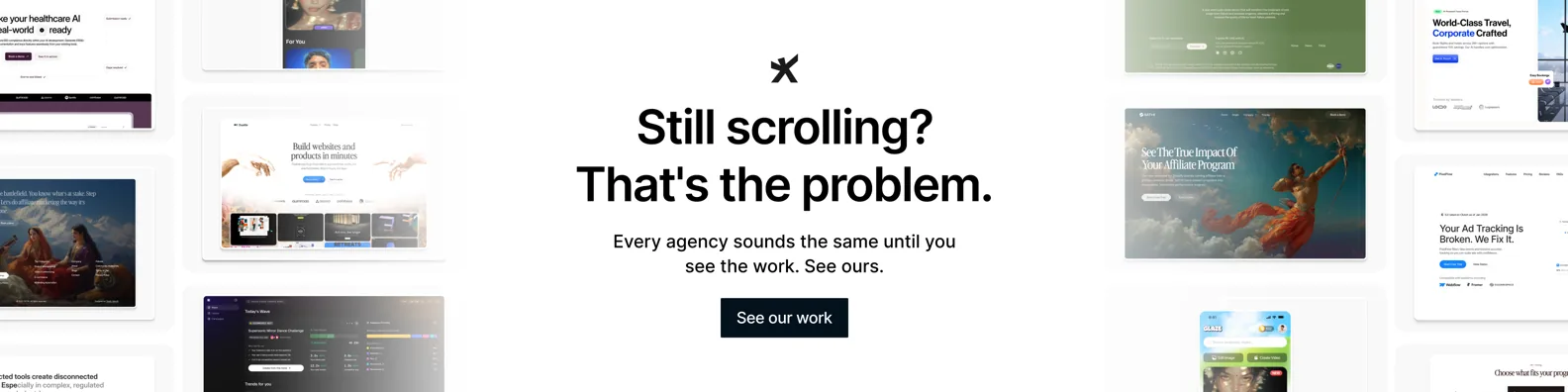
Engine Digital has worked from Vancouver and New York since 2002, in custom code, naming Adidas, Autodesk, Goldman Sachs, and HP. Two decades with clients of that size means rigour around accessibility, performance, and security that most studios never have to demonstrate.
The mismatch is direct. Custom code means every future change goes through someone technical, which is the outcome this brief exists to avoid. No team size or starting figure is published, and the AI-sector proof is partial with no case study.
| Check | Finding |
|---|---|
| Based in | Vancouver and New York |
| Founded | 2002 |
| Team size | Not published |
| Primary platform | Custom code |
| AI-sector proof | Partial. Enterprise clients, no AI case study |
| Named clients | Adidas, Autodesk, Goldman Sachs, HP |
| Pricing | Not published |
| Best fit | Companies with engineers on staff and a governance requirement |
7. Lighthouse Digital
Lighthouse Digital is a London Webflow studio publishing a starting figure and naming HelloSelf, Freetrade, and IGN. Freetrade and HelloSelf both had to explain an unfamiliar service to ordinary people, and a studio practised at that will not hide your product behind vocabulary. The published figure gives you the comparison point you most lack.
They publish no AI client work at all, which is the clearest gap for a founder in this sector. No founding year and no team size are published either, so the size and depth of the practice are unknown until you ask.
| Check | Finding |
|---|---|
| Based in | London, UK |
| Founded | Not published |
| Team size | Not published |
| Primary platform | Webflow |
| AI-sector proof | No. No published AI client work |
| Named clients | HelloSelf, Freetrade, IGN |
| Pricing | Published minimum |
| Best fit | Founders whose product needs explaining to a general audience |
8. basement.studio
basement.studio works from Mar del Plata and Los Angeles, founded in 2018 at eleven to fifty people, in custom code, publishing a starting figure and AI client work, naming Vercel, Cursor, ElevenLabs, Harvey AI, and Scale AI. If your audience is technical, that client list does credibility work no other studio here can match, and a published figure is unusually helpful.
The practice is custom code, so the site they build will need engineering time to change. For a founder without a developer that is a recurring cost with no obvious ceiling, and it is worth pricing before you commit rather than after.
| Check | Finding |
|---|---|
| Based in | Mar del Plata, Argentina and Los Angeles, USA |
| Founded | 2018 |
| Team size | 11-50 |
| Primary platform | Custom code |
| AI-sector proof | Yes. Published AI client work |
| Named clients | Vercel, Cursor, ElevenLabs, Harvey AI, Scale AI |
| Pricing | Published minimum |
| Best fit | Founders with a technical co-founder who will own the site |
9. Phantom
Phantom works from London and Auckland, founded in 2013 at fifty-one to two hundred people, in custom code, publishing AI client work and naming Diageo, SAP, Financial Times, and Zendesk. The Financial Times is a publishing operation run by people who are not developers, so the studio has built systems that non-technical teams operate at volume.
No starting figure is published, the headcount brings an account layer between you and the work, and custom code carries the same dependency problem. A founder learning to buy design will find the process opaque before it becomes useful.
| Check | Finding |
|---|---|
| Based in | London, UK and Auckland, NZ |
| Founded | 2013 |
| Team size | 51-200 |
| Primary platform | Custom code |
| AI-sector proof | Yes. Published AI client work |
| Named clients | Diageo, SAP, Financial Times, Zendesk |
| Pricing | Not published |
| Best fit | Funded companies with a team to run a large publishing system |
10. Feels Like
Feels Like is a Los Angeles studio founded in 2023 working in custom code, with published AI client work and Google, Nike, LVMH, and Suno AI named. Brand work at that level is about making people believe something quickly, which is useful if your problem is that nobody takes the company seriously yet.
The studio is young with a short public record, no team size or starting figure is published, and the custom code practice brings the dependency this brief warns about. For a founder who needs to make changes alone, that combination is the wrong one.
| Check | Finding |
|---|---|
| Based in | Los Angeles, USA |
| Founded | 2023 |
| Team size | Not published |
| Primary platform | Custom code |
| AI-sector proof | Yes. Published AI client work |
| Named clients | Google, Nike, LVMH, Suno AI |
| Pricing | Not published |
| Best fit | Founders whose priority is presence rather than self-service |
How to choose between them
Sort by what you will need to do alone, not by which portfolio you enjoyed.
You will be editing the site yourself every week. Studio Maydit or Push Refresh.
You will hire a marketer next year to run it. Refokus or Finsweet.
Your audience is technical and doubts you. basement.studio or Studio Maydit.
You need a number before you can even plan. Lighthouse Digital or Push Refresh.
One test before you sign. Ask three studios to explain, in writing and in plain language, what you personally will be able to change after handover and what will require them. A studio that suits a non-technical founder will answer with a specific list and name the things you will not be able to do. A studio that is not will answer that you can change anything, which is never true. It takes them ten minutes and it is the most predictive question you can ask.