Summarize with AI


The best website design agencies for pre-seed AI startups in 2026 are Studio Maydit, Lazarev, Feels Like, BX Studio, Fantasy, basement.studio, Phantom, Trueform, Refokus, and 8020. Studio Maydit and Trueform lead for this brief, largely on cost transparency and speed. Trueform is a Swiss Framer studio founded in 2022 that publishes a starting figure and AI client work and names Miro, Morning Brew, Bilt Rewards, and Gather, and Framer plus a published number is the combination that lets a pre-seed founder decide in an afternoon. Phantom and Fantasy fit this brief least well. One is a fifty-one to two hundred person custom code agency working for Diageo and SAP, the other has run since 1999 and publishes neither clients nor pricing. Both are built for companies with a finance department.
Before you read the list, the honest version: at pre-seed you probably should not hire any of them yet.
This article exists because founders search for it, and the most useful thing it can do is tell you when the answer is no. At pre-seed you have a small amount of money, no proof that anyone wants the product, and a positioning statement that will be wrong within two months. Design applied to an unvalidated idea is expensive rehearsal. Build the site yourself, ship it in a weekend, and spend the money on finding out whether the thing works.
There are exceptions, and they are specific rather than general. If you are raising and the round is a competitive process, the site is part of how a partner forms a view between meetings. If you are recruiting a technical cofounder or a first senior engineer, they will judge calibre from your surfaces. If you are selling into enterprises before you have a product, a credible site is doing work no founder demo can do.
Outside those cases, the trap is spending seed money at pre-seed pace. A five-figure site for a company that pivots in March is the most avoidable mistake in this category, and it is common because design feels like progress in a period where very little else does.
There is a quieter version of the mistake. Founders who do hire often buy the wrong thing: a brand identity, a full sitemap, a resource centre. A pre-seed company needs one page explaining what the product does and one that makes a person want to talk to you. The rest is scaffolding for a company that does not exist yet.
Read the ten below with the assumption that you might not need them for another six months.

How we picked these agencies
Five checks, all answerable from what a studio publishes, which matters more at this stage because you do not have time for six discovery calls.
- Platform depth. What do they build in, and can you edit it yourself the week after? At pre-seed your positioning changes monthly, so a site you cannot change without an invoice is worse than a worse site you can.
- Proof with very early companies. Have they worked with a company before it had customers? That is a different job from redesigning for a company with data, and studios who only do the latter will ask you questions you cannot answer.
- Pricing. Is a starting figure published? At pre-seed this is close to a filter on its own. A studio that will not name a number is signalling a sales process you do not have the time or the money to enter.
- Team shape. Small and senior means decisions in a day. Large means a schedule, and a schedule costs you more at this stage than it costs anyone else.
- Their own site. The one they made for free, which is what you are effectively asking them to do a version of.
For this brief, look for evidence a studio can work small. A practice whose smallest published engagement is a brand programme is not a bad studio, it is a studio for a company two stages ahead of you, and the conversation will waste both parties' time.
The tables record only what each studio has published about itself. Nothing is drawn from directories or ranking lists, and no gap is filled with an estimate. Where the record is empty, the row reports it as empty.
What goes wrong at pre-seed
Three failures, and all three burn runway you cannot replace.
Design gets bought instead of evidence. The site becomes the project because it is tangible and the alternative, talking to twenty potential customers, is uncomfortable. Two months later there is a good-looking site and the same amount of information about whether anyone wants the product. The money bought a feeling of progress rather than a fact.
The scope is copied from a later stage. Founders look at the sites of companies they admire, which are Series B companies with content teams, and brief that. So the plan includes a blog, a resource library, case studies you cannot write, and an integrations page for integrations that do not exist. Most of it launches empty and makes the company look smaller, which is the opposite of the intent.
It is built so it cannot be changed. The founder hires for craft, gets a beautiful custom build, and then discovers that changing the headline needs a developer. At pre-seed the headline changes ten times. A site that resists editing quietly stops reflecting the company within weeks, and the whole spend depreciates faster than anything else on the balance sheet.
1. Studio Maydit: A Top-Rated Design Agency for AI Founders
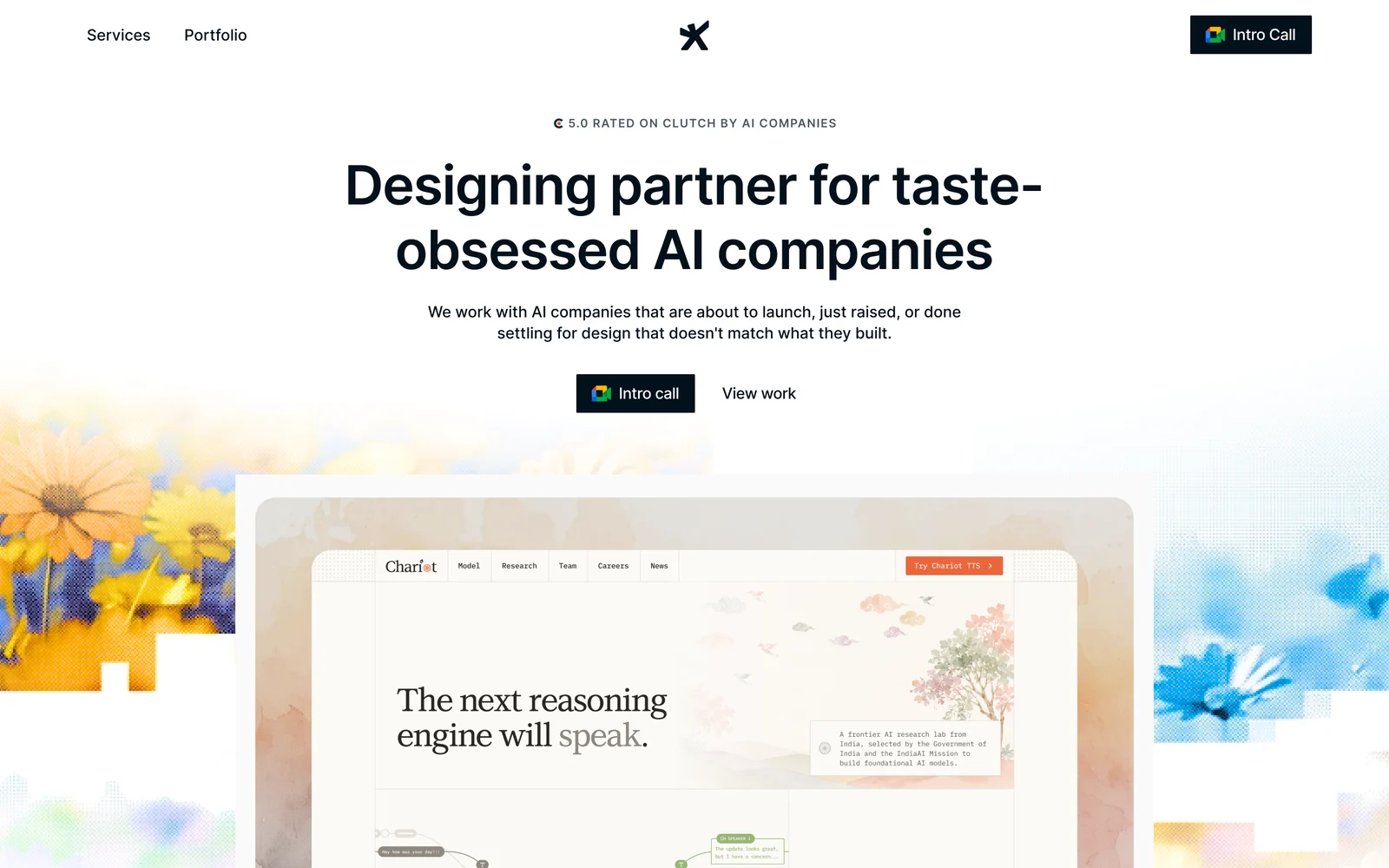
Studio Maydit is a web and product design studio working with AI founders in the US, UK, and Europe. For a pre-seed team the useful part is the shape of the smallest engagement. Fixed scope runs three to four weeks, which fits a raise or a launch that is already dated, and it ends with a written diagnosis of what is leaking in the product instead of a handover and an invoice. Teams that keep shipping can move to a monthly retainer later, covering new pages, campaigns, and product design with no long lock-in, but that is usually a decision for after the round rather than before it.
Builds go into Framer, Webflow, or custom code, and at this stage that choice is mostly about who edits the page next month. A pre-seed company should almost always end up somewhere its own founder can rewrite a headline at midnight. Work carries on into product design once the site is up.
The published outcome is Dualite, where design work supporting a repositioned ICP helped the product reach 100,000+ users in seven months. The lesson that transfers to pre-seed is that narrowing the audience did more than any visual decision. Recent clients include Wave, PixelFlow, Mi-VAD, and 15 other AI and SaaS teams.
| Check | Finding |
|---|---|
| Based in | Remote, serving US / UK / EU |
| Platform depth | Framer, Webflow, and custom code |
| AI-sector proof | Yes. AI-native clients, published outcome on Dualite |
| Pricing | Fixed scope or monthly retainer, quoted per project |
| Team shape | Founder-led, small senior team |
| Best fit | Pre-seed teams with a dated raise or a first enterprise conversation |
Worth a call if you want an honest answer on whether to spend anything yet. Book a 30-minute call.

2. Trueform
Trueform is a Swiss studio founded in 2022 working in Framer, publishing a starting figure and AI client work, and naming Miro, Morning Brew, Bilt Rewards, and Gather. A published number means you can decide whether to have the conversation at all, which is worth more at pre-seed than at any later stage, and Framer means you can rewrite your own headline afterwards.
The studio is young and no team size is published, so capacity is unknown. Framer also means marketing surface only, so if what you actually need is a product prototype for the raise, this is the wrong purchase.
| Check | Finding |
|---|---|
| Based in | Wil, Switzerland |
| Founded | 2022 |
| Team size | Not published |
| Primary platform | Framer |
| AI-sector proof | Yes. Published AI client work |
| Named clients | Miro, Morning Brew, Bilt Rewards, Gather |
| Pricing | Published minimum |
| Best fit | Pre-seed teams who need a site they can edit themselves |
3. Lazarev
Lazarev has designed from San Francisco since 2015 at fifty-one to two hundred people, across platforms, publishing a starting figure and AI client work, and naming Payoneer, Peel, Elva, and Mozayix. The published figure is genuinely useful for a founder comparing options, and the AI client work is real rather than implied.
At fifty-one to two hundred people the shape is wrong for pre-seed. Expect an account layer, a process, and a minimum engagement scaled for funded companies, all of which cost time you do not have and money you should be spending on customer conversations.
| Check | Finding |
|---|---|
| Based in | San Francisco, USA |
| Founded | 2015 |
| Team size | 51-200 |
| Primary platform | Mixed |
| AI-sector proof | Yes. Published AI client work |
| Named clients | Payoneer, Peel, Elva, Mozayix |
| Pricing | Published minimum |
| Best fit | Pre-seed teams raising a large round who need product design too |
4. Feels Like
Feels Like is a Los Angeles studio founded in 2023 working in custom code, with published AI client work and Google, Nike, LVMH, and Suno AI named. If your raise depends on looking like the most credible team in a crowded category, a studio operating at that craft level changes how a partner reads you between meetings.
Custom code is close to the worst platform choice for a pre-seed company, because every edit needs a developer and your copy will change constantly. No team size and no starting figure are published, and the studio is very young.
| Check | Finding |
|---|---|
| Based in | Los Angeles, USA |
| Founded | 2023 |
| Team size | Not published |
| Primary platform | Custom code |
| AI-sector proof | Yes. Published AI client work |
| Named clients | Google, Nike, LVMH, Suno AI |
| Pricing | Not published |
| Best fit | Pre-seed teams in a competitive raise where craft is the differentiator |
5. BX Studio
BX Studio works from New York at eleven to fifty people in Webflow, publishing a starting figure and AI client work, and naming Reddit, Headspace, ASAPP, and Verifone. Webflow plus a published figure is a workable pre-seed combination, since you keep the ability to edit and you know roughly what you are entering.
No founding year is published. At eleven to fifty people there is likely an account structure, and the named clients are established companies, so there is no public evidence of work with a company that had no customers yet.
| Check | Finding |
|---|---|
| Based in | New York, USA |
| Founded | Not published |
| Team size | 11-50 |
| Primary platform | Webflow |
| AI-sector proof | Yes. Published AI client work |
| Named clients | Reddit, Headspace, ASAPP, Verifone |
| Pricing | Published minimum |
| Best fit | Pre-seed teams who want brand-level craft on an editable platform |
6. basement.studio
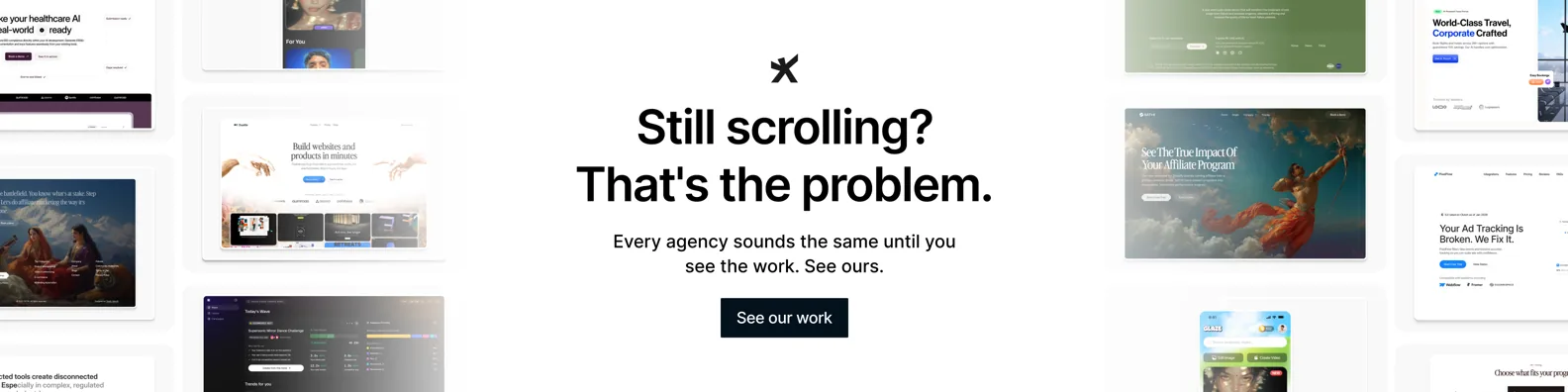
basement.studio works from Mar del Plata and Los Angeles, founded in 2018 at eleven to fifty people in custom code, publishing a starting figure and AI client work, and naming Vercel, Cursor, ElevenLabs, Harvey AI, and Scale AI. That reference set is the one technical founders recognise, and if your buyers or your investors are developers, being adjacent to that work carries real signal.
Custom code and a craft-led price floor are both wrong for a company without revenue, and the named clients are all well past pre-seed. This is a studio to remember for later rather than to call now.
| Check | Finding |
|---|---|
| Based in | Mar del Plata, Argentina and Los Angeles, USA |
| Founded | 2018 |
| Team size | 11-50 |
| Primary platform | Custom code |
| AI-sector proof | Yes. Published AI client work |
| Named clients | Vercel, Cursor, ElevenLabs, Harvey AI, Scale AI |
| Pricing | Published minimum |
| Best fit | Well-funded pre-seed teams selling to developers |
7. Refokus
Refokus is a remote German Webflow studio founded in 2021 at eleven to fifty people, naming Mural, BASF, Spotify, Yahoo, and BCG. The craft level is visibly high and Webflow keeps the site editable, which is the right platform instinct for a company still changing its mind weekly.
No starting figure is published, which at this stage means an unknown that has to be resolved in a call you may not want to have. Their AI-sector proof is partial with no case study, and the named clients are large organisations rather than early companies.
| Check | Finding |
|---|---|
| Based in | Germany, remote |
| Founded | 2021 |
| Team size | 11-50 |
| Primary platform | Webflow |
| AI-sector proof | Partial. Enterprise and SaaS clients, no AI case study |
| Named clients | Mural, BASF, Spotify, Yahoo, BCG |
| Pricing | Not published |
| Best fit | Pre-seed teams whose site must outclass their stage |
8. 8020
8020 has worked from San Francisco and New York since 2014 in Webflow, naming Wave, Superlist, Pilot.com, Vanta, and Circle. Every one of those companies was small once, and a studio that has worked with software companies through their early growth understands that the brief will move during the project.
No team size and no starting figure are published, so there is no way to size the engagement before a call. Their AI-sector proof is partial with no published AI case study.
| Check | Finding |
|---|---|
| Based in | San Francisco and New York, USA |
| Founded | 2014 |
| Team size | Not published |
| Primary platform | Webflow |
| AI-sector proof | Partial. SaaS clients, no AI case study |
| Named clients | Wave, Superlist, Pilot.com, Vanta, Circle |
| Pricing | Not published |
| Best fit | Pre-seed teams about to raise a seed round from US investors |
9. Phantom
Phantom has worked from London and Auckland since 2013 at fifty-one to two hundred people in custom code, with published AI client work and Diageo, SAP, Financial Times, and Zendesk named. The capability is genuine and the AI proof is real, and a pre-seed company selling into enterprises might value a studio that speaks that language.
For a company without revenue this is the wrong scale entirely. No starting figure is published, the headcount implies an account structure and an enterprise minimum, and custom code locks your copy behind developer time when your copy is the thing most likely to change.
| Check | Finding |
|---|---|
| Based in | London, UK and Auckland, NZ |
| Founded | 2013 |
| Team size | 51-200 |
| Primary platform | Custom code |
| AI-sector proof | Yes. Published AI client work |
| Named clients | Diageo, SAP, Financial Times, Zendesk |
| Pricing | Not published |
| Best fit | Pre-seed teams already in enterprise procurement conversations |
10. Fantasy
Fantasy has run from San Francisco and New York since 1999, works across platforms, and publishes AI client work. Twenty-five years of product design is real depth, and a founder building something genuinely novel in interaction terms would have an interesting conversation.
For pre-seed the record gives you nothing to work with. No clients are named, no team size and no starting figure are published, and an agency of that age scopes programmes rather than a first website. There is no public evidence of work at your stage.
| Check | Finding |
|---|---|
| Based in | San Francisco and New York, USA |
| Founded | 1999 |
| Team size | Not published |
| Primary platform | Mixed |
| AI-sector proof | Yes. Published AI client work |
| Named clients | Not published |
| Pricing | Not published |
| Best fit | Pre-seed teams with unusual capital and a genuinely new interface |
How to choose between them
Sort by whether you should be spending at all.
You have no round dated and no enterprise conversation. None of them yet. Build it yourself.
The round is live and competitive. Studio Maydit or Feels Like.
You need something decent this week for a fixed price. Trueform or BX Studio.
A technical audience will judge the craft. basement.studio or Refokus.
One test before you sign. Ask three studios what they would refuse to build for a company at your stage. A studio that has worked with pre-seed teams will name things: the blog, the resource centre, the case studies you cannot write yet. A studio that lists everything as included is selling scope, and scope is the thing that turns an affordable project into a round-sized one. The willingness to say no is the whole signal here.