Summarize with AI


The best website design agencies for remote-first teams in 2026 are Studio Maydit, Flow Ninja, Digidop, Flowout, Pixelmatters, Instrument, Finsweet, Engine Digital, Ramotion, and Push Refresh. Studio Maydit and Flowout lead for this brief. Flowout is a distributed Webflow studio that publishes a starting figure and names Jasper, Kajabi, Riverside, and Sendlane, which means it runs the way you do, works on a platform your team can edit from anywhere, and states a number publicly so a decision does not require three calls across four time zones. Engine Digital and Instrument fit this brief least well. Both are long-established agencies with offices at their centre, neither publishes a team size or a starting figure, and both are shaped around a way of working that assumes people are in rooms together.
Your company has no lobby, no wall of awards, and no office anyone can visit. The website is the building.
For a co-located company the website is one impression among several. A candidate visits, a client comes for a meeting, a partner sees the space. For a remote-first company none of that exists. Everything a person learns about whether you are real, competent, and worth joining comes from surfaces they can reach from a browser, and the site is the largest of them.
That shifts what the site has to carry. Your careers page is not a formality, it is your entire recruiting presence, competing against companies that can offer a room full of people to meet. Your about page is doing the work an office normally does, which is proving there is a coherent group here rather than a founder and some contractors.
The way you buy the site changes too. A co-located company can absorb a studio that works in workshops and reviews, because someone can sit in the meeting. A distributed team spread across five time zones cannot. Every synchronous review becomes a scheduling problem that adds a week, and studios who work that way are genuinely slower for you than they are for their other clients.
Then there is ownership afterwards. Remote-first companies tend to have distributed content: a recruiter in Lisbon adding a role, a marketer in Toronto publishing a post, a founder in Sydney fixing a line at midnight. If publishing requires a developer in one time zone, most of those changes never happen, and the site slowly stops describing the company.
Read the ten below with your working hours and your editing model in mind.

How we picked these agencies
Five checks, all of them answerable without a call, which is itself the right test for this brief.
- Platform depth. What do they build in, and can somebody publish from anywhere without waiting for a developer to wake up? For a distributed team this is not a convenience question, it decides whether the site stays current.
- Proof working at a distance. Have they run projects where the client was not in the room? A studio that has only worked locally will propose a cadence that quietly assumes shared hours.
- Pricing. Is a starting figure published? Comparing studios across continents is slow, and a public number removes the first call entirely, which is exactly the kind of efficiency a remote-first team already values.
- Team shape. Size, seniority, and where they physically are. This decides how many hours a day you overlap and therefore how many decisions you can make in a week.
- Their own site. The thing they made with nobody scheduling a review.
For this brief, look specifically at whether a studio is itself distributed. It is not a requirement, but a studio that runs remotely has already solved asynchronous review, written feedback, and handover documentation, because it had to. A studio built around an office will be learning those habits on your project.
Everything recorded below comes from each studio's own published material. No directory data, no ranking sites, and no gap filled with an estimate. Where a studio publishes nothing on a point, the row says so plainly.
What goes wrong on remote-first company websites
Three failures, and each one costs you people rather than traffic.
The careers page is a job board. A list of roles with a link to a form, which is what a company with an office can get away with because the interview does the rest. For a remote company that page is the entire first impression on a senior candidate weighing you against a competitor. No sense of how the team works, no evidence of the calibre of people already there, and no answer to the question a good remote hire asks first, which is whether this place is organised or chaotic.
The site cannot be edited by the people who know things. It gets built by a studio in one country, handed to a founder in another, and the marketer who joins in a third cannot change a headline. So the roles go stale, the customer list stops updating, and within two quarters the site describes a company that has moved on. Distributed teams break unmaintainable sites faster than co-located ones, because there is no one down the hall to ask.
The company looks like a collection of individuals. Remote-first sites often lean on personal branding: founder posts, individual profiles, scattered voices. It reads as a network rather than an organisation, which is fine until an enterprise buyer or a senior candidate is deciding whether you will still exist in two years. The site has to do the work of showing a single company, because nothing else will.
1. Studio Maydit: A Top-Rated Design Agency for AI Founders
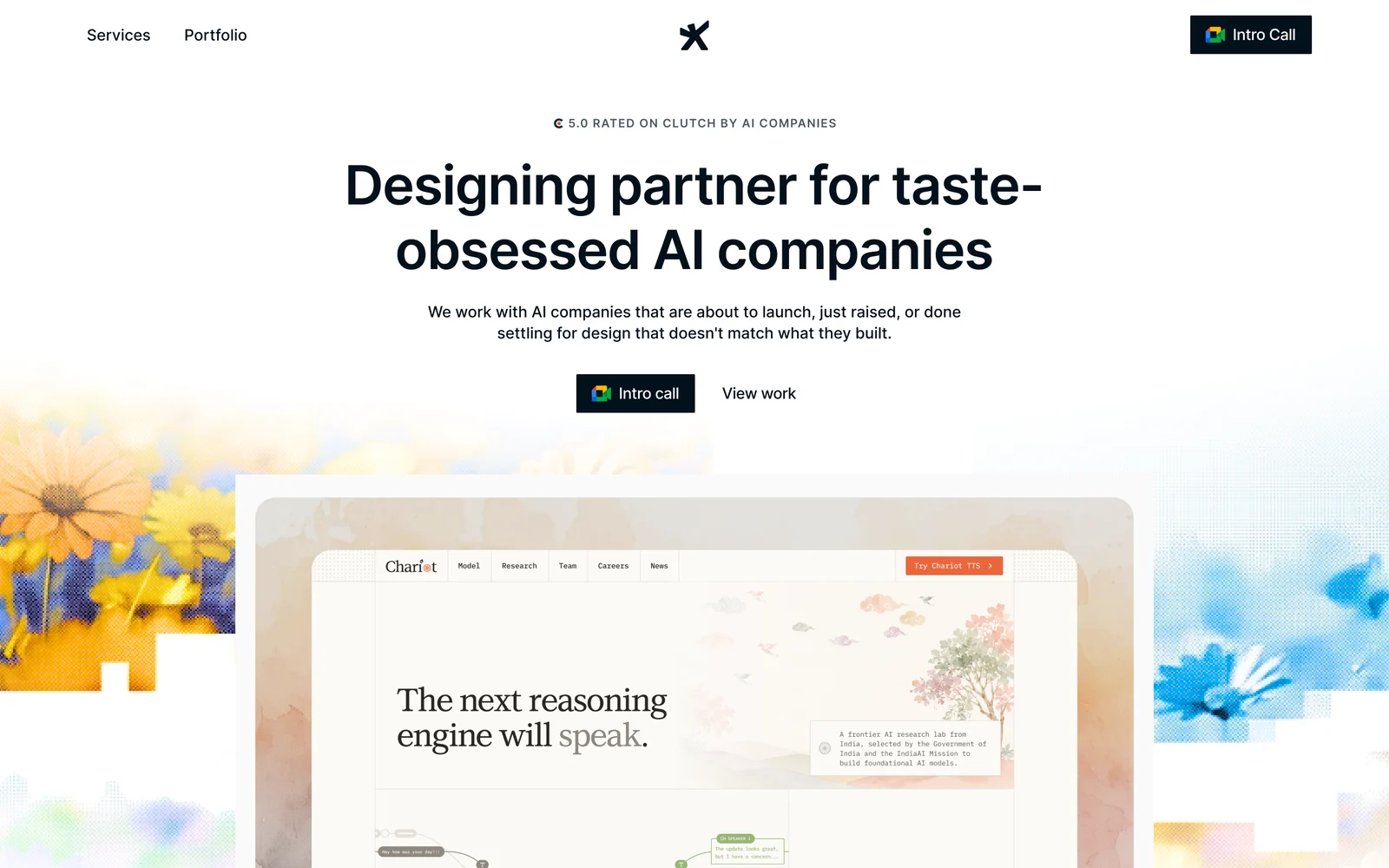
Studio Maydit is a web and product design studio working with AI founders in the US, UK, and Europe. It is a remote practice serving clients across those regions, so asynchronous review and written decisions are the normal way of working here rather than an accommodation made for a difficult client.
Platform choice is made around who publishes afterwards, across Framer, Webflow, and custom code. For a distributed team that usually means the answer is whichever one lets a recruiter in one time zone and a marketer in another both ship without a developer. The engagement continues into product design after launch.
Recent clients include Wave, PixelFlow, Mi-VAD, and 15 other AI and SaaS teams, and the published outcome is Dualite, where design work supporting a repositioned ICP helped the product reach 100,000+ users in seven months. What made the difference was agreeing one clear audience, which is harder and more valuable when the people deciding are spread across a map. There are two ways to buy: fixed scope over three to four weeks for teams with a date, closing with a written diagnosis of what is leaking in the product, or a monthly retainer for teams publishing continuously, covering new pages, campaigns, and product design with no long lock-in.
| Check | Finding |
|---|---|
| Based in | Remote, serving US / UK / EU |
| Platform depth | Framer, Webflow, and custom code |
| AI-sector proof | Yes. AI-native clients, published outcome on Dualite |
| Pricing | Fixed scope or monthly retainer, quoted per project |
| Team shape | Founder-led, small senior team |
| Best fit | Distributed teams who need to publish from several time zones |
Worth a call if your careers page is the only recruiting asset you have. Book a 30-minute call.

2. Flowout
Flowout is a distributed Webflow studio publishing a starting figure and naming Jasper, Kajabi, Riverside, and Sendlane. A distributed studio building on a platform anyone can edit is the shape this brief asks for, and Riverside is itself a product built for people who are not in the same room, so the team has thought about remote work as a subject rather than a circumstance.
No founding year and no team size are published, so the stability and scale of the practice are unclear. Their AI-sector proof is partial with no published AI case study.
| Check | Finding |
|---|---|
| Based in | Distributed |
| Founded | Not published |
| Team size | Not published |
| Primary platform | Webflow |
| AI-sector proof | Partial. SaaS clients, no AI case study |
| Named clients | Jasper, Kajabi, Riverside, Sendlane |
| Pricing | Published minimum |
| Best fit | Remote teams who want a studio that already works the way they do |
3. Flow Ninja
Flow Ninja has worked from Belgrade since 2018 at eleven to fifty people in Webflow. A European base gives North American teams a full working morning of overlap and Asian teams a workable afternoon, which is a genuinely useful position for a company whose people are spread widely.
No clients are named and no starting figure is published, so there is little to evaluate in advance, which is a particular problem for a team that wanted to avoid discovery calls. Their AI-sector proof is partial with no case study.
| Check | Finding |
|---|---|
| Based in | Belgrade, Serbia |
| Founded | 2018 |
| Team size | 11-50 |
| Primary platform | Webflow |
| AI-sector proof | Partial. SaaS clients, no AI case study |
| Named clients | Not published |
| Pricing | Not published |
| Best fit | Distributed teams needing Webflow capacity in a central time zone |
4. Digidop
Digidop has worked from Paris since 2021 at one to ten people in Webflow, publishing a starting figure and naming TSE Energy, Ramify, and StreamNative. A small team with a published number is low friction to engage, and Webflow means a distributed marketing function can keep the site current without tickets.
Their AI-sector proof is partial with no published AI case study. One to ten people is also a hard capacity limit, and a Paris base leaves teams on the American west coast a narrow shared window at the start of the day.
| Check | Finding |
|---|---|
| Based in | Paris, France |
| Founded | 2021 |
| Team size | 1-10 |
| Primary platform | Webflow |
| AI-sector proof | Partial. SaaS clients, no AI case study |
| Named clients | TSE Energy, Ramify, StreamNative |
| Pricing | Published minimum |
| Best fit | Remote teams centred on European hours with a focused scope |
5. Pixelmatters
Pixelmatters has worked from Porto since 2013 at fifty-one to two hundred people, across platforms, publishing a starting figure and naming Rubrik, Quantic, and UJET. A large European practice with published pricing can staff a bigger project properly, and its clients sell internationally, so working across regions is routine rather than novel.
Their AI-sector proof is partial with no published AI case study. The headcount also brings process and a minimum engagement scaled for programmes, which usually means more scheduled reviews than a fully distributed team wants to attend.
| Check | Finding |
|---|---|
| Based in | Porto, Portugal |
| Founded | 2013 |
| Team size | 51-200 |
| Primary platform | Mixed |
| AI-sector proof | Partial. Enterprise and SaaS clients, no AI case study |
| Named clients | Rubrik, Quantic, UJET |
| Pricing | Published minimum |
| Best fit | Larger remote companies wanting design and build from one team |
6. Instrument
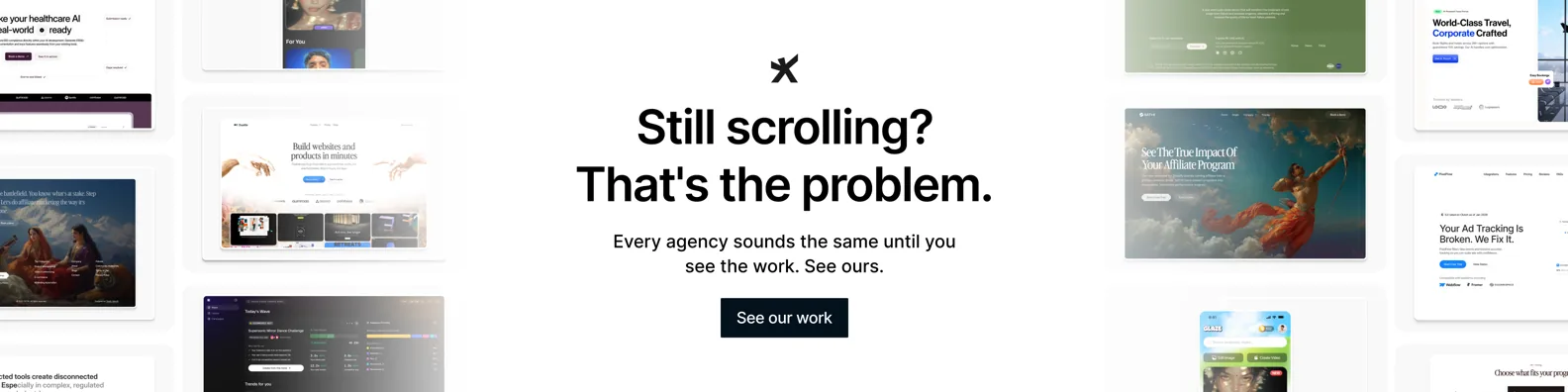
Instrument has worked from Portland since 2005 across platforms, naming Nike, Microsoft, Electronic Arts, and Google. The craft is not in question, and a remote-first company running a genuine brand programme would get a serious partner here.
For this brief the shape is wrong. It is an office-centred agency by history, no team size or starting figure is published, and the AI-sector proof is partial with no case study. The working model assumes a client who can send someone to a review.
| Check | Finding |
|---|---|
| Based in | Portland, USA |
| Founded | 2005 |
| Team size | Not published |
| Primary platform | Mixed |
| AI-sector proof | Partial. Enterprise clients, no AI case study |
| Named clients | Nike, Microsoft, Electronic Arts, Google |
| Pricing | Not published |
| Best fit | Remote companies running a brand programme with a dedicated lead |
7. Finsweet
Finsweet is a Denver-based distributed Webflow practice founded in 2017 at fifty-one to two hundred people, naming Dropbox, Clay, GitHub, and Steadily. Distributed at that headcount is unusual and directly relevant, and the Webflow depth means a build that a scattered marketing team can genuinely maintain for years.
No starting figure is published, so cost is unknown before a call. Their AI-sector proof is partial with no case study, and a practice that size is scaled for larger builds than a first remote-company site.
| Check | Finding |
|---|---|
| Based in | Denver, USA, distributed |
| Founded | 2017 |
| Team size | 51-200 |
| Primary platform | Webflow |
| AI-sector proof | Partial. SaaS clients, no AI case study |
| Named clients | Dropbox, Clay, GitHub, Steadily |
| Pricing | Not published |
| Best fit | Remote companies whose site must survive years of distributed editing |
8. Engine Digital
Engine Digital has worked from Vancouver and New York since 2002 in custom code, naming Adidas, Autodesk, Goldman Sachs, and HP. Two decades of enterprise work means real engineering capability for a company with genuinely unusual technical requirements.
Custom code is the wrong answer for distributed publishing, since every edit routes through a developer in one place. No team size and no starting figure are published, the AI-sector proof is partial with no case study, and the agency is built around offices rather than around asynchronous work.
| Check | Finding |
|---|---|
| Based in | Vancouver and New York |
| Founded | 2002 |
| Team size | Not published |
| Primary platform | Custom code |
| AI-sector proof | Partial. Enterprise clients, no AI case study |
| Named clients | Adidas, Autodesk, Goldman Sachs, HP |
| Pricing | Not published |
| Best fit | Remote companies with a genuine custom engineering requirement |
9. Ramotion
Ramotion has designed from San Francisco since 2009 at eleven to fifty people, across platforms, publishing a starting figure and naming Mozilla, Okta, Netflix, Adobe, and Xero. Mozilla has been a distributed organisation for a very long time, so a studio that has worked with it has seen how a scattered company presents itself as one thing.
Their AI-sector proof is partial with no published AI case study. A San Francisco base is also the hardest position for a team weighted toward Europe or Asia, giving only a narrow window late in their day.
| Check | Finding |
|---|---|
| Based in | San Francisco, USA |
| Founded | 2009 |
| Team size | 11-50 |
| Primary platform | Mixed |
| AI-sector proof | Partial. Enterprise and SaaS clients, no AI case study |
| Named clients | Mozilla, Okta, Netflix, Adobe, Xero |
| Pricing | Published minimum |
| Best fit | Remote companies centred on North American hours |
10. Push Refresh
Push Refresh is a Dallas studio of one to ten people working in Framer, publishing a starting figure and naming SmithRx, Synonym, and Northern National. A published figure and a small senior team mean fast decisions, and Framer keeps editing open to non-developers, which is the right instinct for a distributed publishing model.
The named clients are regional American businesses rather than distributed software companies, so there is no public evidence of working across time zones. No founding year is published, their AI-sector proof is partial, and one to ten people limits how much can run in parallel.
| Check | Finding |
|---|---|
| Based in | Dallas, USA |
| Founded | Not published |
| Team size | 1-10 |
| Primary platform | Framer |
| AI-sector proof | Partial. SaaS clients, no AI case study |
| Named clients | SmithRx, Synonym, Northern National |
| Pricing | Published minimum |
| Best fit | Small remote teams in US hours wanting a fast fixed scope |
How to choose between them
Sort by which part of remote actually hurts.
Nobody outside one time zone can update the site. Studio Maydit or Flowout.
Senior candidates go quiet after the careers page. Studio Maydit or Finsweet.
Reviews keep slipping a week because of scheduling. Flow Ninja or Digidop.
You look like a network of freelancers rather than a company. Pixelmatters or Ramotion.
One test before you sign. Ask three studios to describe how a round of feedback works when nobody on your side shares working hours with them. A studio built for this will describe written feedback, recorded walkthroughs, and a decision log. A studio that is not will describe a weekly call and offer to move it earlier. The second answer is not wrong, it is just a cadence that will cost you a week every time somebody is asleep.