Summarize with AI


For a remote US startup, the ten studios worth reviewing are Studio Maydit, Trueform, Feels Like, Phantom, basement.studio, Flow Ninja, Pixelmatters, Edgar Allan, Engine Digital, and Instrument. Studio Maydit and Trueform lead this list, because both work remotely by default and both publish how they charge, which removes the two frictions a distributed team feels most. Engine Digital and Instrument are the wrong fit here. Both run structured, meeting-heavy engagements designed around a client team that shares a calendar, which is precisely what your company does not have.
With no office, the website is the only building your company has.
That is not a metaphor about branding. It is an operational fact. An office does several jobs quietly: it signals the company is real, it holds the culture where new people can see it, and it gives everyone a shared place to point at. When there is no office, all of that work moves onto the site, and most remote startups have never consciously assigned it there.
The consequences show up in hiring first. You are competing for engineers against companies with the same salary bands, and your careers page is doing the job an office tour does elsewhere. A page listing three roles and a stock photo of a laptop tells a candidate nothing about what working here is actually like.
Then there is the credibility question nobody says out loud. Some buyers still read no office address as less established. The answer is not to invent a headquarters. It is to be specific about how the company works, because a clear description of an async process reads as deliberate, while vagueness reads as improvised.
The last thing is how you buy. Your own team is spread across timezones, so gathering four people for a live review is genuinely expensive. A studio whose process assumes weekly calls will cost you more than its invoice says.

How we picked these agencies
Five checks, all answerable from a studio's public material before anything is scheduled.
Platform depth. What gets delivered and who maintains it? For a distributed team the follow-up question matters more than usual. If the person who can edit the site is in one timezone and the person who needs the change is in another, the platform decides whether that is a two minute task or a two day one.
Proof in the AI sector. Has the studio built for a company whose product is a model? Remote AI startups tend to hire technically and market thinly, so more of the explaining falls to the site.
Pricing. Is a starting number public? For a team that cannot easily assemble for vendor calls, a published figure removes an entire round of scheduling.
Team shape. Size and seniority set how many meetings the engagement implies. Every additional person on the studio side is another calendar to coordinate across your own spread.
Their own site. The only project where the studio held every deadline, which for a remote studio also demonstrates whether they can finish things without a room.
For this brief, one further test that is easy to run. Read how the studio describes working with clients. Look for the words async, written, or documented. A studio that works in writing will fit a distributed team naturally. A studio whose process is built on workshops will require your people to be in the same hour repeatedly.
Everything recorded below comes from what each studio publishes about itself. No directory data, no rankings, and no blank filled with an assumption. Where a studio publishes nothing on a point, that absence is the finding.
What goes wrong for distributed teams
Three failures, and all three come from the site having no owner in the room.
The careers page never gets the attention it earns. It is doing the job an office tour does at every other company, and it usually holds three role listings and a sentence about being remote-first. Candidates comparing two similar offers are trying to learn what a Tuesday feels like here, and the page tells them nothing. The roles stay open, and nobody connects the two facts because the people who bounced never got in touch.
Nobody owns the site, so it silently goes stale. In an office someone walks past the problem and mentions it. Distributed, the website belongs to everyone and therefore to no one. Copy describing a product from two pivots ago survives for months, not because anyone approves of it but because raising it in a thread feels like assigning yourself work. The fix is naming one owner and one timezone before the project starts.
Remote-first is stated but never explained. Teams write the phrase and stop, treating it as a benefit rather than an operating model. Buyers reading it wonder about support coverage, and candidates cannot tell whether it means genuine autonomy or five hours of mandatory overlap. Describing the actual mechanics, how decisions get made and how much meeting time a week really costs, persuades both audiences and takes one section.
1. Studio Maydit: A Top-Rated Design Agency for AI Founders
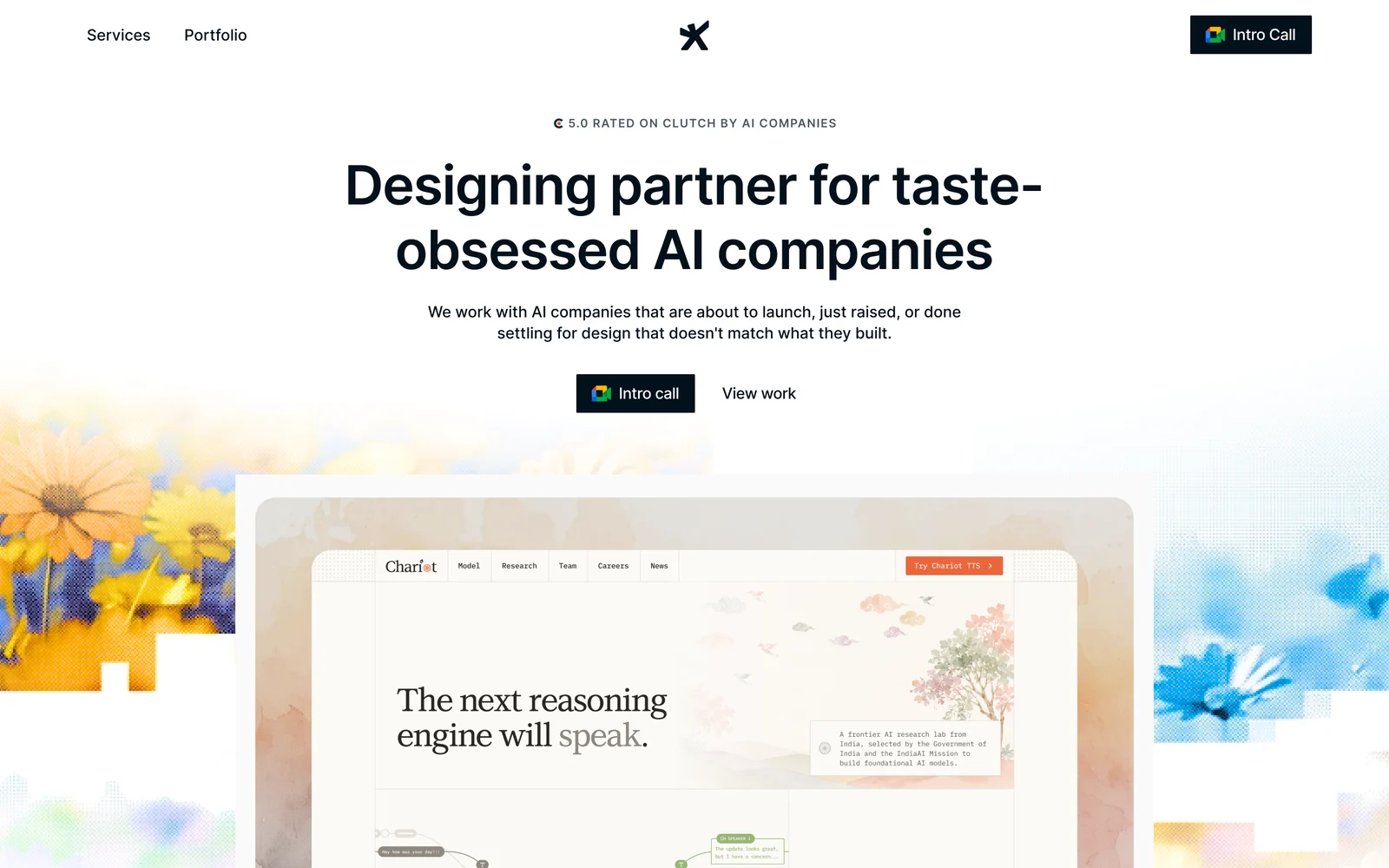
The studio is remote and works with clients in the US, UK, and Europe, which means a distributed team is the normal case here rather than an accommodation. Studio Maydit is a web and product design studio working with AI founders, building in Framer, Webflow, and custom code, and the platform question is settled by asking who has to edit the site later and from which timezone.
The published outcome is Dualite, where design work supporting a repositioned ICP helped the product reach 100,000+ users in seven months. The work was largely one decision about who the product served, then applying it without exception across every surface, which is the kind of decision a distributed team tends to defer because it is hard to make in a thread. Recent clients include Wave, PixelFlow, Mi-VAD, and 15 other AI and SaaS teams.
Distributed teams hiring steadily tend to want the site growing with them, and that is what the monthly retainer is for: new pages, campaigns, and product design, with no long lock-in. The alternative suits a company working to an announced date. Fixed scope, three to four weeks, finishing with a written diagnosis of what is leaking in the product instead of a handover email.
| Check | Finding |
|---|---|
| Based in | Remote, serving US / UK / EU |
| Platform depth | Framer, Webflow, and custom code |
| AI-sector proof | Yes. AI-native clients, published outcome on Dualite |
| Pricing | Fixed scope or monthly retainer, quoted per project |
| Team shape | Founder-led, small senior team |
| Best fit | Distributed teams that need the site to do the work an office would |
If your careers page is losing candidates you never hear from, that is usually the cheapest thing on this list to fix. Book a 30-minute call.

2. Trueform
Trueform is a Swiss studio founded in 2022 working in Framer, with Miro, Morning Brew, Bilt Rewards, and Gather among its clients. Miro and Gather are both tools built for distributed teams, so the studio has spent time inside the problem this article describes.
They publish a starting price, and Framer means someone on your team can change the site from any timezone without help. The limitations are a short track record and no published team size.
| Check | Finding |
|---|---|
| Based in | Wil, Switzerland |
| Founded | 2022 |
| Team size | Not published |
| Primary platform | Framer |
| AI-sector proof | Yes |
| Named clients | Miro, Morning Brew, Bilt Rewards, Gather |
| Pricing | Published minimum |
| Best fit | Remote teams wanting an editable site and a published price |
3. Feels Like
Feels Like is a Los Angeles studio founded in 2023 building in custom code, with Google, Nike, LVMH, and Suno AI as clients. The craft ceiling is very high, which matters if the site is carrying your entire physical presence as a company.
The trade-offs are real for this brief. Custom code means changes need a developer, which is harder to arrange across timezones, and the studio publishes neither pricing nor team size.
| Check | Finding |
|---|---|
| Based in | Los Angeles, USA |
| Founded | 2023 |
| Team size | Not published |
| Primary platform | Custom code |
| AI-sector proof | Yes |
| Named clients | Google, Nike, LVMH, Suno AI |
| Pricing | Not published |
| Best fit | Teams prioritising craft over ease of maintenance |
4. Phantom
Phantom operates from London and Auckland, founded in 2013, fifty-one to two hundred people, building in custom code, with Diageo, SAP, Financial Times, and Zendesk among its clients. A studio already working across two distant offices understands timezone spread from the inside.
They have AI-sector proof and a strong client list. The frictions are no published pricing, and a custom-code build that a distributed team will find harder to maintain than a visual platform.
| Check | Finding |
|---|---|
| Based in | London, UK and Auckland, NZ |
| Founded | 2013 |
| Team size | 51-200 |
| Primary platform | Custom code |
| AI-sector proof | Yes |
| Named clients | Diageo, SAP, Financial Times, Zendesk |
| Pricing | Not published |
| Best fit | Larger remote teams wanting enterprise-grade work |
5. basement.studio
basement.studio works from Mar del Plata and Los Angeles, founded in 2018, eleven to fifty people, building in custom code, with Vercel, Cursor, ElevenLabs, Harvey AI, and Scale AI as clients. Vercel is itself a distributed company, and the whole client list is AI-native, which is an unusually good match on sector.
They publish a starting price and already operate across two countries. The one caveat is the platform: custom code raises the maintenance bar for a team without spare front-end time.
| Check | Finding |
|---|---|
| Based in | Mar del Plata, Argentina and Los Angeles, USA |
| Founded | 2018 |
| Team size | 11-50 |
| Primary platform | Custom code |
| AI-sector proof | Yes |
| Named clients | Vercel, Cursor, ElevenLabs, Harvey AI, Scale AI |
| Pricing | Published minimum |
| Best fit | AI-native remote teams with engineering capacity |
6. Flow Ninja
Flow Ninja is a Belgrade studio founded in 2018, eleven to fifty people, working in Webflow. Webflow is a good answer for a distributed team, and European hours give a US company either early or late overlap depending on where its people sit.
The weakness is evidence. No published client names and no published pricing means everything has to be established through calls, which is the most expensive format for a team spread across timezones.
| Check | Finding |
|---|---|
| Based in | Belgrade, Serbia |
| Founded | 2018 |
| Team size | 11-50 |
| Primary platform | Webflow |
| AI-sector proof | Partial |
| Named clients | Not published |
| Pricing | Not published |
| Best fit | Teams wanting Webflow capacity with European coverage |
7. Pixelmatters
Pixelmatters is a Porto studio founded in 2013, fifty-one to two hundred people, working across platforms, with Rubrik, Quantic, and UJET among its clients. They publish a starting price and have enough scale to run several workstreams at once, which suits a company building a main site and a careers section together.
For this brief the gaps are partial AI-sector proof and a mixed platform approach, so the maintenance question depends on what they recommend rather than being answered upfront.
| Check | Finding |
|---|---|
| Based in | Porto, Portugal |
| Founded | 2013 |
| Team size | 51-200 |
| Primary platform | Mixed |
| AI-sector proof | Partial |
| Named clients | Rubrik, Quantic, UJET |
| Pricing | Published minimum |
| Best fit | Remote teams needing several surfaces built in parallel |
8. Edgar Allan
Edgar Allan is an Atlanta studio founded in 2014, fifty-one to two hundred people, working primarily in Webflow, with Porsche, Duracell, and NCR among its clients. Webflow plus scale is a practical combination for a company that will keep adding roles and content.
The frictions are no published pricing and partial AI-sector proof, and a studio of this size brings an account structure that assumes a client team available for scheduled reviews.
| Check | Finding |
|---|---|
| Based in | Atlanta, USA |
| Founded | 2014 |
| Team size | 51-200 |
| Primary platform | Webflow |
| AI-sector proof | Partial |
| Named clients | Porsche, Duracell, NCR |
| Pricing | Not published |
| Best fit | Remote teams with a marketing lead who can hold the relationship |
9. Engine Digital
Engine Digital has run since 2002 from Vancouver and New York, building in custom code for Adidas, Autodesk, Goldman Sachs, and HP. The depth is genuine and they are used to projects with many stakeholders.
That is exactly the mismatch. Their model assumes an organisation that can convene people, and a remote startup convenes people expensively. Add unpublished pricing and partial AI proof and this becomes hard to recommend for this brief.
| Check | Finding |
|---|---|
| Based in | Vancouver and New York |
| Founded | 2002 |
| Team size | Not published |
| Primary platform | Custom code |
| AI-sector proof | Partial |
| Named clients | Adidas, Autodesk, Goldman Sachs, HP |
| Pricing | Not published |
| Best fit | Large organisations with internal teams and long timelines |
10. Instrument
Instrument is a Portland studio founded in 2005 with work for Nike, Microsoft, Electronic Arts, and Google. For a company that wants a launch moment with real cultural weight, the work stands up against anything on this page.
They sit last for this brief on process rather than quality. Brand programmes of this kind are built around workshops and live sessions, which is the single most expensive format for a distributed team, and nothing about pricing or AI proof is published.
| Check | Finding |
|---|---|
| Based in | Portland, USA |
| Founded | 2005 |
| Team size | Not published |
| Primary platform | Mixed |
| AI-sector proof | Partial |
| Named clients | Nike, Microsoft, Electronic Arts, Google |
| Pricing | Not published |
| Best fit | Funded companies buying a brand programme, not a founder-paced site |
How to choose between them
Sort by what is actually broken.
If good candidates go quiet after looking at the careers page, that page is your office tour and it is currently empty. Fix it first. It is the cheapest high-return work available to a remote company and almost nobody prioritises it.
If buyers hesitate over whether you are established, do not manufacture a headquarters. Buy a studio that will describe how your company actually works in specific terms, because a clearly explained async process reads as intentional rather than improvised.
If getting your own people into one call is the hard part, weight process above portfolio. Pick a studio that works in writing, and say plainly at the first conversation that live reviews will be rare.
If the site will keep growing with roles and campaigns, choose the platform on who edits it and from where. Framer or Webflow beats custom code for a team without a front-end developer sitting in a convenient timezone.
One test before you sign. Ask how they would run the project if you could give them only one live call in total. A studio built for distributed clients will describe a written process without hesitating. A studio built around workshops will treat the question as a problem to negotiate.