
Summarize with AI


For a San Francisco AI startup, the ten studios worth reviewing are Studio Maydit, Feely Studio, Trueform, Feels Like, basement.studio, Phantom, Foundey, Engine Digital, Ramotion, and Clay. basement.studio and Trueform lead this list. basement.studio has built for Vercel, Cursor, ElevenLabs, Harvey AI, and Scale AI, which is the peer group your buyers are unconsciously comparing you to, and Trueform pairs the same sector proof with a published price and a platform your team can run. Engine Digital and Clay are the wrong fit here. Both are built for large organisations with internal design teams and long review cycles, which is not the company you are.
Here is the uncomfortable part. Your website looks like everybody else's, and everybody else is four blocks away.
There is a San Francisco AI house style and it is now so well established it functions as a template. Dark background. A gradient that moves slightly. A sans-serif you can name on sight. A headline promising to build the future of some category, and beneath it a row of logos. It looks competent. It is also completely interchangeable, and interchangeable is the one thing a differentiated company cannot afford to look.
This happens for a rational reason. The style exists because it worked for companies people admire, so copying it feels like reducing risk. In a market with twelve companies it did. In a market where every seed-stage AI company arrived at the same answer, it removes the only thing a website was supposed to do.
The second issue is that your visitors have unusually high standards and no patience. They are technical, they are local, and they have already seen the best-executed sites in the industry that week. The bar is set by companies with full in-house design teams, and you are being judged against it whether or not that is fair.
The third issue is money. Design talent here is expensive and largely absorbed by companies that can pay salaries. Studios serving this market price accordingly, and a good one is often booked out three months when you need something in four weeks.

How we picked these agencies
Five checks, all settled from public material before you contact anyone.
Platform depth. What is handed over and who can change it? San Francisco AI companies rewrite their positioning more often than almost any other category, sometimes twice a year, so a site that requires a developer for every edit becomes a bottleneck within a quarter. The platform choice is really a bet on how stable your story is.
Proof with AI companies specifically. Has the studio built for a company whose product is a model? This matters here more than the geography does. An AI company has to explain something invisible to a technical audience that will notice imprecision immediately, and studios without that experience reach for the visual conventions instead, which lands you back in the house style.
Pricing. Is a starting number public? In this market a published figure is unusual enough to be informative on its own. It also lets you find out quickly whether a studio is priced for a funded company or a seed-stage one.
Team shape. Size and seniority set how fast a project can move and how many people you have to educate about your product. Speed matters unusually much here because your positioning may change before a long engagement ends.
Their own site. The one brief with no client. For studios serving this market it is also the clearest test of whether they can resist the house style when nobody is asking them to.
One more test, specific to this brief. Open three sites the studio has built for AI companies and see whether you could tell them apart with the logos removed. If you cannot, the studio is applying a template, and you will get the same one.
The tables record what each studio publishes about itself and nothing more. Where a figure is absent it is marked absent rather than estimated, and in a market where most studios publish no prices at all, the ones that do are worth noticing.
What goes wrong for San Francisco AI startups
Three failures, and the first one is invisible from inside the city.
The site converges on the local genre and disappears into it. Every reference you gathered came from the same twenty companies, the studio you hired works mostly for that group, and the result is a competent site that could belong to any of them. The failure only becomes visible when a buyer says they cannot remember which company you were. Differentiation is a decision made before design starts, and copying the best-looking site in your category guarantees you will not have it.
Local rates get paid for work that had no local requirement. Studios in this market are priced for it, and the assumption is that proximity buys responsiveness. In practice most of these engagements run in writing and in shared documents regardless of where anyone sits, and the office visit that justified the premium happens once. Meanwhile the strongest AI-sector studios are frequently somewhere else entirely.
The rebuild lands just as the positioning moves again. Companies here iterate on what they claim far faster than they rebuild their sites, so a twelve-week project can deliver a site describing a strategy that changed in week nine. The way out is structural rather than editorial: build something your own team can rewrite, and stop treating the website as a thing that gets finished.
1. Studio Maydit: A Top-Rated Design Agency for AI Founders
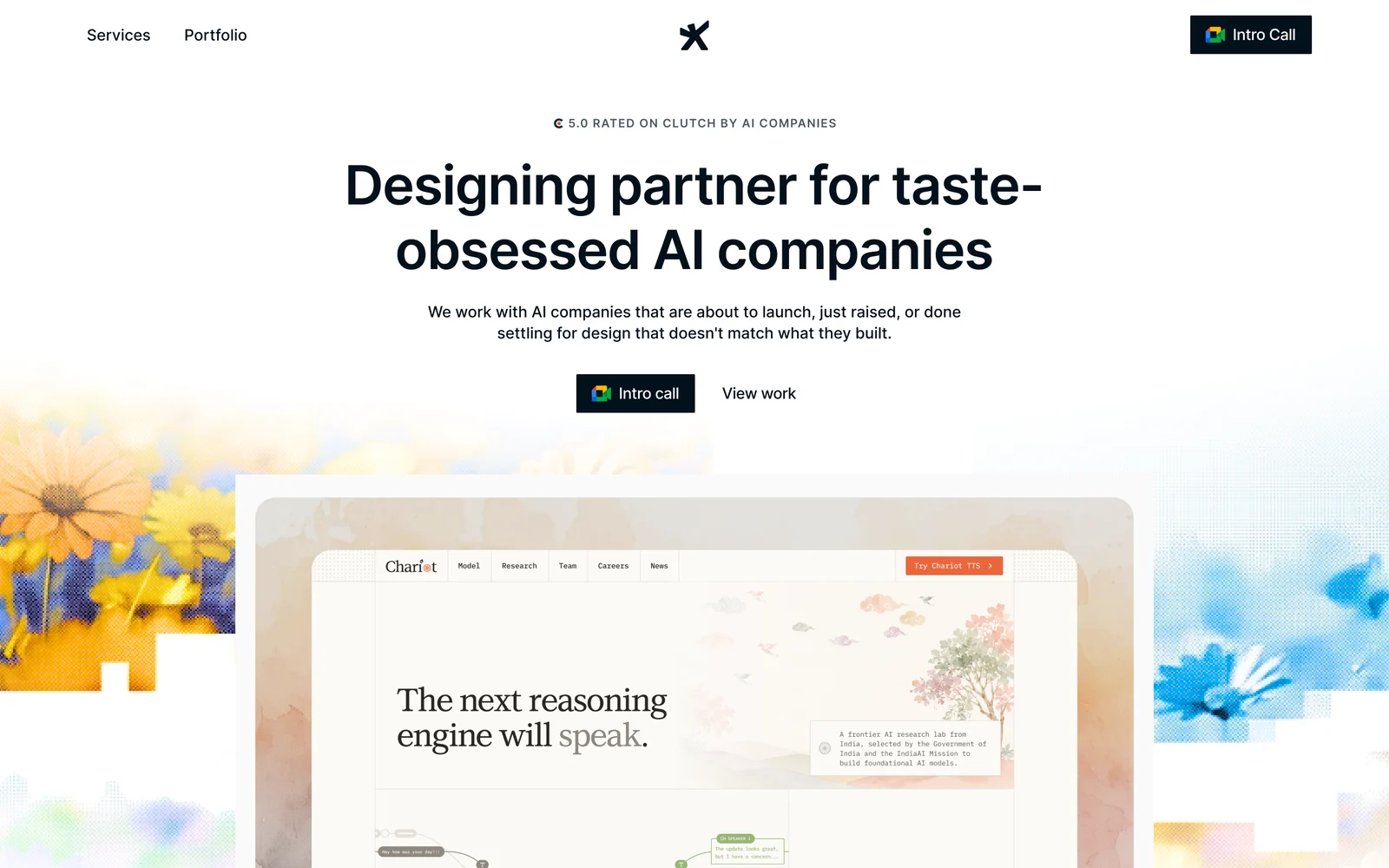
Studio Maydit is a web and product design studio. It works with AI founders, and its clients sit across the US, UK, and Europe. For a San Francisco company the relevant point is that being outside the local scene is a working advantage here, because a studio that does not spend every day inside one aesthetic is less likely to hand it back to you. Framer where the story is still moving, Webflow where a marketing team needs its own control, custom code where the product will not fit either.
The published example is Dualite, and what it demonstrates is not a visual style. A repositioned ICP came first, then design that served that one audience with no hedging, then 100,000+ users inside seven months. Founders in this city usually have the opposite instinct, wanting the site to work for enterprise buyers and developers and investors simultaneously, which is precisely how a homepage ends up sounding like every other homepage. Recent clients include Wave, PixelFlow, Mi-VAD, and 15 other AI and SaaS teams.
Two ways to buy it. Where the company changes what it says every few months, the monthly retainer is the honest fit, covering new pages, campaigns, and product design, with no long lock-in, so the site keeps up rather than falling a quarter behind. Where there is a launch date, fixed scope runs three to four weeks and ends with a written diagnosis of what is leaking in the product rather than a set of files and a farewell.
| Check | Finding |
|---|---|
| Based in | Remote, serving US / UK / EU |
| Platform depth | Framer, Webflow, and custom code |
| AI-sector proof | Yes. AI-native clients, published outcome on Dualite |
| Pricing | Fixed scope or monthly retainer, quoted per project |
| Team shape | Founder-led, small senior team |
| Best fit | SF companies that want to stop looking like their neighbours |
If a buyer cannot recall which company you were an hour later, the site is the reason. Book a 30-minute call.

2. Feely Studio
Feely Studio is a distributed European team of one to ten people with AI-sector proof, a published starting price, and Noxus, Mutiny, Luasai, and Basic Capital as clients. Being outside this market is the point here: the studio arrives without the local visual habits, which is exactly what a differentiation problem needs.
The constraints are real. A team that size has limited capacity for a large site, and no founding year is published.
| Check | Finding |
|---|---|
| Based in | Distributed, Europe |
| Founded | Not published |
| Team size | 1-10 |
| Primary platform | Mixed |
| AI-sector proof | Yes |
| Named clients | Noxus, Mutiny, Luasai, Basic Capital |
| Pricing | Published minimum |
| Best fit | Companies that want a look nobody nearby has |
3. Trueform
Trueform is a Swiss studio founded in 2022 working in Framer, with AI-sector proof, a published starting price, and Miro, Morning Brew, Bilt Rewards, and Gather as clients. Framer matters for this brief specifically: when your positioning shifts in March, your own team rewrites the site rather than joining a queue.
The reservations are a short trading history and no published team size, which is worth weighing on a larger engagement.
| Check | Finding |
|---|---|
| Based in | Wil, Switzerland |
| Founded | 2022 |
| Team size | Not published |
| Primary platform | Framer |
| AI-sector proof | Yes |
| Named clients | Miro, Morning Brew, Bilt Rewards, Gather |
| Pricing | Published minimum |
| Best fit | Companies whose story is still changing every few months |
4. Feels Like
Feels Like is a Los Angeles studio founded in 2023 building in custom code, with Google, Nike, LVMH, and Suno AI as clients. That is fashion and consumer brand work sitting next to an AI-native client, and it is the most direct route on this page to a site that does not look like software.
The costs are the usual custom-code ones. Your team files tickets instead of publishing, and neither pricing nor team size is published.
| Check | Finding |
|---|---|
| Based in | Los Angeles, USA |
| Founded | 2023 |
| Team size | Not published |
| Primary platform | Custom code |
| AI-sector proof | Yes |
| Named clients | Google, Nike, LVMH, Suno AI |
| Pricing | Not published |
| Best fit | Companies willing to trade editability for a distinctive look |
5. basement.studio
basement.studio works from Mar del Plata and Los Angeles, founded in 2018, eleven to fifty people, in custom code, with a published starting price. Vercel, Cursor, ElevenLabs, Harvey AI, and Scale AI is the client list most relevant to this article, because those are the companies your buyers hold as the standard.
The trade-off is that custom code puts a developer between your marketing team and every change, and eleven to fifty is small for a large scope.
| Check | Finding |
|---|---|
| Based in | Mar del Plata, Argentina and Los Angeles, USA |
| Founded | 2018 |
| Team size | 11-50 |
| Primary platform | Custom code |
| AI-sector proof | Yes |
| Named clients | Vercel, Cursor, ElevenLabs, Harvey AI, Scale AI |
| Pricing | Published minimum |
| Best fit | Companies that want to meet the bar their peer group set |
6. Phantom
Phantom operates from London and Auckland, founded in 2013, fifty-one to two hundred people, in custom code, with AI-sector proof and Diageo, SAP, Financial Times, and Zendesk as clients. That is enterprise-grade delivery from a studio that has also done AI work, which is a rarer combination than it sounds.
At that size the engagement is formal and paced accordingly, and no pricing is published.
| Check | Finding |
|---|---|
| Based in | London, UK and Auckland, NZ |
| Founded | 2013 |
| Team size | 51-200 |
| Primary platform | Custom code |
| AI-sector proof | Yes |
| Named clients | Diageo, SAP, Financial Times, Zendesk |
| Pricing | Not published |
| Best fit | Companies selling into enterprises with formal buying processes |
7. Foundey
Foundey is a San Francisco studio founded in 2021 working only in Figma, with DemandIQ, Traycer, and Sero AI as clients. It is local, it is AI-native, and the design-only model suits a company whose engineers would rather build the site themselves anyway.
Nothing gets built, so an implementation gap remains, and neither pricing nor team size is published.
| Check | Finding |
|---|---|
| Based in | San Francisco, USA |
| Founded | 2021 |
| Team size | Not published |
| Primary platform | Figma-only |
| AI-sector proof | Yes |
| Named clients | DemandIQ, Traycer, Sero AI |
| Pricing | Not published |
| Best fit | Local teams whose engineers will build what is designed |
8. Engine Digital
Engine Digital has run from Vancouver and New York since 2002, in custom code, with Adidas, Autodesk, Goldman Sachs, and HP as clients. Two decades and that client list mean real capability on complex, high-stakes projects.
The mismatch is the company you are. Those engagements assume marketing departments, brand guidelines, and long approval cycles, the AI-sector proof is partial, and no pricing is published.
| Check | Finding |
|---|---|
| Based in | Vancouver and New York |
| Founded | 2002 |
| Team size | Not published |
| Primary platform | Custom code |
| AI-sector proof | Partial |
| Named clients | Adidas, Autodesk, Goldman Sachs, HP |
| Pricing | Not published |
| Best fit | Large organisations with internal teams and long timelines |
9. Ramotion
Ramotion has worked from San Francisco since 2009 with eleven to fifty people and a published starting price, for Mozilla, Okta, Netflix, Adobe, and Xero. It is local, long-established, and priced openly, which is an unusual combination in this market.
The AI-sector proof is only partial, so in a category where the hard part is explaining a model to technical readers, that experience would be gained on your project.
| Check | Finding |
|---|---|
| Based in | San Francisco, USA |
| Founded | 2009 |
| Team size | 11-50 |
| Primary platform | Mixed |
| AI-sector proof | Partial |
| Named clients | Mozilla, Okta, Netflix, Adobe, Xero |
| Pricing | Published minimum |
| Best fit | Local teams wanting a long track record and an open price |
10. Clay
Clay is a San Francisco studio founded in 2016, fifty-one to two hundred people, with AI-sector proof, a published minimum, and Slack, Stripe, Google, Coinbase, and Amazon as clients. On craft it is as strong as anything here, and it is local.
It sits last on stage rather than quality. That client list implies a process built for organisations with their own design teams and the review cycles that come with them, which is a poor match for a company that needs to move in weeks.
| Check | Finding |
|---|---|
| Based in | San Francisco, USA |
| Founded | 2016 |
| Team size | 51-200 |
| Primary platform | Mixed |
| AI-sector proof | Yes |
| Named clients | Slack, Stripe, Google, Coinbase, Amazon |
| Pricing | Published minimum |
| Best fit | Later-stage companies with an internal design function |
How to choose between them
Sort by what is actually broken.
If your site is indistinguishable from your neighbours, hire someone who does not live inside the same references. Feely Studio or Feels Like, and settle what makes you different before anyone opens a design tool.
If the problem is that your peer group's sites are simply better executed, that is a craft purchase and you should buy it directly. basement.studio.
If your positioning changes every quarter, stop buying rebuilds and buy a platform your team controls. Trueform, and treat the site as something that is edited rather than finished.
If your engineers intend to build the site regardless, buy the thinking only and skip the implementation argument. Foundey.
One test before you sign. Show them three sites from your category and ask what is wrong with all of them. A studio that can differentiate you will have opinions immediately. A studio that admires all three is going to make you a fourth.