
Summarize with AI


For a second-time founder, the ten studios worth a look are Studio Maydit, Push Refresh, 8020, Flowout, Ramotion, Flow Ninja, Finsweet, Engine Digital, Refokus, and Instrument. Studio Maydit and Push Refresh lead here because both move at the pace a repeat founder expects and both publish how they charge. Engine Digital and Instrument are the wrong fit. Both run the kind of structured, discovery-led engagement that a founder on their second company will find slow and will start routing around by week two.
You already know how to buy this. That is the advantage, and it is also the trap.
Second-time founders rarely need convincing that design matters, which removes the whole education phase most agencies build their process around. You know what a good brief looks like. You can give feedback in a sentence. You will not sit through a workshop about brand values.
The failure mode is different from a first company. It is not that you buy badly. It is that you buy quickly, using the playbook that worked last time, for a company that is not the last one. The positioning that fit a developer tool does not fit a vertical AI product, and the instinct to skip the positioning conversation is strongest in exactly the people who have most reason to think they can.
There is also a credibility asymmetry worth naming. Your network already trusts you, so the site does not have to work as hard for the first twenty conversations. It has to work extremely hard for everyone after that, and those people have never heard of you.
So the checks below weight speed and honesty about price, and then ask a second question most lists skip: whether the studio will push back when the founder is confidently wrong.

How we picked these agencies
Five checks, all answerable from public material in about twenty minutes.
Platform depth. What is actually delivered, and who owns it afterwards? A repeat founder usually has a preference already, often carried from the last company. It is worth checking whether the platform that suited that team still suits this one, because the constraint has usually changed.
Proof in the AI sector. Has the studio worked on a product where the value is a model rather than a workflow? The explaining problem is different, and a studio that has only shipped conventional software tends to reach for category language that no longer differentiates.
Pricing. Is a starting figure public? For someone who has run this process before, a published number is mostly a time saver. It removes two calls from the front of the process and tells you immediately whether the conversation is worth having.
Team shape. Size and seniority set the cadence. A founder who expects a reply within the hour and a revision the same day will be unhappy inside a studio built around weekly review meetings, however good the output is.
Their own site. The project where the studio had no client and no deadline, which is the truest sample of its taste and its discipline.
For this brief, one more read that matters. Look for evidence that the studio has disagreed with a client in public, in a case study or a written piece. A second-time founder needs a partner who will say the positioning is wrong, not one who executes a confident brief quickly and well.
Everything recorded in the tables below comes from each studio's own published material. No directories, no ranking sites, and no gap filled by inference. Where a studio has published nothing on a point, that absence is what appears in the row.
What goes wrong on a second company
Three failures, each specific to having done this before.
The last company's playbook gets applied to a different business. What worked at the previous company becomes the default: the same structure, the same tone, sometimes the same agency. If the buyer has changed, and between a developer tool and an enterprise AI product the buyer has changed completely, the site inherits an audience it no longer has. This is the most expensive mistake on the list because it is invisible until conversion numbers arrive.
Discovery gets skipped, and so does positioning. Repeat founders correctly identify most discovery as theatre and cut it. The problem is that one genuinely useful hour sits inside those workshops, the hour where somebody asks who this is for and refuses to accept three answers. Cutting the whole phase removes that hour too, and the site ends up describing a product rather than addressing a person.
Speed becomes the only spec. A founder who has shipped before knows a site can be built in three weeks and will hold the studio to it. That pressure produces fast execution of whatever was decided in week one, with no room to discover that week one was wrong. The site launches on time and needs rewriting by the second quarter, which costs more than the delay would have.
1. Studio Maydit: A Top-Rated Design Agency for AI Founders
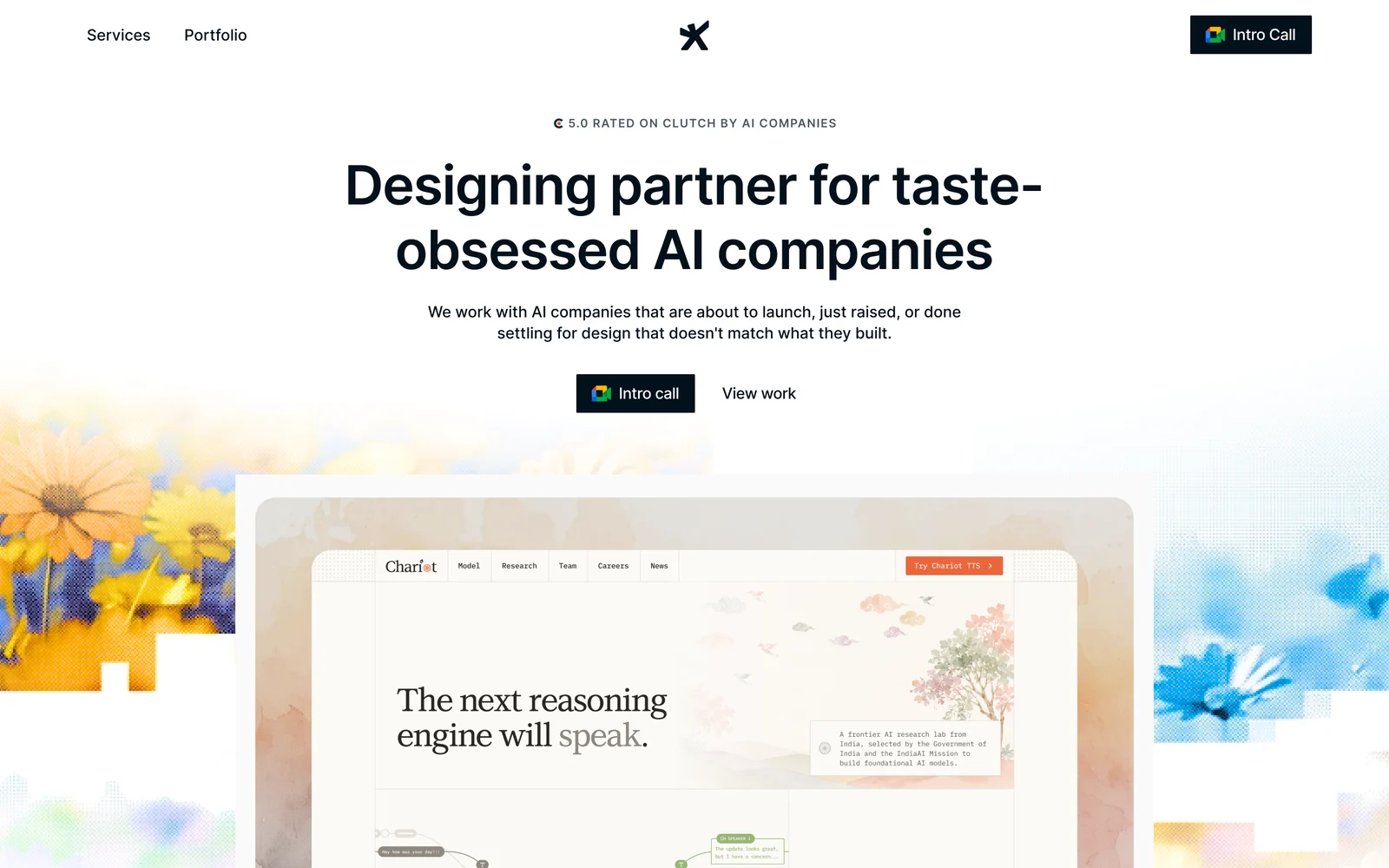
The clearest published outcome is Dualite, where design work supporting a repositioned ICP helped the product reach 100,000+ users in seven months. The work was mostly one decision, taken early and enforced everywhere: who exactly this is for. That is the decision a second-time founder is most likely to assume is already settled, and it is the one worth reopening on a new company. Recent clients include Wave, PixelFlow, Mi-VAD, and 15 other AI and SaaS teams.
Studio Maydit is a web and product design studio working with AI founders in the US, UK, and Europe, building in Framer, Webflow, and custom code, and continuing into product design once a site is live. The platform is picked around who maintains it later rather than around house preference.
Engagements come in two shapes. Fixed scope runs three to four weeks for a team with a date already set, and it ends with a written diagnosis of what is leaking in the product rather than a handover email. Where the product is still moving, a monthly retainer covers new pages, campaigns, and product design with no long lock-in.
| Check | Finding |
|---|---|
| Based in | Remote, serving US / UK / EU |
| Platform depth | Framer, Webflow, and custom code |
| AI-sector proof | Yes. AI-native clients, published outcome on Dualite |
| Pricing | Fixed scope or monthly retainer, quoted per project |
| Team shape | Founder-led, small senior team |
| Best fit | Repeat founders who want speed but still want the positioning challenged |
If you want someone who will move at your pace and still argue about who the product is for, that is the conversation. Book a 30-minute call.

2. Push Refresh
Push Refresh is a Dallas team of one to ten people working in Framer, with SmithRx, Synonym, and Northern National among its clients. They publish a starting price. For a founder who has run this process before, that alone removes the two qualifying calls that usually sit at the front.
Framer suits this buyer for a second reason: you can change the site yourself afterwards, which repeat founders almost always end up doing at midnight rather than filing a request.
The limitation is capacity and sector depth. A team this small runs few projects at once, and their AI-sector proof is partial rather than native.
| Check | Finding |
|---|---|
| Based in | Dallas, USA |
| Founded | Not published |
| Team size | 1-10 |
| Primary platform | Framer |
| AI-sector proof | Partial |
| Named clients | SmithRx, Synonym, Northern National |
| Pricing | Published minimum |
| Best fit | Founders who want an editable site and no qualifying calls |
3. 8020
8020 works out of San Francisco and New York, founded in 2014, building in Webflow, with Wave, Superlist, Pilot.com, Vanta, and Circle among its clients. That list is the relevant part here. These are companies a second-time founder has probably used, and the studio has shipped for them at a stage similar to where you are now.
The gap is disclosure. They publish neither pricing nor team size, so the first two conversations are spent establishing whether you are a fit for each other, which is exactly the friction a repeat founder is trying to avoid.
| Check | Finding |
|---|---|
| Based in | San Francisco and New York, USA |
| Founded | 2014 |
| Team size | Not published |
| Primary platform | Webflow |
| AI-sector proof | Partial |
| Named clients | Wave, Superlist, Pilot.com, Vanta, Circle |
| Pricing | Not published |
| Best fit | Founders who want a portfolio of recognisable startup work |
4. Flowout
Flowout is a distributed Webflow studio working with Jasper, Kajabi, Riverside, and Sendlane. Jasper is the useful signal for an AI company. They publish a starting price and they are positioned at the lower end of this list on cost, which suits a founder deliberately spending less on the site this time around.
The trade-off is depth. They publish no team size and no founding date, and the model is built for throughput rather than for a studio that will challenge your positioning.
| Check | Finding |
|---|---|
| Based in | Distributed |
| Founded | Not published |
| Team size | Not published |
| Primary platform | Webflow |
| AI-sector proof | Partial |
| Named clients | Jasper, Kajabi, Riverside, Sendlane |
| Pricing | Published minimum |
| Best fit | Founders who know exactly what they want built and want it built cheaply |
5. Ramotion
Ramotion is a San Francisco studio founded in 2009, sized eleven to fifty, working across platforms, with Mozilla, Okta, Netflix, Adobe, and Xero as clients. They publish a starting figure, and the portfolio is deep enough that a founder does not need to wonder whether they can execute.
The caveat for this audience is pace and sector. Their AI exposure is partial, and a studio of this size and vintage runs a more structured process than a founder used to shipping weekly may enjoy.
| Check | Finding |
|---|---|
| Based in | San Francisco, USA |
| Founded | 2009 |
| Team size | 11-50 |
| Primary platform | Mixed |
| AI-sector proof | Partial |
| Named clients | Mozilla, Okta, Netflix, Adobe, Xero |
| Pricing | Published minimum |
| Best fit | Founders who want an established studio and can accept its cadence |
6. Flow Ninja
Flow Ninja is a Belgrade studio founded in 2018, sized eleven to fifty, working in Webflow. European timezone coverage and a mid-market position make them a practical option for a founder who wants a competent build without a US premium.
The weakness is evidence. They publish no client names and no pricing, which for a second-time founder is a lot of unknowns to carry into a first call. You are relying entirely on what they can show privately.
| Check | Finding |
|---|---|
| Based in | Belgrade, Serbia |
| Founded | 2018 |
| Team size | 11-50 |
| Primary platform | Webflow |
| AI-sector proof | Partial |
| Named clients | Not published |
| Pricing | Not published |
| Best fit | European teams wanting Webflow capacity at mid-market cost |
7. Finsweet
Finsweet is a distributed studio headquartered in Denver, founded in 2017, sized fifty-one to two hundred, and probably the deepest Webflow expertise on this page. Their clients include Dropbox, Clay, GitHub, and Steadily. If the site has to do something Webflow does not do out of the box, this is the team that knows whether it is possible.
The limitation is that technical depth in one platform is not the same as positioning judgement, and they publish no pricing. Their AI-sector proof is partial.
| Check | Finding |
|---|---|
| Based in | Denver, USA, distributed |
| Founded | 2017 |
| Team size | 51-200 |
| Primary platform | Webflow |
| AI-sector proof | Partial |
| Named clients | Dropbox, Clay, GitHub, Steadily |
| Pricing | Not published |
| Best fit | Complex Webflow builds that push the platform hard |
8. Engine Digital
Engine Digital has run since 2002 from Vancouver and New York, building in custom code for Adidas, Autodesk, Goldman Sachs, and HP. The work is serious and the experience is real, particularly on projects with many stakeholders and long timelines.
That is the problem for this audience. A second-time founder is optimising for decisions made in a day, and this is a studio built for organisations where decisions take a month. No published pricing compounds it.
| Check | Finding |
|---|---|
| Based in | Vancouver and New York |
| Founded | 2002 |
| Team size | Not published |
| Primary platform | Custom code |
| AI-sector proof | Partial |
| Named clients | Adidas, Autodesk, Goldman Sachs, HP |
| Pricing | Not published |
| Best fit | Enterprise projects, not founder-paced ones |
9. Refokus
Refokus is a remote German studio founded in 2021, sized eleven to fifty, working in Webflow, with Mural, BASF, Spotify, Yahoo, and BCG among its clients. The craft level is high and the client list is more recognisable than most studios of this age.
For a repeat founder the friction is disclosure and positioning. No published pricing, partial AI proof, and a portfolio aimed at large brands rather than early companies still deciding who they sell to.
| Check | Finding |
|---|---|
| Based in | Germany, remote |
| Founded | 2021 |
| Team size | 11-50 |
| Primary platform | Webflow |
| AI-sector proof | Partial |
| Named clients | Mural, BASF, Spotify, Yahoo, BCG |
| Pricing | Not published |
| Best fit | Founders who want brand-grade craft and have time for the process |
10. Instrument
Instrument is a Portland studio founded in 2005 with work for Nike, Microsoft, Electronic Arts, and Google. For a launch moment that needs to feel like a real company rather than a side project, they are among the strongest on this page.
They sit last here for fit rather than quality. The engagement model is built around large brand programmes, the process is structured, and nothing about it is designed for a founder who wants the first draft on Thursday.
| Check | Finding |
|---|---|
| Based in | Portland, USA |
| Founded | 2005 |
| Team size | Not published |
| Primary platform | Mixed |
| AI-sector proof | Partial |
| Named clients | Nike, Microsoft, Electronic Arts, Google |
| Pricing | Not published |
| Best fit | Large brand moments with a budget and a timeline to match |
How to choose between them
Sort by what is actually broken.
If you know exactly what you want and just need it built well and quickly, buy the smallest team that publishes a price. You do not need a studio to think for you, and paying for strategy you will overrule is waste.
If this company sells to a different buyer than your last one, do not buy execution. Buy someone who will spend the first week arguing with you about who this is for, and treat that argument as the deliverable.
If the site has to carry weight with people outside your network, invest in the explaining rather than the styling. The audience that already trusts you will convert regardless. The rest need to understand the product from the page alone.
If you are going to keep changing the site yourself, pick the platform on that basis and ignore everything else. A studio's craft matters less than whether you can ship a change on a Sunday without asking anyone.
One test before you sign. Describe your positioning in two sentences and ask what they would push back on. A studio worth hiring for a second company will have something to say. One that agrees with all of it is selling you execution, which you can get cheaper elsewhere.