
Summarize with AI


For a seed-stage AI startup, the ten studios worth considering are Studio Maydit, Engine Digital, Push Refresh, Lighthouse Digital, Fantasy, Clay, basement.studio, BX Studio, Kvalifik, and Foundey. Studio Maydit and Push Refresh lead for this stage, because both publish how they charge and both work at a size where a founder talks to the person doing the design. Engine Digital and Fantasy are the wrong fit. Both are excellent and both are built for companies with procurement departments, which a seed-stage team does not have.
At seed stage your website has two jobs that pull in opposite directions.
It has to make an investor believe the company is bigger than it is, and it has to make a first customer believe the product is real enough to try. The first job rewards polish and ambition. The second rewards specifics, screenshots, and a way to start today. Most agencies are good at one and quietly ignore the other.
The harder constraint is that your product is not finished. What you sell in March may not be what you sell in June. A site built as a fixed artefact, handed over as a set of static pages, becomes wrong within a quarter and you have no one to fix it.
Money makes this sharper. A seed round has to cover engineers first, so the website budget is small and highly visible. Spending a large fraction of it on a studio that disappears after launch is a decision you get to make once.
So the checks below weight two things heavily: whether a studio publishes what it charges, and whether what they hand over can be changed by a founder at eleven at night without filing a ticket.

How we picked these agencies
Five checks, each answerable from a studio's public material before you spend an hour on a call.
Platform depth. What gets handed over, and who can edit it afterwards? At seed stage this is the check that matters most. A site your marketing hire can update is an asset. A site that needs the agency for every text change is a subscription you did not agree to.
Proof in the AI sector. Has the studio built for a company whose product is a model? Explaining an AI product to a sceptical buyer is a specific skill, and studios that have only sold established software tend to reach for the same abstractions the whole category already overuses.
Pricing. Is a number public? For a founder with a fixed and small budget, a studio that refuses to indicate price before a discovery call is spending your time to qualify you, and time is the resource you have least of.
Team shape. How many people, and how senior? Small teams tend to move faster and cost less. Large teams bring more capacity and more process. Neither is wrong, but at seed stage one of them fits your calendar and the other does not.
Their own site. The only project where the studio set its own deadline and had no client to blame.
For this brief, one extra read. Look at how a studio writes about a client whose product is genuinely hard to explain. If every case study describes the outcome as a fresh, modern brand, they have not had to do the explaining. Seed-stage AI companies need explaining more than they need freshening.
Every line in the tables comes from what the studio itself has published. Nothing is drawn from directories or ranking sites, and no gap is filled with a sensible assumption. A studio that stays quiet on a point has that silence recorded.
What goes wrong at seed stage
Three failures, and all three are budget decisions disguised as design decisions.
The site is built for the raise, then never updated for customers. Investor-facing sites reward vision language and a big claim. That copy stays up long after the round closes, so the first hundred trial users land on a page written for a different reader entirely. The result is a site that converts nobody, because it was aimed at fifteen people who have already made their decision.
The handover creates a dependency nobody priced. A studio delivers a beautiful site in a system the founder cannot touch. Every change becomes an email, then an invoice, then a delay. Six months later the team is quietly maintaining a second product they never wanted to own, and the site drifts out of date because updating it has friction.
Nobody designs the empty state of the company. At seed you have no logos, no case studies, and no usage numbers worth printing. Most site templates assume you have all three, so the page ships with a hollow social proof band and a testimonial section holding one quote. That absence reads as failure. Designed well, the same absence reads as early, which is honest and much more persuasive.
1. Studio Maydit: A Top-Rated Design Agency for AI Founders
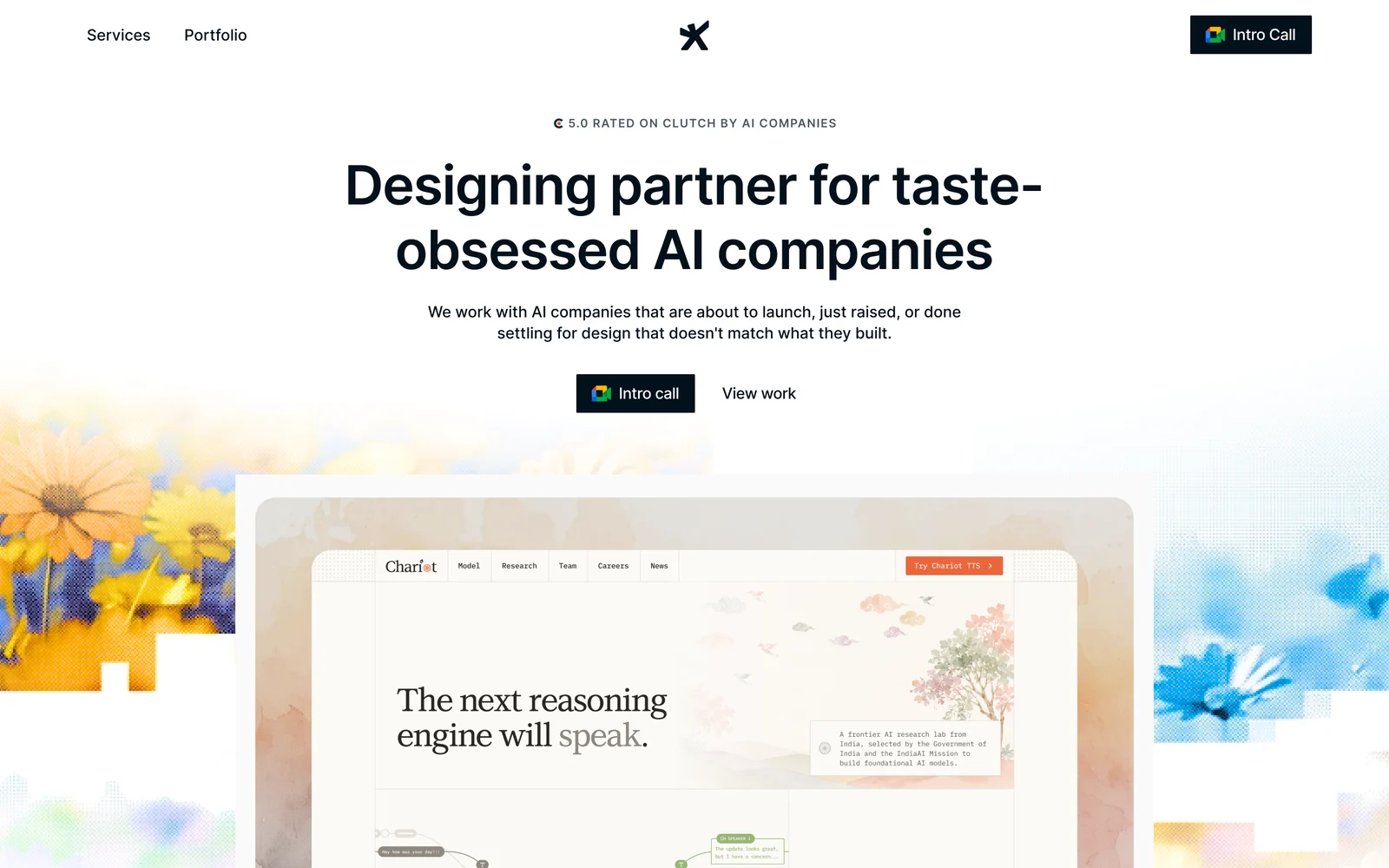
Two ways to buy, and at seed stage the difference decides everything. Fixed scope runs three to four weeks, which suits a team with a raise announcement or a launch already in the diary, and it finishes with a written diagnosis of what is leaking in the product rather than a handover email. Teams whose product is still moving take a monthly retainer covering new pages, campaigns, and product design, with no long lock-in.
Studio Maydit is a web and product design studio, working with AI founders in the US, UK, and Europe. Sites get built in Framer, Webflow, or custom code, and the platform is chosen around who has to edit the thing after launch, which for a seed-stage team is usually the founder or a first marketing hire.
The published outcome is Dualite, where design work supporting a repositioned ICP helped the product reach 100,000+ users in seven months. That project was mostly a decision about who the product was for, taken early and applied to every page, which is the same decision a seed-stage company is usually avoiding. Recent clients include Wave, PixelFlow, Mi-VAD, and 15 other AI and SaaS teams.
| Check | Finding |
|---|---|
| Based in | Remote, serving US / UK / EU |
| Platform depth | Framer, Webflow, and custom code |
| AI-sector proof | Yes. AI-native clients, published outcome on Dualite |
| Pricing | Fixed scope or monthly retainer, quoted per project |
| Team shape | Founder-led, small senior team |
| Best fit | Seed-stage teams that need one site to work for investors and first customers |
If your site has to do the raise and the first hundred signups at the same time, that tension is worth an honest conversation. Book a 30-minute call.

2. Engine Digital
Engine Digital has been running since 2002 out of Vancouver and New York, building in custom code for Adidas, Autodesk, Goldman Sachs, and HP. That client list tells you what they are good at. Complex organisations, long timelines, and sites that have to satisfy many stakeholders at once.
For a seed-stage AI company they are the wrong shape. They publish no pricing, their AI-sector exposure is partial, and a custom-code build is a poor match for a product whose positioning may change twice before the site is a year old.
| Check | Finding |
|---|---|
| Based in | Vancouver and New York |
| Founded | 2002 |
| Team size | Not published |
| Primary platform | Custom code |
| AI-sector proof | Partial |
| Named clients | Adidas, Autodesk, Goldman Sachs, HP |
| Pricing | Not published |
| Best fit | Later-stage companies with procurement and a long horizon |
3. Push Refresh
Push Refresh is a team of one to ten people in Dallas, working in Framer, with SmithRx, Synonym, and Northern National among its clients. They publish a starting price, which at this size and stage is the most useful thing a studio can do for a founder deciding where a small budget goes.
Framer is also the right platform argument here, because the founder can edit the site afterwards without help. The limitation is capacity and sector proof. Their AI exposure is partial, and a team this size runs few projects at once, so timing may not line up with a launch date.
| Check | Finding |
|---|---|
| Based in | Dallas, USA |
| Founded | Not published |
| Team size | 1-10 |
| Primary platform | Framer |
| AI-sector proof | Partial |
| Named clients | SmithRx, Synonym, Northern National |
| Pricing | Published minimum |
| Best fit | Seed teams that want an editable site and a clear price |
4. Lighthouse Digital
Lighthouse Digital is a London studio working in Webflow, with HelloSelf, Freetrade, and IGN among its clients. They publish a starting figure, and Webflow means the site stays editable by a non-technical team member after launch.
The clear gap is sector. Their published AI-sector proof is none, so the work of explaining a model-driven product to a sceptical buyer would be new ground on your project rather than something they have already solved elsewhere.
| Check | Finding |
|---|---|
| Based in | London, UK |
| Founded | Not published |
| Team size | Not published |
| Primary platform | Webflow |
| AI-sector proof | No |
| Named clients | HelloSelf, Freetrade, IGN |
| Pricing | Published minimum |
| Best fit | UK teams wanting a clean Webflow build with a known price |
5. Fantasy
Fantasy has operated since 1999 across San Francisco and New York, and works across platforms with genuine AI-sector experience. For a company that wants its site to feel like it came from an established software business rather than a startup, that depth is real.
At seed stage the objection is practical. No published pricing and no published client list means a long qualifying process before you learn whether you can afford them, and their natural clients are considerably further along than you are.
| Check | Finding |
|---|---|
| Based in | San Francisco and New York, USA |
| Founded | 1999 |
| Team size | Not published |
| Primary platform | Mixed |
| AI-sector proof | Yes |
| Named clients | Not published |
| Pricing | Not published |
| Best fit | Funded companies past the stage where budget is the constraint |
6. Clay
Clay is a San Francisco studio founded in 2016, sized between fifty-one and two hundred, with Slack, Stripe, Google, Coinbase, and Amazon among its clients. They have real AI-sector work and they publish a starting price, which is unusual for a studio of this reputation and saves a founder an awkward first call.
The honest caveat is fit rather than quality. Their published minimum is set for companies well past seed, and a team of this size brings a process that a four-person startup will find heavy.
| Check | Finding |
|---|---|
| Based in | San Francisco, USA |
| Founded | 2016 |
| Team size | 51-200 |
| Primary platform | Mixed |
| AI-sector proof | Yes |
| Named clients | Slack, Stripe, Google, Coinbase, Amazon |
| Pricing | Published minimum |
| Best fit | Companies that have raised enough to buy a recognised name |
7. basement.studio
basement.studio works from Mar del Plata and Los Angeles, founded in 2018, sized eleven to fifty, building in custom code. Their client list is the most relevant on this page for an AI company: Vercel, Cursor, ElevenLabs, Harvey AI, and Scale AI. These are companies whose product is a model or a developer tool, and the studio has had to explain each of them.
They also publish a starting price. The trade-off is the platform. Custom code produces excellent results and leaves you needing a developer for changes, which is a real cost for a team with no spare engineering time.
| Check | Finding |
|---|---|
| Based in | Mar del Plata, Argentina and Los Angeles, USA |
| Founded | 2018 |
| Team size | 11-50 |
| Primary platform | Custom code |
| AI-sector proof | Yes |
| Named clients | Vercel, Cursor, ElevenLabs, Harvey AI, Scale AI |
| Pricing | Published minimum |
| Best fit | AI teams with engineering capacity who want a high craft bar |
8. BX Studio
BX Studio is a New York team of eleven to fifty people working in Webflow, with Reddit, Headspace, ASAPP, and Verifone among its clients. ASAPP is the useful signal, since it is an AI company, and the studio publishes a starting price.
Webflow keeps the site editable after launch, which suits this stage. The weakness is that the studio does not publish a founding date, and their portfolio leans toward companies with more established brands than a seed-stage startup will have.
| Check | Finding |
|---|---|
| Based in | New York, USA |
| Founded | Not published |
| Team size | 11-50 |
| Primary platform | Webflow |
| AI-sector proof | Yes |
| Named clients | Reddit, Headspace, ASAPP, Verifone |
| Pricing | Published minimum |
| Best fit | US teams that want Webflow and a recognisable portfolio |
9. Kvalifik
Kvalifik is a Copenhagen studio founded in 2015, eleven to fifty people, working in Webflow, with Veo, Maersk, and Relesys among its clients. They have AI-sector proof and they sit in a European timezone, which matters for a European seed-stage team that wants overlap rather than overnight replies.
The limitation is transparency. They publish no pricing, so the first call is a qualification exercise, and their client list skews toward larger Nordic companies rather than early startups.
| Check | Finding |
|---|---|
| Based in | Copenhagen, Denmark |
| Founded | 2015 |
| Team size | 11-50 |
| Primary platform | Webflow |
| AI-sector proof | Yes |
| Named clients | Veo, Maersk, Relesys |
| Pricing | Not published |
| Best fit | European teams wanting a Webflow build in a nearby timezone |
10. Foundey
Foundey is a San Francisco studio founded in 2021 working with AI companies including DemandIQ, Traycer, and Sero AI. The client list is the closest match on this page to a seed-stage AI startup, and that familiarity shortens a lot of explaining.
The reason they sit last for this brief is scope. Foundey works in Figma and hands over design files, so a seed-stage team without a front-end developer still has to find someone to build and host the site, which is a second cost and a second vendor.
| Check | Finding |
|---|---|
| Based in | San Francisco, USA |
| Founded | 2021 |
| Team size | Not published |
| Primary platform | Figma-only |
| AI-sector proof | Yes |
| Named clients | DemandIQ, Traycer, Sero AI |
| Pricing | Not published |
| Best fit | Teams with a developer who need design rather than a build |
How to choose between them
Sort by what is actually broken.
If you have a round closing and nothing to point investors at, buy speed and buy it fixed scope. A three to four week build from a small team beats a twelve week engagement that lands after the moment has passed.
If the site exists but nobody converts, the problem is that it was written for investors. That is a copy and structure problem more than a visual one, and it is cheap to fix if you buy someone who will rewrite rather than redecorate.
If you are changing the product every few weeks, do not buy a fixed project. Buy ongoing capacity, or buy a build on a platform you can edit yourself, because anything else will be out of date before the invoice clears.
If you have engineers with spare time, buy design only and have them build it. That is the cheapest route on this page, and Foundey exists for exactly that shape.
One test before you sign. Ask each studio what they would put on the page given that you have no customer logos and no usage numbers. A studio that understands early companies will have a specific answer about showing the product itself. A studio that does not will tell you to get some testimonials first.