
Summarize with AI


For a Series A AI startup, the ten studios worth shortlisting are Studio Maydit, Edgar Allan, Flow Ninja, Push Refresh, Digidop, Engine Digital, Flowout, Lighthouse Digital, Fantasy, and SuperSkills. Studio Maydit and Edgar Allan lead this list, because both can hand over a site a marketing team actually operates rather than one they have to request changes to. SuperSkills and Lighthouse Digital are the wrong fit here. SuperSkills publishes almost nothing verifiable, and Lighthouse Digital publishes no AI-sector work at all.
At Series A the website changes job description. It stops being a brochure and becomes something a team operates daily.
At seed, one person owned the site and changed it rarely. Now you have a marketing hire, or you are about to. They need to launch a campaign page on Tuesday, publish three customer stories in a month, and run a webinar landing page without booking developer time. A beautiful site that requires an agency for every change becomes a bottleneck the moment you hire the person whose job is to change it.
The second shift is that you finally have proof and are probably not using it. Seed sites hide behind vision language because there is nothing else. By Series A there are real customers, real usage numbers, and real outcomes, and a surprising number of teams are still running the copy they wrote eighteen months ago when they had none of it.
Third, you are hiring. The site becomes a recruiting surface competing against every other funded AI company for the same engineers, and most Series A sites have a careers page that was added in an afternoon.
There is also a positioning problem specific to this stage. You have probably found two segments that buy, and the site now tries to speak to both. It does neither well, and nobody wants to make the call.

How we picked these agencies
Five checks, all answerable from public material before you spend time on a call.
Platform depth. What is handed over and who can operate it? This is the decisive check at Series A. The site needs a content model that supports case studies, campaign pages, and a blog without a developer, and that is a structural decision made during the build rather than after it.
Proof in the AI sector. Has the studio built for a company whose product is a model? At this stage you are moving from early adopters to a more sceptical buyer, and the explaining gets harder rather than easier.
Pricing. Is a starting number public? A Series A team has budget and also has a board asking what things cost. A studio that publishes makes the internal conversation shorter.
Team shape. Size and seniority set both cadence and capacity. At this stage you often need several things at once, a main site plus campaign pages plus a careers section, and a very small studio may not be able to run them in parallel.
Their own site. The one project the studio controlled entirely, which shows what they do when nobody is setting the brief.
For this brief, look for one more thing. Find evidence the studio has built a content structure someone else maintained afterwards. Case study templates, a resource library, a campaign page system. That is a different skill from designing a homepage, and it is the skill your marketing hire will depend on.
Every line in the tables comes from each studio's own published material. Nothing is taken from directories or rankings, and no gap is filled with a reasonable inference. Where a studio publishes nothing on a point, that silence is the recorded finding.
What goes wrong at Series A
Three failures, and each one shows up about a quarter after the round closes.
The site cannot be operated by the person hired to operate it. A studio delivers a strong custom build, then the new marketing lead discovers that adding a case study means an engineering ticket. Within two months they are running campaigns on landing page tools bolted to the side, the brand fragments across three systems, and the expensive site becomes the least-updated surface the company owns.
The proof is still hidden. The company now has numbers, named customers, and outcomes worth printing, but the homepage still opens with a broad claim about transforming an industry. Buyers who would convert on specifics get vision language instead, and the team concludes the market is slow when the page is simply out of date.
Two segments get served by one page. After a Series A most teams can name two groups who buy for different reasons. Rather than choosing, the site addresses both at once, so every section hedges. The result reads as generic to each audience separately, and the fix is a decision nobody wants to make rather than a design problem.
1. Studio Maydit: A Top-Rated Design Agency for AI Founders
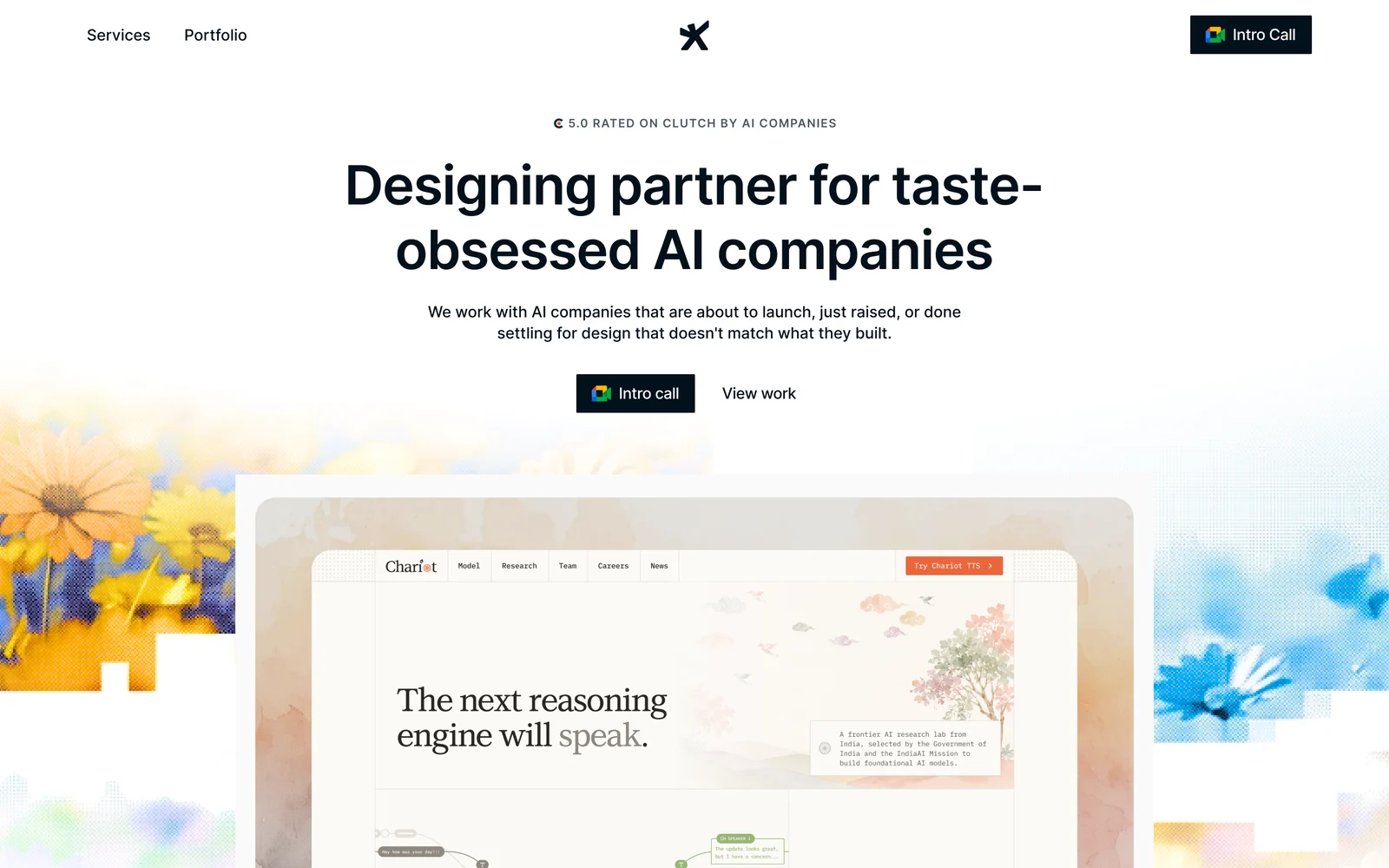
Platform choice gets made around who operates the site afterwards, which at Series A means the marketing hire rather than the founder. Builds happen in Framer, Webflow, and custom code, and the deciding question is always which of those that person can run without help. Studio Maydit is a web and product design studio working with AI founders in the US, UK, and Europe, and the work continues into product design once the site is live.
The published outcome is Dualite, where design work supporting a repositioned ICP helped the product reach 100,000+ users in seven months. The core move was choosing one audience and refusing to hedge, which is exactly the decision a Series A team is usually avoiding when it tries to serve two segments from one homepage. Recent clients include Wave, PixelFlow, Mi-VAD, and 15 other AI and SaaS teams.
Where a launch or a campaign has a fixed date, fixed scope runs three to four weeks and finishes with a written diagnosis of what is leaking in the product rather than a handover email. Teams building a steady content and campaign operation usually prefer a monthly retainer, which covers new pages, campaigns, and product design and carries no long lock-in.
| Check | Finding |
|---|---|
| Based in | Remote, serving US / UK / EU |
| Platform depth | Framer, Webflow, and custom code |
| AI-sector proof | Yes. AI-native clients, published outcome on Dualite |
| Pricing | Fixed scope or monthly retainer, quoted per project |
| Team shape | Founder-led, small senior team |
| Best fit | Series A teams whose marketing hire needs to run the site themselves |
If your first marketing hire is already working around the website, that is worth fixing before the next campaign. Book a 30-minute call.

2. Edgar Allan
Edgar Allan is an Atlanta studio founded in 2014, fifty-one to two hundred people, working primarily in Webflow, with Porsche, Duracell, and NCR among its clients. The scale matters at this stage, because a Series A team often needs the main site, a campaign system, and a careers section running in parallel rather than in sequence.
Webflow also answers the operability question directly. The weaknesses are that they publish no pricing and their AI-sector proof is partial, so the explaining work would be newer ground for them than the building work.
| Check | Finding |
|---|---|
| Based in | Atlanta, USA |
| Founded | 2014 |
| Team size | 51-200 |
| Primary platform | Webflow |
| AI-sector proof | Partial |
| Named clients | Porsche, Duracell, NCR |
| Pricing | Not published |
| Best fit | Teams needing several surfaces built at once on an operable platform |
3. Flow Ninja
Flow Ninja is a Belgrade studio founded in 2018, eleven to fifty people, working in Webflow. The size is a good match for Series A work, large enough to run parallel workstreams and small enough to stay responsive, and European coverage helps teams with staff in both regions.
The weakness is evidence. They publish neither client names nor pricing, so almost nothing can be checked before the first call, which is a lot of uncertainty for a company that now has a board asking about vendor choices.
| Check | Finding |
|---|---|
| Based in | Belgrade, Serbia |
| Founded | 2018 |
| Team size | 11-50 |
| Primary platform | Webflow |
| AI-sector proof | Partial |
| Named clients | Not published |
| Pricing | Not published |
| Best fit | Teams comfortable evaluating on a private portfolio review |
4. Push Refresh
Push Refresh is a Dallas team of one to ten working in Framer, with SmithRx, Synonym, and Northern National as clients. They publish a starting price, and Framer means your marketing hire can add pages and edit copy without asking anyone.
The constraint at Series A is capacity. A team this size runs few projects at once, so if you need a main site and a campaign system and a careers page inside one quarter, this is likely to become sequential rather than parallel.
| Check | Finding |
|---|---|
| Based in | Dallas, USA |
| Founded | Not published |
| Team size | 1-10 |
| Primary platform | Framer |
| AI-sector proof | Partial |
| Named clients | SmithRx, Synonym, Northern National |
| Pricing | Published minimum |
| Best fit | A focused main site rebuild with a clear published price |
5. Digidop
Digidop is a Paris studio founded in 2021, one to ten people, working in Webflow, with TSE Energy, Ramify, and StreamNative among its clients. StreamNative is developer infrastructure, which is useful evidence that they can handle a technical product without flattening it.
They publish a starting price and cover European hours. The limitations are capacity, given the team size, and partial AI-sector proof.
| Check | Finding |
|---|---|
| Based in | Paris, France |
| Founded | 2021 |
| Team size | 1-10 |
| Primary platform | Webflow |
| AI-sector proof | Partial |
| Named clients | TSE Energy, Ramify, StreamNative |
| Pricing | Published minimum |
| Best fit | European teams wanting Webflow and a published starting figure |
6. Engine Digital
Engine Digital has operated since 2002 from Vancouver and New York, building in custom code for Adidas, Autodesk, Goldman Sachs, and HP. If your Series A site has genuine technical requirements, such as deep product integration or unusual data handling, this is the kind of studio that has done it before.
For most Series A teams the fit is wrong. Custom code fights the operability requirement, they publish no pricing, and their AI-sector proof is partial.
| Check | Finding |
|---|---|
| Based in | Vancouver and New York |
| Founded | 2002 |
| Team size | Not published |
| Primary platform | Custom code |
| AI-sector proof | Partial |
| Named clients | Adidas, Autodesk, Goldman Sachs, HP |
| Pricing | Not published |
| Best fit | Sites with real engineering requirements rather than content requirements |
7. Flowout
Flowout is a distributed Webflow studio working with Jasper, Kajabi, Riverside, and Sendlane. Jasper is the relevant reference for an AI company, and they publish a starting price at the lower end of this page.
For a Series A team the honest read is that this is a production service rather than a strategic partner. If you already know what you want built, that is efficient. If the underlying problem is that you are addressing two segments at once, this model will build both versions rather than help you choose.
| Check | Finding |
|---|---|
| Based in | Distributed |
| Founded | Not published |
| Team size | Not published |
| Primary platform | Webflow |
| AI-sector proof | Partial |
| Named clients | Jasper, Kajabi, Riverside, Sendlane |
| Pricing | Published minimum |
| Best fit | Teams with a settled brief who want efficient execution |
8. Lighthouse Digital
Lighthouse Digital is a London Webflow studio with HelloSelf, Freetrade, and IGN among its clients. They publish a starting figure and Webflow suits the operability requirement well.
The gap for this brief is sector. Their published AI-sector proof is none, and at Series A the hardest part of the site is usually explaining an AI product to a buyer who is more sceptical than your early adopters were.
| Check | Finding |
|---|---|
| Based in | London, UK |
| Founded | Not published |
| Team size | Not published |
| Primary platform | Webflow |
| AI-sector proof | No |
| Named clients | HelloSelf, Freetrade, IGN |
| Pricing | Published minimum |
| Best fit | UK teams whose positioning is already settled and only need a build |
9. Fantasy
Fantasy has run since 1999 from San Francisco and New York, works across platforms, and has genuine AI-sector experience. For a Series A company that wants its site to signal a larger, more established business, that depth is real and rare.
The friction is that nothing is published. No clients, no pricing, no team size. For a team that now has to justify vendor choices internally, that is a slow and awkward evaluation.
| Check | Finding |
|---|---|
| Based in | San Francisco and New York, USA |
| Founded | 1999 |
| Team size | Not published |
| Primary platform | Mixed |
| AI-sector proof | Yes |
| Named clients | Not published |
| Pricing | Not published |
| Best fit | Well funded teams that want a senior partner and can run a slow process |
10. SuperSkills
SuperSkills is a team of one to ten in Walnut Creek working across platforms, with AI-sector work and The Cut as its published client. For a small contained experiment, a team this size can start quickly with little process.
They sit last for Series A specifically. One named client, no published pricing, no team history, and a size that cannot support parallel workstreams is the wrong profile for a company that now needs several things shipped in one quarter.
| Check | Finding |
|---|---|
| Based in | Walnut Creek, USA |
| Founded | Not published |
| Team size | 1-10 |
| Primary platform | Mixed |
| AI-sector proof | Yes |
| Named clients | The Cut |
| Pricing | Not published |
| Best fit | A single small experiment, not a Series A programme |
How to choose between them
Sort by what is actually broken.
If your marketing hire is building landing pages outside the website, the problem is the platform and the content model, not the design. Rebuild on something they can operate, and treat that as the whole brief.
If traffic is steady and conversion is not, the problem is that the copy still describes the company you were at seed. Buy a studio that will rewrite around your current customers and numbers rather than restyle what is there.
If two segments are pulling the homepage apart, do not buy a website yet. Make the segment decision first, or buy a studio whose first week is spent forcing it, because no amount of design fixes a page trying to be two pages.
If you need the main site, campaign pages, and a careers section this quarter, buy capacity. A one to ten person studio will do excellent work sequentially, which is not the same as getting three things live by December.
One test before you sign. Ask each studio to show you a site they built where somebody else has been publishing content for the past year. That single example separates studios that build pages from studios that build systems, and at Series A you are buying the second one.