
Summarize with AI


For a Series B AI startup, the ten studios worth reviewing are Studio Maydit, Feels Like, Kvalifik, Trueform, basement.studio, Phantom, BX Studio, Push Refresh, 8020, and Flowout. basement.studio and Trueform lead this list. basement.studio has built for Vercel, Cursor, ElevenLabs, Harvey AI, and Scale AI, which is this exact stage and sector, and Trueform brings the same AI proof with a platform your marketing team can run without help. Push Refresh and Flowout are the wrong fit here. Both are built for speed on a contained scope, and a Series B site is not a contained scope.
Somewhere between the last round and this one, your company stopped being one thing.
The site did not notice. It still describes the product you raised the Series A on, in the language you used when your buyers were early adopters who already knew why the category mattered. Everything since then has been added to it: a second product as a nav item, an enterprise story as a paragraph, a compliance page nobody links to.
This is the most common condition of a Series B AI company's website, and it is rarely diagnosed as a design problem because nothing about it looks broken. The pages load. The brand is fine. It just quietly costs you deals with buyers who cannot work out what you sell them specifically.
The visitors changed too. A procurement team is now reading your site, and so is a security reviewer, and so is a staff engineer deciding whether to interview. Each of them is looking for something different, and each will leave if they cannot find it in about a minute. A site built for one audience serves them all badly.
Then there is the part nobody says out loud. At Series A you were early. At Series B there are five companies doing something adjacent and their sites look like yours. The differentiation that used to be obvious now has to be argued.

How we picked these agencies
Five checks, all answerable from what a studio publishes before you contact them.
Platform depth. What is delivered, and who can change it afterwards? At this stage the marketing team is a real team with its own roadmap, and every campaign that needs a developer is a campaign that ships late. The platform decision is really a staffing decision.
Proof at venture scale. Has the studio worked with a funded company mid-growth, rather than a seed startup or an established enterprise? These are different jobs. A seed site argues one idea. An enterprise site maintains a position. A Series B site has to do both at once, for buyers who have never heard of you and buyers already evaluating you against two named competitors.
Pricing. Is a starting number public? A Series B budget can absorb most quotes on this list, which is exactly why a published figure matters: it tells you where a studio thinks it sits before you have spent three weeks discovering it.
Team shape. Headcount decides who actually works on your project. At larger studios the people in the pitch and the people in the file are frequently different, and this is the stage where that switch stops being acceptable.
Their own site. It is the only brief where the studio was both client and agency, so it shows their taste with no one to blame. Look at how they handle a second product, if they have one.
For this brief, add one test. Ask the studio how they would structure a site for three different buyers without building three different sites. Everyone will have an answer. The good answers are about hierarchy and entry points. The weak answers are about adding pages.
The tables below record only what each studio states publicly about itself, with nothing estimated. A missing number is left missing, since at this stage what a studio declines to publish is part of what you are evaluating.
What goes wrong for Series B companies
Three failures, and none of them is a design failure to begin with.
The site sells the wedge long after the company outgrew it. You now have a platform, or at least a second product, and the homepage still argues the original narrow use case because that argument works and nobody wants to touch it. New buyers arrive expecting the thing your sales team pitched them and find a page about something smaller. The fix is a positioning decision, and it has to be made before anybody opens a design tool.
Nothing on the site survives a procurement review. Enterprise deals now stall in places the founders never see. A security reviewer wants a page listing certifications, subprocessors, and a contact. A legal reviewer wants terms that exist. A buyer wants a customer at their scale, named. When those are missing the deal does not die loudly, it just slows until the quarter ends.
The rebuild starts before the decision is made. A studio gets hired, discovery happens, and it emerges in week three that the leadership team does not agree on what the company now claims. Design work then becomes a proxy for that argument, conducted in layouts. It is the most expensive way to have that conversation, and the project overruns while it happens.
1. Studio Maydit: A Top-Rated Design Agency for AI Founders
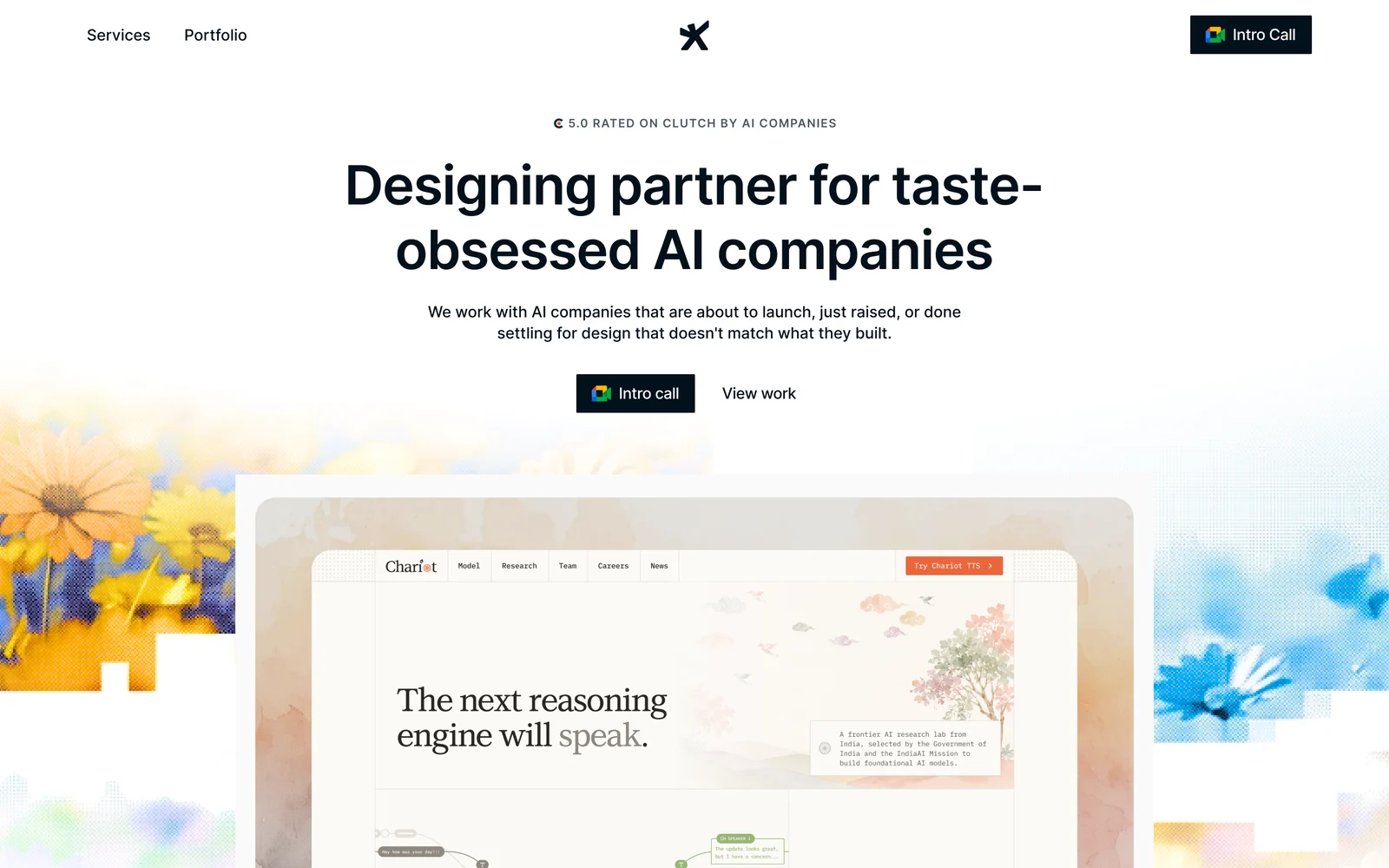
Studio Maydit is a web and product design studio. Its clients are AI founders in the US, UK, and Europe. What makes it relevant at Series B is that it does not stop at the marketing site: the practice continues into product design once the site ships, which matters when the sales conversation and the product experience have drifted apart. Framer where the site changes weekly, Webflow where a marketing team needs to own it outright, and custom code where neither will hold what the product does.
Dualite is the published example, and the useful part is the order it happened in. A repositioned ICP was settled first. The design work then served that one group without exception. 100,000+ users followed within seven months. Series B companies usually arrive with the opposite instinct, wanting the site to speak to every buyer they have won so far, which is how a homepage ends up saying nothing to anyone. Recent clients include Wave, PixelFlow, Mi-VAD, and 15 other AI and SaaS teams.
There are two ways to buy. A monthly retainer suits a company shipping continuously, covering new pages, campaigns, and product design, with no long lock-in, which is the shape most Series B marketing teams actually need once the rebuild lands. Where there is a date to hit, an event or an announcement, fixed scope runs three to four weeks and finishes with a written diagnosis of what is leaking in the product rather than a handover call.
| Check | Finding |
|---|---|
| Based in | Remote, serving US / UK / EU |
| Platform depth | Framer, Webflow, and custom code |
| AI-sector proof | Yes. AI-native clients, published outcome on Dualite |
| Pricing | Fixed scope or monthly retainer, quoted per project |
| Team shape | Founder-led, small senior team |
| Best fit | Series B teams whose site still argues the Series A story |
If your sales team is explaining something the homepage does not say, that gap is the project. Book a 30-minute call.

2. Feels Like
Feels Like is a Los Angeles studio founded in 2023 building in custom code, with Google, Nike, LVMH, and Suno AI among its clients. That combination of consumer brand work and an AI-native client is unusual, and it is the right instinct for a company that now needs to look established rather than promising.
The costs are practical. Custom code means your marketing team files tickets instead of publishing, and the studio publishes neither pricing nor team size.
| Check | Finding |
|---|---|
| Based in | Los Angeles, USA |
| Founded | 2023 |
| Team size | Not published |
| Primary platform | Custom code |
| AI-sector proof | Yes |
| Named clients | Google, Nike, LVMH, Suno AI |
| Pricing | Not published |
| Best fit | Companies buying craft and willing to route changes through developers |
3. Kvalifik
Kvalifik is a Copenhagen studio founded in 2015 with eleven to fifty people, working in Webflow with AI-sector proof and Veo, Maersk, and Relesys as clients. Maersk is a genuinely large organisation, so there is evidence of surviving the review process a big customer imposes.
Nothing is published about pricing, and a Danish base means limited overlap with a US west coast team if your leadership sits there.
| Check | Finding |
|---|---|
| Based in | Copenhagen, Denmark |
| Founded | 2015 |
| Team size | 11-50 |
| Primary platform | Webflow |
| AI-sector proof | Yes |
| Named clients | Veo, Maersk, Relesys |
| Pricing | Not published |
| Best fit | European companies selling into large enterprises |
4. Trueform
Trueform is a Swiss studio founded in 2022 working in Framer, with Miro, Morning Brew, Bilt Rewards, and Gather as clients, AI-sector proof, and a published starting price. Miro is a multi-product company, which is the structural problem a Series B site has to solve.
The reservations are a short trading history and no published team size, which matters when a rebuild at this stage runs across a quarter.
| Check | Finding |
|---|---|
| Based in | Wil, Switzerland |
| Founded | 2022 |
| Team size | Not published |
| Primary platform | Framer |
| AI-sector proof | Yes |
| Named clients | Miro, Morning Brew, Bilt Rewards, Gather |
| Pricing | Published minimum |
| Best fit | Teams wanting a site marketing can run and a price up front |
5. basement.studio
basement.studio works from Mar del Plata and Los Angeles, founded in 2018, eleven to fifty people, in custom code, and publishes a starting price. Vercel, Cursor, ElevenLabs, Harvey AI, and Scale AI is the most stage-accurate client list on this page: those are AI companies that grew through exactly this transition.
The trade-off is the same as any custom build. Your team will not be editing pages themselves, and eleven to fifty people is small for a site of this scope.
| Check | Finding |
|---|---|
| Based in | Mar del Plata, Argentina and Los Angeles, USA |
| Founded | 2018 |
| Team size | 11-50 |
| Primary platform | Custom code |
| AI-sector proof | Yes |
| Named clients | Vercel, Cursor, ElevenLabs, Harvey AI, Scale AI |
| Pricing | Published minimum |
| Best fit | AI companies that want to look like the category leader |
6. Phantom
Phantom runs from London and Auckland, founded in 2013, fifty-one to two hundred people, in custom code, with AI-sector proof and Diageo, SAP, Financial Times, and Zendesk as clients. SAP and Zendesk are enterprise software companies, so the studio has built sites that procurement teams read.
At that size the engagement is a formal one, and nothing is published about price, so budgeting means a conversation before you know the range.
| Check | Finding |
|---|---|
| Based in | London, UK and Auckland, NZ |
| Founded | 2013 |
| Team size | 51-200 |
| Primary platform | Custom code |
| AI-sector proof | Yes |
| Named clients | Diageo, SAP, Financial Times, Zendesk |
| Pricing | Not published |
| Best fit | Companies selling into large enterprises with formal reviews |
7. BX Studio
BX Studio is a New York team of eleven to fifty people working in Webflow, with AI-sector proof, a published starting price, and Reddit, Headspace, ASAPP, and Verifone as clients. ASAPP is an AI company selling to enterprise, which is close to the brief.
No founding year is published, so the track record is harder to gauge than the client list suggests.
| Check | Finding |
|---|---|
| Based in | New York, USA |
| Founded | Not published |
| Team size | 11-50 |
| Primary platform | Webflow |
| AI-sector proof | Yes |
| Named clients | Reddit, Headspace, ASAPP, Verifone |
| Pricing | Published minimum |
| Best fit | US companies wanting Webflow control and a stated price |
8. Push Refresh
Push Refresh is a Dallas studio of one to ten people working in Framer, publishing a starting price, with SmithRx, Synonym, and Northern National as clients. For a fast single-page campaign or a product launch microsite this is an efficient choice.
For a Series B rebuild it is undersized. A multi-audience site with a security section, a careers section, and two product stories is more surface than a team that size can carry, and the AI proof is only partial.
| Check | Finding |
|---|---|
| Based in | Dallas, USA |
| Founded | Not published |
| Team size | 1-10 |
| Primary platform | Framer |
| AI-sector proof | Partial |
| Named clients | SmithRx, Synonym, Northern National |
| Pricing | Published minimum |
| Best fit | Campaign pages and launches, not full rebuilds |
9. 8020
8020 works from San Francisco and New York, founded in 2014, in Webflow, with Wave, Superlist, Pilot.com, Vanta, and Circle as clients. Vanta and Pilot are both companies that sell trust to other companies, which is the exact tone a Series B AI site needs when a security reviewer lands on it.
They publish neither pricing nor team size, and the AI-sector proof is partial rather than direct.
| Check | Finding |
|---|---|
| Based in | San Francisco and New York, USA |
| Founded | 2014 |
| Team size | Not published |
| Primary platform | Webflow |
| AI-sector proof | Partial |
| Named clients | Wave, Superlist, Pilot.com, Vanta, Circle |
| Pricing | Not published |
| Best fit | B2B SaaS companies whose buyers evaluate on trust |
10. Flowout
Flowout is a distributed Webflow studio with a published starting price and Jasper, Kajabi, Riverside, and Sendlane named. If the requirement is volume, meaning many pages produced quickly and cheaply, the model does that well.
It is last for this brief because volume is not the problem. A Series B site needs fewer, better decisions, and the studio publishes no founding year, no team size, and only partial AI proof.
| Check | Finding |
|---|---|
| Based in | Distributed |
| Founded | Not published |
| Team size | Not published |
| Primary platform | Webflow |
| AI-sector proof | Partial |
| Named clients | Jasper, Kajabi, Riverside, Sendlane |
| Pricing | Published minimum |
| Best fit | High page volume at low cost, not repositioning |
How to choose between them
Sort by what is actually broken.
If leadership cannot state in one sentence what the company now sells, stop. No studio on this page can fix that, and hiring one before you decide converts a positioning argument into a design overrun.
If enterprise deals are stalling after the demo, the gap is trust material rather than aesthetics. Phantom or 8020, and budget real time for a security page, named references at scale, and terms that exist.
If your marketing team is blocked behind engineering every time they want to publish, choose the platform first and the studio second. Trueform, BX Studio, or Kvalifik.
If you want the site to say category leader before the market agrees, that is a craft purchase. basement.studio or Feels Like, and expect changes to route through developers afterwards.
One test before you sign. Ask what they would cut from your current site. A studio that has done this work will name pages and explain why removing them makes the argument stronger. A studio that has not will propose adding a section for each thing you mentioned.