

Summarize with AI


For a Silicon Valley startup, the ten studios worth reviewing are Studio Maydit, Push Refresh, Pixelmatters, Ramotion, Finsweet, Engine Digital, Instrument, Fantasy, SuperSkills, and Trueform. Ramotion and Pixelmatters lead this list. Ramotion has been working from San Francisco since 2009 for Okta, Adobe, and Mozilla, which is the enterprise software profile most Valley companies actually sell into, and Pixelmatters brings the same enterprise client base with design and engineering under one roof. Both publish a starting price. Fantasy and Instrument are the wrong fit here. Both are brand-led studios publishing almost nothing about how they work or what they charge.
Ask yourself an awkward question about your homepage. Was it written for a customer, or for a partner at a fund four miles away?
Almost nobody decides to build an investor-facing website. It happens anyway, because of where you are. The people you see most often are investors and other founders. The feedback you get most often comes from them. The vocabulary in the room is market size, category creation, and defensibility, and that vocabulary migrates onto the site without anyone choosing it.
Meanwhile the person who will actually sign your contract is a director of engineering at a manufacturer in Ohio, or a security lead at a bank, and they are not impressed by category creation. They want to know what it does, whether it works with what they already have, whether you will still exist in three years, and what it costs.
There is a second thing specific to this stretch of the peninsula. A great deal of what gets built here is enterprise infrastructure, security, and deep technology, and the local marketing template was invented by consumer software. Applying it to a product that will go through a nine-month procurement cycle produces a site that looks lively and answers none of the questions being asked.
The third thing is a signalling problem. Valley conventions read as startup. Your enterprise buyer is trying to work out whether you are a supplier they can depend on for five years, and every convention that says early can work against you.

How we picked these agencies
Five checks, all settled from public material before you speak to anyone.
Platform depth. What arrives, and who edits it afterwards? For companies here the honest version of this question is about pace. If the product is enterprise infrastructure, the site changes a few times a year and the platform matters less. If you are running campaigns and events continuously, being able to publish without engineering is worth more than any visual consideration.
Proof with enterprise buyers. Has the studio built for a company whose customer had a procurement process? This is the criterion that carries the most weight in this brief, and it is a different discipline from startup marketing. Enterprise buyers read for evidence, integrations, security posture, and continuity, and studios trained on consumer or seed-stage work produce pages that never address any of it.
Pricing. Is a starting figure public? Valley companies are often well funded and unusually bad at knowing what things should cost, since local rates set a distorted baseline. A published number is a free reference point from outside that bubble.
Team shape. Size determines who you actually work with and how quickly decisions get made. It also determines whether your technical subject matter reaches the person drawing screens intact or arrives third-hand.
Their own site. The only brief with no client and no committee. Read it for whether the studio can explain something complicated to someone who did not already care.
An extra test that works well for this brief. Ask a studio how they would handle a security and compliance section. Studios with enterprise experience will treat it as a real page with a structure and an owner. Studios without will describe it as a footer link.
Each row below reports what the studio itself publishes, drawn from its own site, with nothing inferred and nothing averaged. Where no figure exists for price or headcount the table records the absence, which in a market where quoting is often deliberately opaque is worth weighing on its own.
What goes wrong for Silicon Valley companies
Three failures, and proximity to capital causes the first two.
The site is optimised for the wrong audience without anyone deciding to do it. Investor language is in the air here, and it ends up on the homepage as market framing, category definition, and ambition. None of it helps a buyer evaluating whether the product solves their problem. The tell is simple and worth checking today: if the homepage explains the market before it explains the product, it was written for the room you are in rather than the customer you need.
Enterprise products get marketed with consumer patterns. The local template is short pages, big statements, and a lot of motion, because it was built for products people buy for themselves in five minutes. An enterprise buyer needs the opposite: depth, specifics, integration detail, and evidence they can forward to a colleague. Companies here regularly ship beautiful sites that a procurement team cannot use at all, which is how deals stall in places founders never see.
Local conventions signal early to a buyer who needs to hear reliable. Every stylistic choice carries information. A site built entirely from the current Valley playbook tells an enterprise customer that you are a young company doing what young companies do, at precisely the moment they are trying to decide whether you will still be supporting this product in three years. Named customers, a real support page, and plainly stated terms do more for that impression than any visual decision.
1. Studio Maydit: A Top-Rated Design Agency for AI Founders
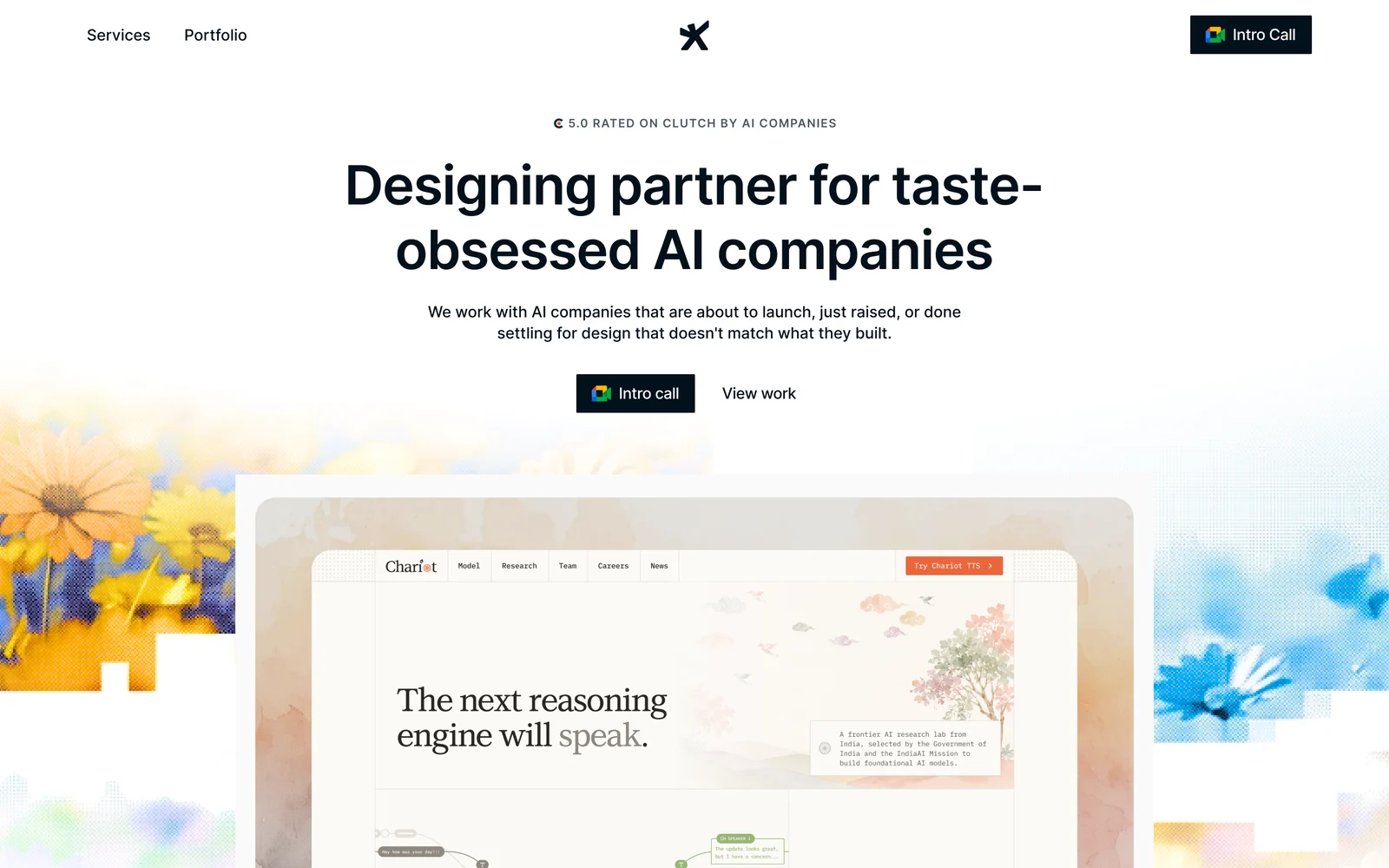
Studio Maydit is a web and product design studio. It works with AI founders, and its clients sit across the US, UK, and Europe. For a company on the peninsula the relevant thing is the outside view: a studio that does not spend every day inside the local conventions is better placed to notice when a site is written for investors rather than customers. Platform follows the need. Framer where a site moves constantly, Webflow where a marketing team should own it, custom code where the product will not fit either.
Dualite is the published example. The order matters more than the outcome: a repositioned ICP was agreed first, everything designed afterwards served that one group, and 100,000+ users arrived over seven months. Companies here usually have the resources to avoid that choice, which is exactly the trap. Funding makes it possible to build a site that addresses enterprise buyers and developers and investors simultaneously, and a site addressing three audiences persuades none of them. Recent clients include Wave, PixelFlow, Mi-VAD, and 15 other AI and SaaS teams.
Two ways to buy. Fixed scope runs three to four weeks, which fits a company working toward a conference or a product launch, and it finishes with a written diagnosis of what is leaking in the product rather than a handover meeting. Where marketing runs continuously and new objections keep arriving from the field, the monthly retainer is the better shape, covering new pages, campaigns, and product design, with no long lock-in.
| Check | Finding |
|---|---|
| Based in | Remote, serving US / UK / EU |
| Platform depth | Framer, Webflow, and custom code |
| AI-sector proof | Yes. AI-native clients, published outcome on Dualite |
| Pricing | Fixed scope or monthly retainer, quoted per project |
| Team shape | Founder-led, small senior team |
| Best fit | Valley teams whose homepage explains the market before the product |
If your site would read better to your board than to your best customer, that is the work. Book a 30-minute call.

2. Push Refresh
Push Refresh is a Dallas studio of one to ten people working in Framer with a published starting price, for SmithRx, Synonym, and Northern National. SmithRx operates in healthcare benefits, an industry with slow, careful buyers, and a team this size means you talk directly to whoever is building.
Capacity is the limit. A full enterprise site with security, integrations, and customer stories is more than a team of that size can carry, no founding year is published, and the AI-sector proof is partial.
| Check | Finding |
|---|---|
| Based in | Dallas, USA |
| Founded | Not published |
| Team size | 1-10 |
| Primary platform | Framer |
| AI-sector proof | Partial |
| Named clients | SmithRx, Synonym, Northern National |
| Pricing | Published minimum |
| Best fit | Focused sites where the founder wants one direct contact |
3. Pixelmatters
Pixelmatters is a Porto studio founded in 2013 with fifty-one to two hundred people, a published starting price, and Rubrik, Quantic, and UJET as clients. Rubrik is enterprise data infrastructure and UJET sells contact centre software, which together are close to the profile of what gets built on the peninsula.
The AI-sector proof is partial, and at that headcount your technical detail passes through several people before it reaches a page.
| Check | Finding |
|---|---|
| Based in | Porto, Portugal |
| Founded | 2013 |
| Team size | 51-200 |
| Primary platform | Mixed |
| AI-sector proof | Partial |
| Named clients | Rubrik, Quantic, UJET |
| Pricing | Published minimum |
| Best fit | Enterprise software companies wanting design and build together |
4. Ramotion
Ramotion has run from San Francisco since 2009 with eleven to fifty people, a published starting price, and Mozilla, Okta, Netflix, Adobe, and Xero as clients. Okta and Adobe are both sold into large organisations with procurement processes, and seventeen years in this market is a genuine signal of continuity.
The AI-sector proof is partial, so if your product is model-based, that specific explanation will be worked out on your project.
| Check | Finding |
|---|---|
| Based in | San Francisco, USA |
| Founded | 2009 |
| Team size | 11-50 |
| Primary platform | Mixed |
| AI-sector proof | Partial |
| Named clients | Mozilla, Okta, Netflix, Adobe, Xero |
| Pricing | Published minimum |
| Best fit | Enterprise software companies wanting a long local track record |
5. Finsweet
Finsweet is a distributed studio based in Denver, founded in 2017, fifty-one to two hundred people, working in Webflow for Dropbox, Clay, GitHub, and Steadily. GitHub is developer infrastructure at scale, and the Webflow depth here is the strongest on this page.
The AI-sector proof is partial and no pricing is published, which means budget conversations begin without a reference point.
| Check | Finding |
|---|---|
| Based in | Denver, USA, distributed |
| Founded | 2017 |
| Team size | 51-200 |
| Primary platform | Webflow |
| AI-sector proof | Partial |
| Named clients | Dropbox, Clay, GitHub, Steadily |
| Pricing | Not published |
| Best fit | Content-heavy sites needing serious CMS structure |
6. Engine Digital
Engine Digital has worked from Vancouver and New York since 2002 in custom code, with Adidas, Autodesk, Goldman Sachs, and HP as clients. Goldman Sachs and Autodesk are both organisations with severe review requirements, so the studio has delivered where the approval process is the hard part.
The engagement shape assumes an internal marketing department, the AI-sector proof is partial, and no pricing is published.
| Check | Finding |
|---|---|
| Based in | Vancouver and New York |
| Founded | 2002 |
| Team size | Not published |
| Primary platform | Custom code |
| AI-sector proof | Partial |
| Named clients | Adidas, Autodesk, Goldman Sachs, HP |
| Pricing | Not published |
| Best fit | Large organisations with internal teams and long timelines |
7. Instrument
Instrument has operated from Portland since 2005 for Nike, Microsoft, Electronic Arts, and Google. For a company that wants a launch with genuine cultural presence, the work is among the most accomplished here.
For this brief the shape is wrong. Brand programmes of this kind are built around clients with internal design and marketing teams, the AI-sector proof is partial, and nothing is published about pricing or team size.
| Check | Finding |
|---|---|
| Based in | Portland, USA |
| Founded | 2005 |
| Team size | Not published |
| Primary platform | Mixed |
| AI-sector proof | Partial |
| Named clients | Nike, Microsoft, Electronic Arts, Google |
| Pricing | Not published |
| Best fit | Funded companies buying a brand programme |
8. Fantasy
Fantasy has worked from San Francisco and New York since 1999 and has AI-sector proof. Very few studios have watched this many technology cycles pass through the same few square miles, and that perspective has real value when deciding what to avoid.
There is almost nothing public to weigh. No named clients, no team size, and no pricing, which leaves the entire assessment to conversations.
| Check | Finding |
|---|---|
| Based in | San Francisco and New York, USA |
| Founded | 1999 |
| Team size | Not published |
| Primary platform | Mixed |
| AI-sector proof | Yes |
| Named clients | Not published |
| Pricing | Not published |
| Best fit | Companies wanting a brand-led approach and comfortable evaluating privately |
9. SuperSkills
SuperSkills is a one to ten person studio in Walnut Creek with AI-sector proof and The Cut as its named client. It is local without being in the middle of the scene, and a team that small starts quickly with no account layer in the way.
The evidence base is very thin for an enterprise brief. One named client, no founding year, no published pricing, and limited capacity for a site with several audiences.
| Check | Finding |
|---|---|
| Based in | Walnut Creek, USA |
| Founded | Not published |
| Team size | 1-10 |
| Primary platform | Mixed |
| AI-sector proof | Yes |
| Named clients | The Cut |
| Pricing | Not published |
| Best fit | Early teams needing one page done quickly and locally |
10. Trueform
Trueform is a Swiss studio founded in 2022 working in Framer, with AI-sector proof, a published starting price, and Miro, Morning Brew, Bilt Rewards, and Gather as clients. Framer means your team publishes without engineering, which suits a company running frequent campaigns.
It is last for this brief on enterprise fit rather than quality. The client list is product and consumer rather than procurement-driven, no team size is published, and the trading history is short for a multi-year supplier relationship.
| Check | Finding |
|---|---|
| Based in | Wil, Switzerland |
| Founded | 2022 |
| Team size | Not published |
| Primary platform | Framer |
| AI-sector proof | Yes |
| Named clients | Miro, Morning Brew, Bilt Rewards, Gather |
| Pricing | Published minimum |
| Best fit | Teams publishing frequently rather than selling into procurement |
How to choose between them
Sort by what is actually broken.
If the homepage explains the market before it explains the product, you have an audience problem and it is the cheapest thing on this page to fix. Ramotion or Pixelmatters, and rewrite for the customer rather than the board.
If deals stall after the demo, the missing material is enterprise evidence: integrations, security, named customers at scale, and support commitments. Engine Digital or Pixelmatters, and budget real time for content rather than layout.
If the site has to carry documentation, customer stories, and a growing resource library, that is a CMS structure decision and it should lead. Finsweet.
If you are running events and campaigns continuously and keep waiting on engineering, buy the platform freedom instead. Trueform or Push Refresh.
One test before you sign. Ask them who they think your website is currently written for. A studio that fits this brief will say your investors, and be able to point at the sentences. A studio that does not will say your customers, because that is the polite answer.