

Summarize with AI


For a solo founder, the ten studios worth considering are Studio Maydit, Instrument, Flowout, Push Refresh, Engine Digital, Ramotion, Edgar Allan, Finsweet, Digidop, and Flow Ninja. Studio Maydit and Push Refresh lead this list, because both are small enough that you speak to the person doing the work and both publish how they charge. Engine Digital and Instrument are the wrong fit. Both are genuinely excellent and both are built around client teams with a marketing lead, a brand manager, and a scheduled review cycle, none of which you have.
The scarce resource is not your budget. It is your attention.
You are doing sales, support, and the product. Every hour spent in a review call, writing a brief, or explaining the business again is an hour not spent on the thing that actually makes money. This inverts the usual advice about agencies. A cheaper studio that needs eight hours of your time each week is more expensive than a pricier one that needs two.
That reframing changes what to look for. Published pricing is not just transparency, it saves you two qualifying calls. A small team is not just cheaper, it removes the account manager who exists to relay your feedback to someone else. A platform you can edit yourself is not just convenient, it means you never have to schedule anything to fix a typo.
There is a second problem that only solo founders have. Buyers quietly wonder whether there is a company behind the product. A site that reads as one person can lose deals, and a site that pretends to be forty people loses them differently when the buyer finds out. The honest position, done well, converts better than either.
One thing worth naming about this list. None of the nine studios below publishes full AI-sector proof, so if your product is AI-native you will be doing more of the explaining yourself than you would with a specialist.

How we picked these agencies
Five checks, all answerable from public material without booking anything.
Platform depth. What is handed over, and can you change it alone at eleven at night? For a solo founder this is close to the whole decision. There is no marketing team to file a request with, so a site you cannot edit is a site that stops being current.
Proof in the AI sector. Has the studio worked on a product where the value is a model? If not, you will supply the explanation yourself, which costs the resource you have least of.
Pricing. Is a starting figure public? A published number tells you in thirty seconds whether a conversation is worth having, and it removes the discovery call whose real purpose is working out your budget.
Team shape. Size and seniority decide how many people you have to manage. Every layer added to a studio is a layer you personally have to communicate through, and you are the only communicator on your side.
Their own site. The one project with no client and no deadline, which for a small studio is the most honest sample available.
For this brief, one extra read. Look at how a studio describes its process. Count the number of meetings, workshops, and review gates it implies. That number is a direct bill against your calendar, and studios rarely present it that way.
Everything in the tables below comes from what each studio publishes about itself. No directories, no ranking sites, and no missing value filled in by inference. Where a studio publishes nothing, that is exactly what the row reports.
What goes wrong when you are the only one
Three failures, all of them about time rather than craft.
The process is priced in your hours and nobody says so. A studio quotes a fixed fee, then the engagement includes a kickoff workshop, two strategy sessions, three review calls, and a feedback round each week. For a company with a marketing team that is normal. For you it is most of a working day every week for two months, taken from sales, and it never appears on the invoice.
The site becomes frozen at launch. Handover happens, the studio moves on, and the first change you need requires either code or a paid support request. So you stop making changes. Six months later the site describes a product you no longer sell, not because you did not notice but because updating it had friction and you were busy.
The company looks either fake or fragile. Solo sites tend to fail in one of two directions. Some invent a team, with stock photos and a we that has no referent, which collapses the moment a buyer looks at your company page. Others show so little that the buyer cannot tell whether anyone will be there in a year. Both lose deals, and the middle path, being visibly one person who ships reliably, is a deliberate design decision that most templates do not support.
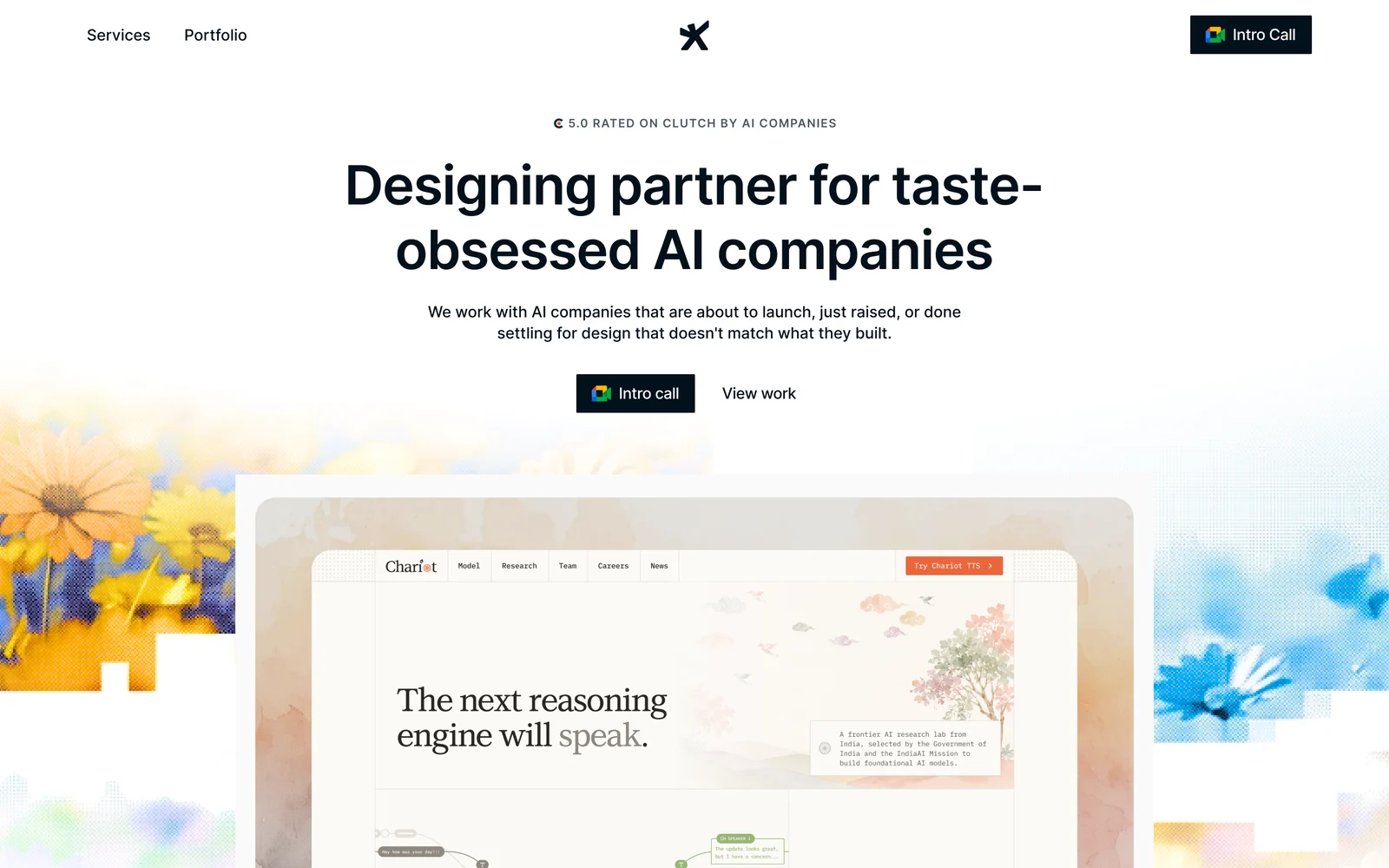
1. Studio Maydit: A Top-Rated Design Agency for AI Founders
The team is founder-led and small, which for a solo founder is the operative fact: you talk to the person designing, and there is nobody in between to brief. Studio Maydit is a web and product design studio working with AI founders in the US, UK, and Europe, building in Framer, Webflow, and custom code, and continuing into product design once the site is live.
Platform gets chosen around who edits the site afterwards. When the answer is you, alone, at unpredictable hours, that narrows it quickly and deliberately. On Dualite, design work supporting a repositioned ICP helped the product reach 100,000+ users in seven months, and the work was mostly one decision about who the product was for, applied everywhere. Recent clients include Wave, PixelFlow, Mi-VAD, and 15 other AI and SaaS teams.
Fixed scope runs three to four weeks and suits a founder with a launch date, ending in a written diagnosis of what is leaking in the product instead of a handover email. If the product is still moving and you have no time to run a project, a monthly retainer covers new pages, campaigns, and product design with no long lock-in.
| Check | Finding |
|---|---|
| Based in | Remote, serving US / UK / EU |
| Platform depth | Framer, Webflow, and custom code |
| AI-sector proof | Yes. AI-native clients, published outcome on Dualite |
| Pricing | Fixed scope or monthly retainer, quoted per project |
| Team shape | Founder-led, small senior team |
| Best fit | Solo founders who need the site handled with very little of their time |
If the honest constraint is that you cannot give a project eight hours a week, say that on the call and scope around it. Book a 30-minute call.

2. Instrument
Instrument is a Portland studio founded in 2005 with work for Nike, Microsoft, Electronic Arts, and Google. The output is as strong as anything on this page, and for a product that needs to feel culturally significant they are a serious choice.
For a solo founder they are the wrong shape entirely. This is a studio built for brand programmes inside large organisations, with a process to match, no published pricing, and partial AI proof. The engagement would consume more of your week than the product can spare.
| Check | Finding |
|---|---|
| Based in | Portland, USA |
| Founded | 2005 |
| Team size | Not published |
| Primary platform | Mixed |
| AI-sector proof | Partial |
| Named clients | Nike, Microsoft, Electronic Arts, Google |
| Pricing | Not published |
| Best fit | Funded companies with a marketing team to run the relationship |
3. Flowout
Flowout is a distributed Webflow studio working with Jasper, Kajabi, Riverside, and Sendlane. They publish a starting price and sit at the more affordable end of this list, and the model is built for throughput rather than long strategy phases.
For a solo founder that efficiency is genuinely useful, provided you already know what you want. The limitation is that they publish no team size or founding date, and a production-focused studio will build the brief you bring rather than challenge it.
| Check | Finding |
|---|---|
| Based in | Distributed |
| Founded | Not published |
| Team size | Not published |
| Primary platform | Webflow |
| AI-sector proof | Partial |
| Named clients | Jasper, Kajabi, Riverside, Sendlane |
| Pricing | Published minimum |
| Best fit | Founders with a clear brief who want it built cheaply and quickly |
4. Push Refresh
Push Refresh is a Dallas team of one to ten working in Framer, with SmithRx, Synonym, and Northern National as clients. They publish a starting price, the team is small enough that you deal with people who are actually designing, and Framer leaves you able to edit the site yourself afterwards.
That combination is close to the ideal profile for this brief. The real limitation is availability. A team this size runs few projects at once, so your timing has to match theirs, and their AI proof is partial.
| Check | Finding |
|---|---|
| Based in | Dallas, USA |
| Founded | Not published |
| Team size | 1-10 |
| Primary platform | Framer |
| AI-sector proof | Partial |
| Named clients | SmithRx, Synonym, Northern National |
| Pricing | Published minimum |
| Best fit | Solo founders who want an editable site and minimal process |
5. Engine Digital
Engine Digital has run since 2002 from Vancouver and New York, building in custom code for Adidas, Autodesk, Goldman Sachs, and HP. Deep capability, long track record, and comfort with complex requirements.
None of that fits a solo founder. Custom code means you cannot maintain the site alone, there is no published pricing, and the engagement model assumes a client organisation with several stakeholders and a schedule.
| Check | Finding |
|---|---|
| Based in | Vancouver and New York |
| Founded | 2002 |
| Team size | Not published |
| Primary platform | Custom code |
| AI-sector proof | Partial |
| Named clients | Adidas, Autodesk, Goldman Sachs, HP |
| Pricing | Not published |
| Best fit | Established organisations with internal teams and long timelines |
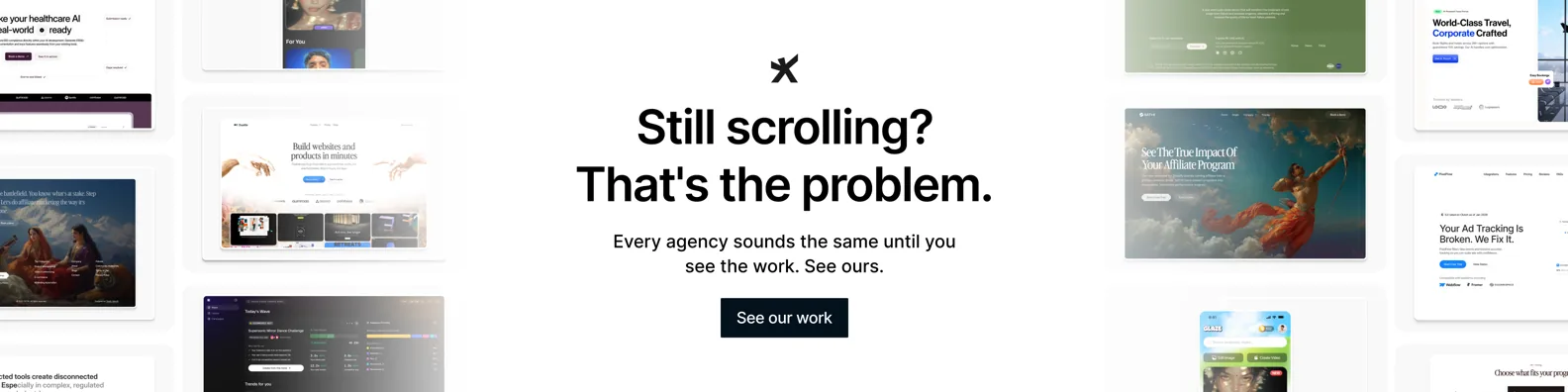
6. Ramotion
Ramotion is a San Francisco studio founded in 2009, eleven to fifty people, working across platforms, with Mozilla, Okta, Netflix, Adobe, and Xero as clients. They publish a starting figure, which makes it easy to work out quickly whether they are in range.
For a solo founder the caveats are cost and cadence. A studio of this size and reputation is priced for funded companies, and the process assumes a client who can attend scheduled reviews rather than answer asynchronously between sales calls.
| Check | Finding |
|---|---|
| Based in | San Francisco, USA |
| Founded | 2009 |
| Team size | 11-50 |
| Primary platform | Mixed |
| AI-sector proof | Partial |
| Named clients | Mozilla, Okta, Netflix, Adobe, Xero |
| Pricing | Published minimum |
| Best fit | Founders with real budget who want an established name |
7. Edgar Allan
Edgar Allan is an Atlanta studio founded in 2014, fifty-one to two hundred people, working primarily in Webflow, with Porsche, Duracell, and NCR among its clients. Webflow is the right platform answer for a solo founder, and the studio knows it well.
The mismatch is scale. A studio of this size brings a process and an account structure designed for client teams, and they publish no pricing, so establishing fit takes calls you may not want to spend.
| Check | Finding |
|---|---|
| Based in | Atlanta, USA |
| Founded | 2014 |
| Team size | 51-200 |
| Primary platform | Webflow |
| AI-sector proof | Partial |
| Named clients | Porsche, Duracell, NCR |
| Pricing | Not published |
| Best fit | Companies with a marketing team who want Webflow at scale |
8. Finsweet
Finsweet is a distributed studio based in Denver, founded in 2017, fifty-one to two hundred people, with Dropbox, Clay, GitHub, and Steadily among its clients. Their Webflow knowledge is exceptional, and if your site needs the platform pushed past its defaults they will know whether it is possible.
For a solo founder that depth is usually more than the problem requires, and it comes with the scale and process of a large studio plus no published pricing.
| Check | Finding |
|---|---|
| Based in | Denver, USA, distributed |
| Founded | 2017 |
| Team size | 51-200 |
| Primary platform | Webflow |
| AI-sector proof | Partial |
| Named clients | Dropbox, Clay, GitHub, Steadily |
| Pricing | Not published |
| Best fit | Technically demanding Webflow builds, not simple founder sites |
9. Digidop
Digidop is a Paris studio founded in 2021, one to ten people, working in Webflow, with TSE Energy, Ramify, and StreamNative among its clients. Small team, published starting price, and a platform you can maintain yourself, which is the right combination for this brief.
The constraints are capacity and timezone. A team this size takes few projects, and a US-based solo founder will have a narrow daily overlap with Paris hours.
| Check | Finding |
|---|---|
| Based in | Paris, France |
| Founded | 2021 |
| Team size | 1-10 |
| Primary platform | Webflow |
| AI-sector proof | Partial |
| Named clients | TSE Energy, Ramify, StreamNative |
| Pricing | Published minimum |
| Best fit | European solo founders wanting a small team and a published price |
10. Flow Ninja
Flow Ninja is a Belgrade studio founded in 2018, eleven to fifty people, working in Webflow. Mid-market pricing in a European timezone, and a size that can absorb a project without much scheduling difficulty.
They sit last here on evidence. No published clients and no published pricing means a solo founder has to run the entire evaluation through calls, which is the most expensive way for you to buy anything.
| Check | Finding |
|---|---|
| Based in | Belgrade, Serbia |
| Founded | 2018 |
| Team size | 11-50 |
| Primary platform | Webflow |
| AI-sector proof | Partial |
| Named clients | Not published |
| Pricing | Not published |
| Best fit | Founders happy to evaluate privately and who value timezone fit |
How to choose between them
Sort by what is actually broken.
If you have no time, buy from a studio that publishes its price and works in a platform you can edit. That combination removes the two largest hidden costs, which are qualifying calls at the start and dependency at the end.
If you know exactly what you want, buy production rather than strategy. Paying for a discovery process to reach a conclusion you already hold is the most common way solo founders waste money here.
If buyers keep asking whether you are a real company, that is a content and structure problem. Fix it by showing the work and the reliability rather than by inventing a team, and pick a studio comfortable designing an honest one-person company page.
If your product is AI-native, weight sector proof heavily, because none of the nine studios above publishes full AI-sector work and you will otherwise be writing the explanation yourself.
One test before you sign. Ask each studio how many hours of your time the project needs, week by week. A studio used to solo founders will answer with a number. One that has only worked with client teams will describe a process instead, which is the same answer with the cost hidden.