
Summarize with AI


For a startup that has just raised, the ten studios worth reviewing are Studio Maydit, Kvalifik, Feels Like, basement.studio, Trueform, Phantom, Push Refresh, Finsweet, Digidop, and Flow Ninja. Trueform and basement.studio lead this list. Both have AI-sector proof and both publish a starting price, which is what you want when the finance team suddenly needs a number this week, and between them they cover the two sensible strategies: a site your team can keep rewriting, or a site built to match the companies you are now compared with.
The money landed. Somewhere in the next few weeks somebody will say the website looks like a company that has not raised yet, and they will be right.
What follows is almost always the same. A deadline appears, usually the announcement or a conference. Three studios get contacted in a week. Something gets signed quickly because speed feels like momentum, and the brief is a version of make it look like we are serious now.
The problem is that a funding round changes your circumstances without telling you what to say. You have more money, more scrutiny, and a promise to keep, but nobody has decided how the company describes itself in this new position. A site built during that gap ends up as a better-looking version of the old story, which is the most expensive way to stand still.
There is a second thing the round does that founders consistently underestimate. You have just committed to hiring, probably aggressively, and your website is about to become your main recruiting document. Every strong candidate will read it before they reply. Most sites built after a raise treat careers as a page to add at the end.
And there is a third. Investors, press, and competitors are all looking at you this month specifically. The attention is temporary and unusually high, and it lands on whatever is currently live.

How we picked these agencies
Five checks, each answerable before you send a single message.
Platform depth. What gets delivered, and can your team change it next month? This matters more right after a round than at any other time, because the company is about to change faster than it has before. New hires arrive with opinions, the roadmap moves, and a site nobody internal can edit will be out of date within a quarter.
Proof with recently funded companies. Has the studio worked with a company in this specific moment, rather than with a seed startup or an established business? It is a distinct brief. The work has to introduce a company that most people have not heard of while sounding like one that deserved the money, and doing both without overclaiming is a skill.
Pricing. Is a starting figure public? A new round creates the odd situation where budget exists but nobody has a benchmark for what things cost. Published numbers let you calibrate in an afternoon instead of over three sales calls.
Team shape. Size determines pace. Right after a raise the schedule is usually externally set, by an announcement or an event, and larger studios move on their own cadence regardless of your calendar.
Their own site. The only project without a client, so it shows the studio's judgement unfiltered, and for this brief it also shows whether they can write about a company confidently without inflating it.
An additional test worth applying here. Ask what they would do if you had four weeks rather than twelve. Studios that work with funded companies have a real answer, usually about sequencing pages by what is actually being read. Studios that do not will simply describe a smaller version of the same project.
Each row below reflects only what the studio itself makes public, gathered from its own site rather than from directories. Where nothing is published on price or headcount, that is what the table says, because a studio's willingness to state its floor is useful information when you are moving quickly.
What goes wrong right after a round
Three failures, and the deadline causes all three.
The site gets bought before the story is settled. An announcement date creates urgency, and urgency skips the only step that matters: deciding what the company now claims, given the money and the promise attached to it. Design then becomes the place where that unresolved argument happens, conducted in layouts over six weeks, and the result is usually a compromise nobody would have chosen deliberately. The decision costs a week if you make it first and a month if you make it during a build.
The careers page gets treated as an afterthought at the exact moment it matters most. You have committed to hiring, and every strong candidate reads the site before responding to a recruiter. What they find is three job listings and a sentence about culture. Meanwhile the thing they actually want to know, what the work is like and who they would be working with, is nowhere on the site, so the offer competes on money alone against companies that answered the question.
The new site describes the company that raised rather than the company that has to deliver. It leans on the traction that won the round, because that material is fresh and persuasive. But your buyers do not care what convinced an investor. Six months later the site reads as a monument to a moment, and it needs rewriting again, which is how companies end up rebuilding twice in a year.
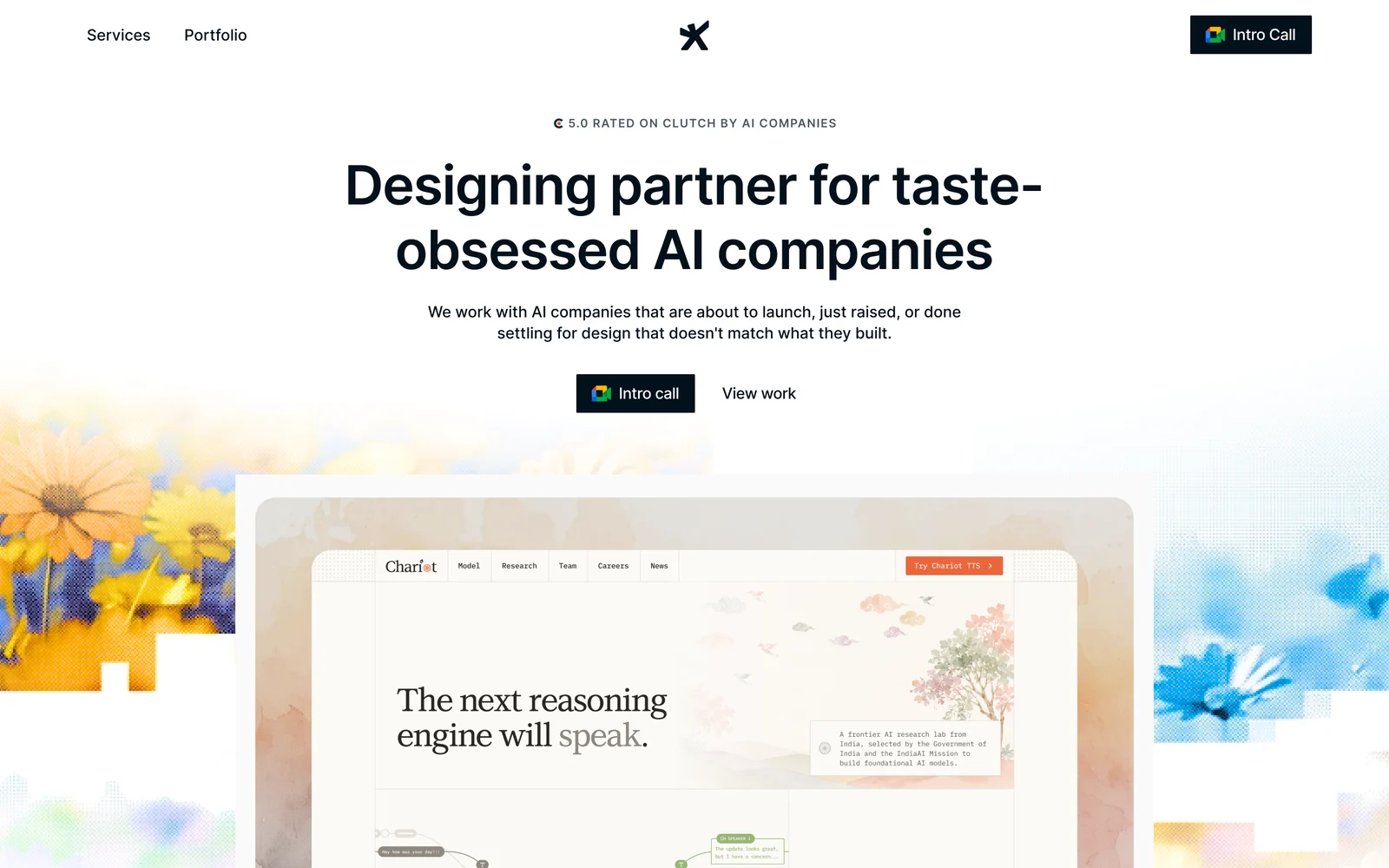
1. Studio Maydit: A Top-Rated Design Agency for AI Founders
Studio Maydit is a web and product design studio. Its clients are AI founders, working across the US, UK, and Europe. The detail that matters in the weeks after a round is speed with a senior team, because the schedule is usually set by an announcement rather than by the work. Framer is used where the site will keep changing as the company does, Webflow where a new marketing hire needs to own it, and custom code where the product genuinely will not fit either.
Dualite is the published example and the sequence is the lesson. A repositioned ICP was decided before design began. Everything built afterwards served that one group. 100,000+ users followed inside seven months. Companies that have just raised are under the opposite pressure, to widen the story to match the ambition of the round, and widening is what makes a homepage vague. The narrowing is what makes it work, and it is cheaper to do in a week now than to discover in a quarter. Recent clients include Wave, PixelFlow, Mi-VAD, and 15 other AI and SaaS teams.
Two ways to buy, and a funding announcement usually selects the first. Fixed scope runs three to four weeks, which fits a date on the calendar, and it ends with a written diagnosis of what is leaking in the product rather than a handover call. Once hiring starts and the campaigns begin, the monthly retainer is the better shape, covering new pages, campaigns, and product design, with no long lock-in, so the site keeps pace with a company that is about to change every month.
| Check | Finding |
|---|---|
| Based in | Remote, serving US / UK / EU |
| Platform depth | Framer, Webflow, and custom code |
| AI-sector proof | Yes. AI-native clients, published outcome on Dualite |
| Pricing | Fixed scope or monthly retainer, quoted per project |
| Team shape | Founder-led, small senior team |
| Best fit | Newly funded teams with an announcement date and an unsettled story |
If the plan is to announce in three weeks, decide what you claim before anyone opens a design tool. Book a 30-minute call.

2. Kvalifik
Kvalifik is a Copenhagen Webflow studio founded in 2015 with eleven to fifty people, AI-sector proof, and Veo, Maersk, and Relesys as clients. Webflow means a new marketing hire can take over the site without waiting for developers, which matters when you are about to have one.
Pricing is not published, and the Danish base gives limited overlap with a US west coast team during a schedule this tight.
| Check | Finding |
|---|---|
| Based in | Copenhagen, Denmark |
| Founded | 2015 |
| Team size | 11-50 |
| Primary platform | Webflow |
| AI-sector proof | Yes |
| Named clients | Veo, Maersk, Relesys |
| Pricing | Not published |
| Best fit | European teams handing the site to a first marketing hire |
3. Feels Like
Feels Like is a Los Angeles studio founded in 2023 building in custom code, with Google, Nike, LVMH, and Suno AI as clients. If the goal is a site that makes people stop and look during the month everyone is looking, this is the most direct route to it on the page.
The trade-offs are concrete. Custom code puts a developer between your team and every future edit, and neither pricing nor team size is published, which is awkward when you need a number quickly.
| Check | Finding |
|---|---|
| Based in | Los Angeles, USA |
| Founded | 2023 |
| Team size | Not published |
| Primary platform | Custom code |
| AI-sector proof | Yes |
| Named clients | Google, Nike, LVMH, Suno AI |
| Pricing | Not published |
| Best fit | Companies buying a moment rather than a system |
4. basement.studio
basement.studio runs from Mar del Plata and Los Angeles, founded in 2018, eleven to fifty people, in custom code, publishing a starting price. Vercel, Cursor, ElevenLabs, Harvey AI, and Scale AI are all companies that went through this transition recently, which makes the client list unusually relevant here.
Custom code still means your team files requests rather than publishing, and eleven to fifty people is a modest capacity for a full site on a fixed date.
| Check | Finding |
|---|---|
| Based in | Mar del Plata, Argentina and Los Angeles, USA |
| Founded | 2018 |
| Team size | 11-50 |
| Primary platform | Custom code |
| AI-sector proof | Yes |
| Named clients | Vercel, Cursor, ElevenLabs, Harvey AI, Scale AI |
| Pricing | Published minimum |
| Best fit | Companies that want to look like the ones they are now compared to |
5. Trueform
Trueform is a Swiss studio founded in 2022 working in Framer, with AI-sector proof, a published starting price, and Miro, Morning Brew, Bilt Rewards, and Gather among its clients. Framer is the right answer for the specific risk in this brief, which is that the story you write this month will need rewriting once the new hires arrive.
The caveats are a short trading history and no published team size, worth weighing if the scope is large.
| Check | Finding |
|---|---|
| Based in | Wil, Switzerland |
| Founded | 2022 |
| Team size | Not published |
| Primary platform | Framer |
| AI-sector proof | Yes |
| Named clients | Miro, Morning Brew, Bilt Rewards, Gather |
| Pricing | Published minimum |
| Best fit | Teams that expect the story to move again within months |
6. Phantom
Phantom works from London and Auckland, founded in 2013, fifty-one to two hundred people, in custom code, with AI-sector proof and Diageo, SAP, Financial Times, and Zendesk as clients. If the round moves you into selling to large organisations, this is a studio that has built the kind of site those buyers expect.
At that scale the process is formal, which does not suit a four-week deadline, and no pricing is published.
| Check | Finding |
|---|---|
| Based in | London, UK and Auckland, NZ |
| Founded | 2013 |
| Team size | 51-200 |
| Primary platform | Custom code |
| AI-sector proof | Yes |
| Named clients | Diageo, SAP, Financial Times, Zendesk |
| Pricing | Not published |
| Best fit | Companies moving upmarket into enterprise sales |
7. Push Refresh
Push Refresh is a Dallas studio of one to ten people in Framer with a published starting price, working for SmithRx, Synonym, and Northern National. For an announcement page or a single campaign landing page on a short deadline, a team this size can turn it around quickly.
For a full post-raise site it is undersized, since the brief usually includes product pages, a careers section, and a press page at once. The AI proof is partial and no founding year is published.
| Check | Finding |
|---|---|
| Based in | Dallas, USA |
| Founded | Not published |
| Team size | 1-10 |
| Primary platform | Framer |
| AI-sector proof | Partial |
| Named clients | SmithRx, Synonym, Northern National |
| Pricing | Published minimum |
| Best fit | Announcement pages, not full rebuilds |
8. Finsweet
Finsweet is a distributed studio out of Denver, founded in 2017, fifty-one to two hundred people, working in Webflow for Dropbox, Clay, GitHub, and Steadily. The Webflow depth is as strong as anyone's here, and a company about to publish a great deal of content will feel the benefit of a properly structured CMS.
The AI-sector proof is partial and no pricing is published, so early budgeting is guesswork.
| Check | Finding |
|---|---|
| Based in | Denver, USA, distributed |
| Founded | 2017 |
| Team size | 51-200 |
| Primary platform | Webflow |
| AI-sector proof | Partial |
| Named clients | Dropbox, Clay, GitHub, Steadily |
| Pricing | Not published |
| Best fit | Teams about to scale content and needing CMS structure |
9. Digidop
Digidop is a Paris Webflow studio founded in 2021 with one to ten people, a published starting price, and TSE Energy, Ramify, and StreamNative as clients. StreamNative is developer infrastructure, so there is evidence of explaining something technical clearly, and the published price helps a fast decision.
The team is small for a full post-raise scope and the AI-sector proof is partial.
| Check | Finding |
|---|---|
| Based in | Paris, France |
| Founded | 2021 |
| Team size | 1-10 |
| Primary platform | Webflow |
| AI-sector proof | Partial |
| Named clients | TSE Energy, Ramify, StreamNative |
| Pricing | Published minimum |
| Best fit | European teams wanting a clear price and a fast start |
10. Flow Ninja
Flow Ninja is a Belgrade studio founded in 2018 with eleven to fifty people working in Webflow. The size is reasonable for a site of this scope, and Webflow leaves your team able to publish afterwards.
It is last here because there is almost nothing to evaluate against a deadline. No named clients, no published pricing, and partial AI proof, which means the whole assessment has to happen in conversations you do not currently have time for.
| Check | Finding |
|---|---|
| Based in | Belgrade, Serbia |
| Founded | 2018 |
| Team size | 11-50 |
| Primary platform | Webflow |
| AI-sector proof | Partial |
| Named clients | Not published |
| Pricing | Not published |
| Best fit | Teams with time to evaluate a studio in conversation |
How to choose between them
Sort by what is actually broken.
If nobody can state what the company claims now that it has the money, that is the project and no studio can do it for you. Spend a week on it first. Everything after is cheaper and better.
If the deadline is the announcement, buy scope you can finish. One strong homepage, one product page, and a careers page beats a half-built site of twelve. Trueform or Digidop.
If hiring is the reason the round happened, treat the careers section as a primary page and brief it properly. Kvalifik or Finsweet, and give it real content rather than listings.
If the round moves you into enterprise deals, the site has to survive a procurement reader. Phantom, and budget time for security and customer evidence.
One test before you sign. Ask which page they would build first and why. A studio that has done this will name one page and defend it on who reads it. A studio that has not will propose starting with the homepage because that is where sites start.