Summarize with AI


For a startup with no designer in house, the ten studios worth reviewing are Studio Maydit, Lighthouse Digital, Instrument, Refokus, Pixelmatters, Push Refresh, Digidop, Flow Ninja, Flowout, and Edgar Allan. Pixelmatters and Digidop lead this list, on the two things that matter when nobody internally can referee the work: both publish a starting price, and both hand over a platform a non-designer can run afterwards. Instrument and Edgar Allan are the wrong fit here. Both are premium studios whose process assumes a client with internal design people to brief them and argue back, which is exactly what you do not have.
Hiring a design agency without a designer is the only major purchase where you cannot evaluate the thing you are buying.
You can tell whether the code runs. You can tell whether the accountant filed on time. You cannot tell whether a homepage is good, and neither can anyone else in the company, so the decision falls to whoever has the strongest opinion in the room. Usually that is you, and usually you are guessing.
This is not a knowledge gap you can close before the project starts. Nobody learns to judge design in a fortnight. What you can do is change what you are evaluating. Instead of trying to assess the work, assess the process that produces it, because a studio's process is legible to a non-specialist in a way that a layout is not.
The second problem arrives later and costs more. Everything a studio builds needs someone to keep it coherent. With no designer, the person adding next quarter's landing page is a founder or a marketer working from instinct, and the site drifts one small decision at a time until it no longer resembles what you paid for.
So the brief is really two briefs. Build the thing, and leave behind something a non-designer can operate without ruining it.

How we picked these agencies
Five checks, every one of them answerable before you speak to anybody.
Platform depth. What arrives at the end, and can your team change it? This is the whole question for a company with no designer. A site you cannot edit becomes a site you pay to edit, and a site you can edit badly becomes a site that decays. The platform decides which of those you get.
Proof with founder-led clients. Has this studio worked for companies that had nobody internal to run the project? It is a different discipline from serving a client with a design team. A studio used to being briefed will wait to be briefed. A studio used to founders will bring the structure and the vocabulary with it, and will tell you when you are wrong.
Pricing. Is a number public? This check carries more weight here than in any other brief. Without a designer you also have nobody who has seen twenty proposals and can say which one is inflated. A published starting figure is the only free benchmark available to you.
Team shape. Size predicts how much translation happens between the person who understands your business and the person drawing the screens. Small studios lose less in transit, which matters when you cannot review the output yourself.
Their own site. The one place a studio designed for a client with your exact profile: no designer, no committee, complete freedom. If it is confusing, that is the ceiling.
One extra test for this brief, and it is the most useful thing on this page. Ask a studio to explain a design decision on their own site to somebody with no design background. Studios that work with founders do this fluently, because they do it every week. Studios that work with design teams often cannot, because they have never had to.
Nothing below is inferred. Each row reports what the studio itself publishes, and where a studio stays quiet on price or headcount the table says so, since for this decision silence is one of the more useful signals available.
What goes wrong without an in-house designer
Three failures, and all of them come from having nobody who can referee.
Feedback has no vocabulary, so the project runs on rounds. You know something is wrong and the only available words are that it should feel more premium, or cleaner, or more like a company you admire. The studio interprets, guesses, and returns something different. Two more rounds go by. The fix is not learning design language, it is changing what you say: describe the reaction you want from a specific visitor, and let the studio solve for it.
Nobody defines done, so scope drifts quietly. With a designer in house somebody says the homepage is finished and means it. Without one, every review reopens settled work because there is no authority to close it. Projects then overrun on decisions rather than production, and the studio absorbs the delay until it starts charging for it.
The handover assumes a designer will be there, and one never arrives. A component library ships with no written rules, a set of templates with no guidance on which to use when. Six months later there are four button styles, three heading sizes, and a landing page nobody wants to show anyone. This is entirely preventable and almost nobody asks for the prevention.
1. Studio Maydit: A Top-Rated Design Agency for AI Founders
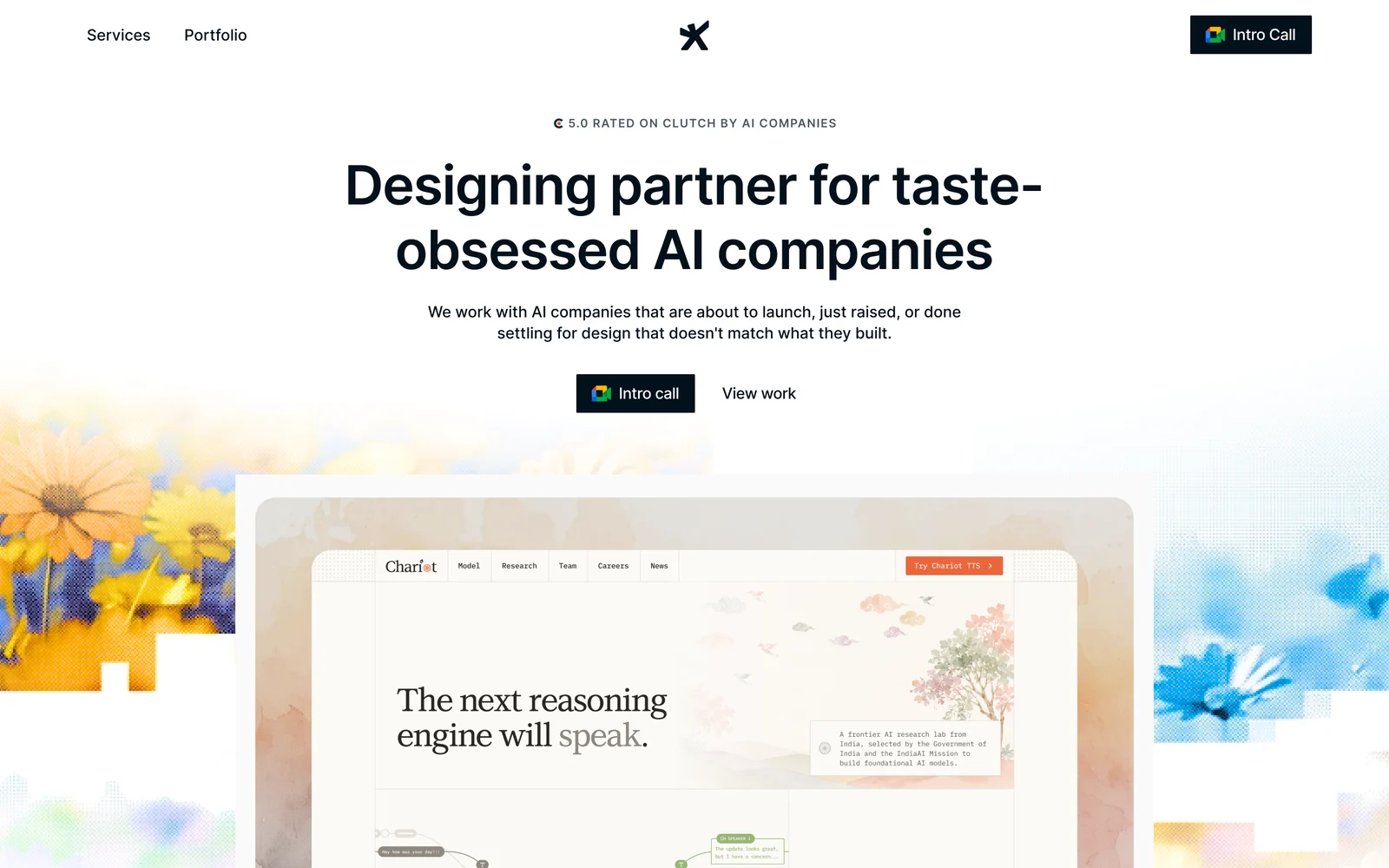
Studio Maydit is a web and product design studio, working with AI founders based in the US, UK, and Europe. The relevant detail for a team with no designer is that it is founder-led and senior, so the person who understands the business is the person doing the work. Framer is used where the site will change most weeks, Webflow where a marketer needs to own it without asking, and custom code only where the product genuinely will not fit either.
Take Dualite. Seven months, 100,000+ users, and the design work that produced them started from a repositioned ICP rather than from a layout. That is the part worth noticing if you have no designer, because the decision that mattered was not a visual one at all. It was choosing who the product was for, which is a decision a founder is far better placed to make than a design team. Recent clients include Wave, PixelFlow, Mi-VAD, and 15 other AI and SaaS teams.
Buying works two ways. Fixed scope takes three to four weeks and suits a company with a date in mind, and it closes with a written diagnosis of what is leaking in the product, which is useful when there is nobody internally whose job it is to notice. Companies that keep shipping take the monthly retainer instead, covering new pages, campaigns, and product design, with no long lock-in, and it doubles as the design judgement the company does not employ.
| Check | Finding |
|---|---|
| Based in | Remote, serving US / UK / EU |
| Platform depth | Framer, Webflow, and custom code |
| AI-sector proof | Yes. AI-native clients, published outcome on Dualite |
| Pricing | Fixed scope or monthly retainer, quoted per project |
| Team shape | Founder-led, small senior team |
| Best fit | Teams with no designer who need decisions made, not options presented |
If your feedback keeps coming out as make it feel more premium, the missing piece is a translator. Book a 30-minute call.

2. Lighthouse Digital
Lighthouse Digital is a London Webflow studio publishing a starting price, with HelloSelf, Freetrade, and IGN as clients. Freetrade is a consumer fintech, which means work that had to be understood instantly by people who were not going to study it, and that is a good instinct for a founder-led site.
Two gaps matter here. There is no AI-sector proof at all, and neither a founding year nor a team size is published, so there is little to weigh besides the client list.
| Check | Finding |
|---|---|
| Based in | London, UK |
| Founded | Not published |
| Team size | Not published |
| Primary platform | Webflow |
| AI-sector proof | No |
| Named clients | HelloSelf, Freetrade, IGN |
| Pricing | Published minimum |
| Best fit | UK teams wanting a clear Webflow build at a stated price |
3. Instrument
Instrument has worked from Portland since 2005 for Nike, Microsoft, Electronic Arts, and Google. The craft is not in question and neither is the longevity, and for a company that wants a genuine brand moment the work is among the strongest here.
The mismatch is structural. Engagements of this kind are built around clients with internal design and brand teams to brief and to review, no pricing is published, and the AI proof is partial.
| Check | Finding |
|---|---|
| Based in | Portland, USA |
| Founded | 2005 |
| Team size | Not published |
| Primary platform | Mixed |
| AI-sector proof | Partial |
| Named clients | Nike, Microsoft, Electronic Arts, Google |
| Pricing | Not published |
| Best fit | Organisations with their own design function |
4. Refokus
Refokus is a remote German studio founded in 2021 with eleven to fifty people in Webflow, working for Mural, BASF, Spotify, Yahoo, and BCG. That is a serious client list for a studio of that age, and Webflow means a marketer can publish without help afterwards.
Nothing is published on pricing, and the AI-sector proof is partial, so a technical product will need explaining from scratch.
| Check | Finding |
|---|---|
| Based in | Germany, remote |
| Founded | 2021 |
| Team size | 11-50 |
| Primary platform | Webflow |
| AI-sector proof | Partial |
| Named clients | Mural, BASF, Spotify, Yahoo, BCG |
| Pricing | Not published |
| Best fit | Teams wanting recognised brand work on an editable platform |
5. Pixelmatters
Pixelmatters is a Porto studio founded in 2013 with fifty-one to two hundred people, a published starting price, and Rubrik, Quantic, and UJET as clients. It carries both design and engineering, which is useful when there is no one internally to bridge the two, and it has been doing so long enough to bring a process rather than wait for a brief.
The AI-sector proof is partial, and at that headcount your project passes through several hands before it reaches a screen.
| Check | Finding |
|---|---|
| Based in | Porto, Portugal |
| Founded | 2013 |
| Team size | 51-200 |
| Primary platform | Mixed |
| AI-sector proof | Partial |
| Named clients | Rubrik, Quantic, UJET |
| Pricing | Published minimum |
| Best fit | Founder-led teams wanting design and build from one supplier |
6. Push Refresh
Push Refresh is a Dallas studio of one to ten people in Framer with a published starting price, working for SmithRx, Synonym, and Northern National. A team that small means the person you brief is the person building, with nothing lost in translation, and Framer is about as approachable as a handover gets.
Capacity and evidence are both thin. No founding year is published, the AI proof is partial, and a team of that size cannot carry a large site alongside other clients.
| Check | Finding |
|---|---|
| Based in | Dallas, USA |
| Founded | Not published |
| Team size | 1-10 |
| Primary platform | Framer |
| AI-sector proof | Partial |
| Named clients | SmithRx, Synonym, Northern National |
| Pricing | Published minimum |
| Best fit | Small sites where the founder wants one person to talk to |
7. Digidop
Digidop is a Paris Webflow studio founded in 2021 with one to ten people, a published starting price, and TSE Energy, Ramify, and StreamNative as clients. StreamNative is developer infrastructure, so there is proof of taking something technical and making it legible, which is the harder half of this job.
The team is small and the AI-sector proof is partial, and working across French and English adds a little friction for a US team.
| Check | Finding |
|---|---|
| Based in | Paris, France |
| Founded | 2021 |
| Team size | 1-10 |
| Primary platform | Webflow |
| AI-sector proof | Partial |
| Named clients | TSE Energy, Ramify, StreamNative |
| Pricing | Published minimum |
| Best fit | Technical products needing a clear site and a stated price |
8. Flow Ninja
Flow Ninja is a Belgrade studio founded in 2018 with eleven to fifty people working in Webflow. The size is a reasonable middle ground: large enough to hold a full site, small enough that a founder is not managed by an account layer.
Almost nothing else is public. No named clients at all, no pricing, and partial AI proof, which leaves very little to evaluate before a call.
| Check | Finding |
|---|---|
| Based in | Belgrade, Serbia |
| Founded | 2018 |
| Team size | 11-50 |
| Primary platform | Webflow |
| AI-sector proof | Partial |
| Named clients | Not published |
| Pricing | Not published |
| Best fit | Teams comfortable evaluating a studio in conversation |
9. Flowout
Flowout is a distributed Webflow studio with a published starting price and Jasper, Kajabi, Riverside, and Sendlane named. The productised model has a real advantage for this brief: the scope is defined by the studio rather than by you, which removes the hardest task on a founder's list.
That same definition is the limit. You get what the model produces rather than a considered answer to your situation, and no founding year, team size, or full AI proof is published.
| Check | Finding |
|---|---|
| Based in | Distributed |
| Founded | Not published |
| Team size | Not published |
| Primary platform | Webflow |
| AI-sector proof | Partial |
| Named clients | Jasper, Kajabi, Riverside, Sendlane |
| Pricing | Published minimum |
| Best fit | Founders who want scope decided for them |
10. Edgar Allan
Edgar Allan is an Atlanta Webflow studio founded in 2014 with fifty-one to two hundred people and Porsche, Duracell, and NCR as clients. Brands of that size mean the studio is genuinely capable, and the Webflow depth is real.
It sits last for the same reason as Instrument. Clients of that scale come with marketing and brand teams, so the process expects counterparts you do not have, and neither pricing nor full AI proof is published.
| Check | Finding |
|---|---|
| Based in | Atlanta, USA |
| Founded | 2014 |
| Team size | 51-200 |
| Primary platform | Webflow |
| AI-sector proof | Partial |
| Named clients | Porsche, Duracell, NCR |
| Pricing | Not published |
| Best fit | Established brands with marketing teams to work alongside |
How to choose between them
Sort by what is actually broken.
If you cannot judge the work, buy the process instead. Pick a studio that publishes a price and can explain a decision in plain words. Pixelmatters or Digidop.
If nobody internally will own the site afterwards, the platform is the decision and everything else is secondary. Webflow or Framer, so a marketer can publish. Push Refresh, Digidop, or Refokus.
If the real risk is that the project never ends, buy something with edges. A productised scope removes the endless review problem by deciding for you. Flowout.
If you want work that will still look considered in three years and you have the budget, that is a craft purchase, and you should bring in an outside advisor for one hour to review the proposal. Instrument or Edgar Allan.
One test before you sign. Ask them what they will leave behind so a non-designer can add a page next year without ruining it. A studio that works with founders will describe rules, examples, and limits. A studio that works with design teams will describe a file.