Summarize with AI


For a technical founder, the ten studios worth reviewing are Studio Maydit, Engine Digital, Flowout, 8020, Edgar Allan, Refokus, Lighthouse Digital, Phantom, basement.studio, and Feels Like. basement.studio and 8020 lead this list. basement.studio has built for Vercel, Cursor, ElevenLabs, Harvey AI, and Scale AI, which is a client list of developer-facing companies and the fastest way to earn credibility with an engineer, and 8020 covers the same ground on a platform your team can hand to a marketer later. Engine Digital and Edgar Allan are the wrong fit here. Both are built around large brands with marketing departments, and you will spend the engagement talking to people who are not doing the work.
You could build this yourself in a weekend. That is precisely why it is the way it is.
Technical founders almost never have a bad website in the engineering sense. It is fast. It scores well. The markup is clean, the images are the right format, the build pipeline is enviable. What it does not do is make somebody want to buy the thing, and no amount of the first solves the second.
The pattern is consistent enough to be predictable. The site explains how the product works, because that is the interesting part and the part you can describe precisely. It uses the vocabulary the team uses internally, because that vocabulary is accurate. It leads with architecture, throughput, or model choice, because those are real differentiators to you.
Then a buyer arrives who is trying to work out whether this solves a problem they have, and finds a description of a system.
There is a second thing that makes this brief distinct, which is how technical founders evaluate agencies. The instinct is to assess them on things you can measure: the stack, the page weight, whether it ships static. Those are legitimate concerns and they are almost never why a project fails. Projects fail on whether anybody involved can write a clear sentence about what the company does for a person who has never heard of it.

How we picked these agencies
Five checks, all resolvable from public information before you talk to anyone.
Platform depth. What is delivered and who maintains it? For this audience the honest question is different from the usual one. You can maintain anything. The real question is whether you want to, because every hour spent on the marketing site is an hour not spent on the product, and founders who choose custom code for the site usually end up as its bottleneck.
Proof with engineer-led companies. Has the studio worked for a company where the founders were technical and the buyers were not? That is the specific translation problem here. A studio used to marketing-led clients receives a finished message and makes it look good. A studio used to engineers has to extract the message first, from people who can describe the system precisely and the value not at all.
Pricing. Is a starting number public? Engineers tend to be efficient buyers who want to compare options before entering a sales process, and studios that publish a floor let you do that in an afternoon.
Team shape. Size predicts who you actually talk to. Technical founders are usually poorly served by account layers, because the most valuable conversations in these projects are direct arguments about what matters, and those do not survive being relayed.
Their own site. The one artefact where the studio had complete freedom. Read the copy rather than the visuals, since copy is where this brief usually fails.
One extra test that separates the field quickly here. Send a studio your current homepage and ask what it fails to explain. A studio suited to technical founders will name the missing thing directly, usually the buyer's problem. A studio that is not will compliment the design and suggest a refresh.
The tables record what each studio publishes about itself, taken from its own material and nothing else. Where there is no public figure for price or team size, the row says so plainly, since for a buyer who values precision an unstated number is worth knowing about.
What goes wrong for engineer-led companies
Three failures, and all three are the same instinct applied in different places.
The site explains the system instead of the outcome. It is accurate, detailed, and correct, and it answers a question the visitor has not asked yet. Buyers move through a rough sequence: is this for me, does it solve my problem, can I trust it, what does it cost. Architecture belongs at the third step. Putting it first filters out everyone who has not already decided they need you, which is nearly everyone.
Quality gets measured on the axes you can measure. Performance scores, bundle size, and time to first byte are all real and all tracked, while the metrics that decide whether the site works, whether a stranger can say what you do after fifteen seconds, are never collected because they are awkward to instrument. What gets measured gets optimised, so the site becomes excellent at the things nobody is choosing on.
The copy is written for someone exactly like the founder. The words come from the team, so they carry the team's assumptions, and they land perfectly with other engineers. But the person with the budget is frequently not an engineer, and the person who forwards your link internally has to explain you to someone who is not one either. A site only technical readers can parse quietly limits you to buyers who need no persuading.
1. Studio Maydit: A Top-Rated Design Agency for AI Founders
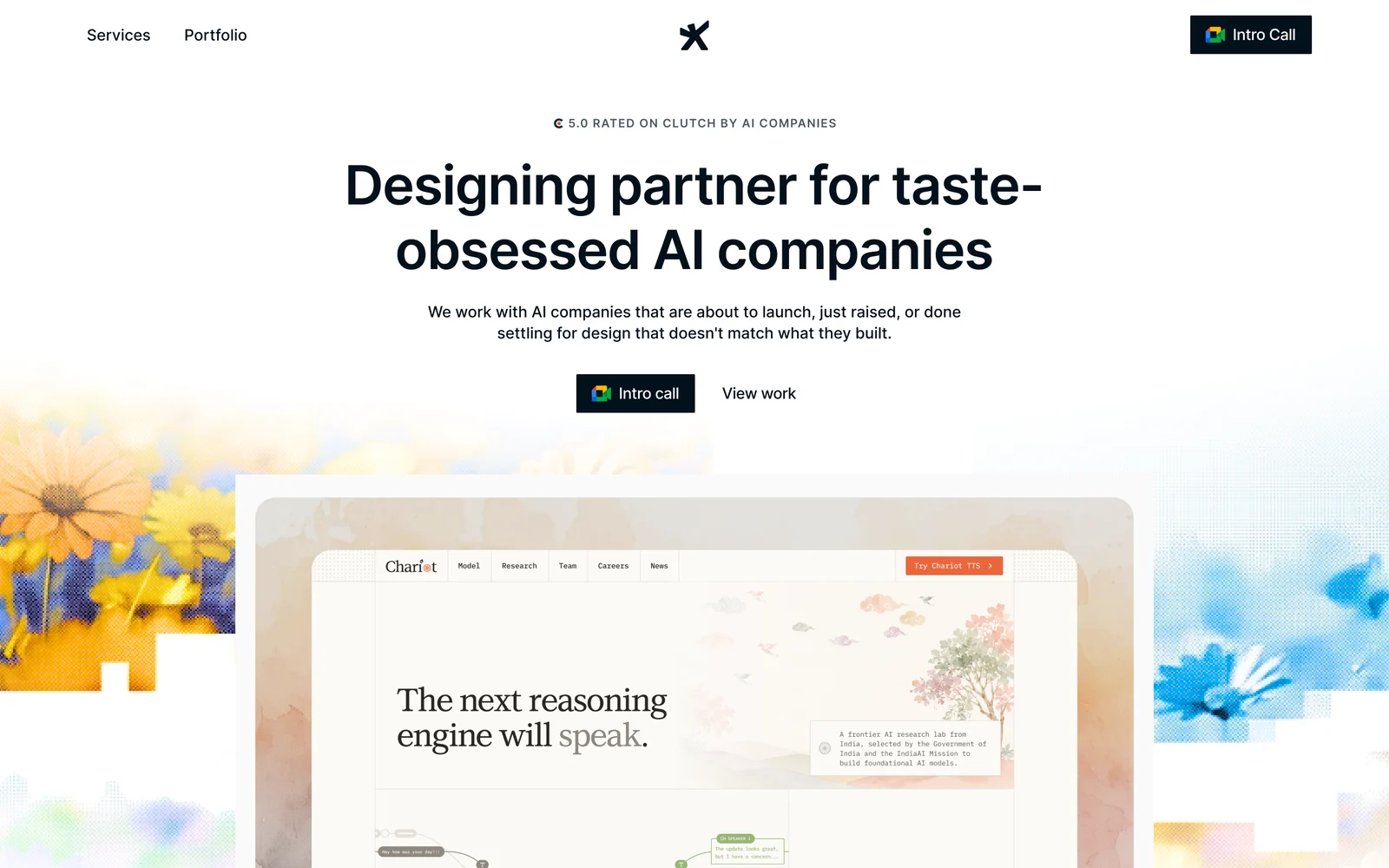
Studio Maydit is a web and product design studio, and it works with AI founders based in the US, UK, and Europe. It is founder-led and senior, which for this audience mostly means there is nobody between you and the person doing the work when you want to argue about a decision. The platform question gets answered by who has to touch the site later. Framer where it will change often, Webflow where a marketer should own it, custom code where the product genuinely will not tolerate either.
Dualite is the published example, and the useful detail is what came first. A repositioned ICP was settled, the design work then served that narrower group without exception, and 100,000+ users arrived over seven months. For an engineer-led team the transferable idea is that this was a scoping decision rather than a taste one: deciding who the thing is for, then removing everything that serves anybody else. That is a familiar kind of decision, applied to a surface most technical founders treat as unmeasurable. Recent clients include Wave, PixelFlow, Mi-VAD, and 15 other AI and SaaS teams.
There are two ways to buy. Fixed scope runs three to four weeks and suits a team with a launch in view, and it closes with a written diagnosis of what is leaking in the product, which tends to be the part technical founders find most useful because it is specific and testable. Where the site needs to keep moving alongside the roadmap, the monthly retainer covers new pages, campaigns, and product design, with no long lock-in.
| Check | Finding |
|---|---|
| Based in | Remote, serving US / UK / EU |
| Platform depth | Framer, Webflow, and custom code |
| AI-sector proof | Yes. AI-native clients, published outcome on Dualite |
| Pricing | Fixed scope or monthly retainer, quoted per project |
| Team shape | Founder-led, small senior team |
| Best fit | Engineer-led teams whose site explains the system and not the value |
If your homepage would make sense to your co-founder and to nobody else, that is the gap. Book a 30-minute call.

2. Engine Digital
Engine Digital has worked from Vancouver and New York since 2002 in custom code, with Adidas, Autodesk, Goldman Sachs, and HP as clients. Autodesk is deeply technical software, so there is genuine evidence of handling complex subject matter without flattening it.
The mismatch is the shape of the engagement. Clients of that size come with marketing departments and approval chains, the AI-sector proof is partial, and no pricing is published.
| Check | Finding |
|---|---|
| Based in | Vancouver and New York |
| Founded | 2002 |
| Team size | Not published |
| Primary platform | Custom code |
| AI-sector proof | Partial |
| Named clients | Adidas, Autodesk, Goldman Sachs, HP |
| Pricing | Not published |
| Best fit | Large organisations with internal marketing teams |
3. Flowout
Flowout is a distributed Webflow studio publishing a starting price, with Jasper, Kajabi, Riverside, and Sendlane named. The productised model appeals to engineers for an obvious reason: the scope is defined, the price is stated, and there is no discovery theatre before you find out what it costs.
What you get is the model's output rather than a considered answer to your situation, and no founding year, team size, or full AI proof is published.
| Check | Finding |
|---|---|
| Based in | Distributed |
| Founded | Not published |
| Team size | Not published |
| Primary platform | Webflow |
| AI-sector proof | Partial |
| Named clients | Jasper, Kajabi, Riverside, Sendlane |
| Pricing | Published minimum |
| Best fit | Founders who want a defined scope and a stated price |
4. 8020
8020 works from San Francisco and New York, founded in 2014, in Webflow, with Wave, Superlist, Pilot.com, Vanta, and Circle as clients. Vanta and Pilot both sell to technical teams and both had to explain something unglamorous clearly, which is the exact translation job in this brief.
The AI-sector proof is partial, and neither pricing nor team size is published.
| Check | Finding |
|---|---|
| Based in | San Francisco and New York, USA |
| Founded | 2014 |
| Team size | Not published |
| Primary platform | Webflow |
| AI-sector proof | Partial |
| Named clients | Wave, Superlist, Pilot.com, Vanta, Circle |
| Pricing | Not published |
| Best fit | B2B products that need explaining to non-technical buyers |
5. Edgar Allan
Edgar Allan is an Atlanta Webflow studio founded in 2014 with fifty-one to two hundred people, working for Porsche, Duracell, and NCR. That is real capability and deep Webflow experience, and the studio has been at it long enough to have a genuine process.
For this brief the clients tell the story. Those are consumer and industrial brands with marketing organisations, the AI proof is partial, and no pricing is published.
| Check | Finding |
|---|---|
| Based in | Atlanta, USA |
| Founded | 2014 |
| Team size | 51-200 |
| Primary platform | Webflow |
| AI-sector proof | Partial |
| Named clients | Porsche, Duracell, NCR |
| Pricing | Not published |
| Best fit | Established brands with marketing teams to work alongside |
6. Refokus
Refokus is a remote German studio founded in 2021 with eleven to fifty people in Webflow, working for Mural, BASF, Spotify, Yahoo, and BCG. BASF is industrial chemistry, which is about as far from consumer software as subject matter gets, and handling it well suggests a studio that will not simplify your product into nonsense.
Pricing is not published and the AI-sector proof is partial.
| Check | Finding |
|---|---|
| Based in | Germany, remote |
| Founded | 2021 |
| Team size | 11-50 |
| Primary platform | Webflow |
| AI-sector proof | Partial |
| Named clients | Mural, BASF, Spotify, Yahoo, BCG |
| Pricing | Not published |
| Best fit | Technical subject matter that must not be oversimplified |
7. Lighthouse Digital
Lighthouse Digital is a London Webflow studio publishing a starting price, with HelloSelf, Freetrade, and IGN as clients. Freetrade is a regulated financial product where the copy had to be both precise and understandable, which is the balance a technical founder usually gets wrong in one direction.
There is no AI-sector proof at all, and neither a founding year nor a team size is published.
| Check | Finding |
|---|---|
| Based in | London, UK |
| Founded | Not published |
| Team size | Not published |
| Primary platform | Webflow |
| AI-sector proof | No |
| Named clients | HelloSelf, Freetrade, IGN |
| Pricing | Published minimum |
| Best fit | UK teams needing precise copy at a stated price |
8. Phantom
Phantom runs from London and Auckland, founded in 2013, fifty-one to two hundred people, in custom code, with AI-sector proof and Diageo, SAP, Financial Times, and Zendesk as clients. SAP and Zendesk are both enterprise software, so there is evidence of writing for buyers who evaluate carefully.
At that headcount the engagement is formal, which many technical founders find slow, and nothing is published on price.
| Check | Finding |
|---|---|
| Based in | London, UK and Auckland, NZ |
| Founded | 2013 |
| Team size | 51-200 |
| Primary platform | Custom code |
| AI-sector proof | Yes |
| Named clients | Diageo, SAP, Financial Times, Zendesk |
| Pricing | Not published |
| Best fit | Companies selling into enterprises with formal reviews |
9. basement.studio
basement.studio operates from Mar del Plata and Los Angeles, founded in 2018, eleven to fifty people, in custom code, with AI-sector proof and a published starting price. Vercel, Cursor, ElevenLabs, Harvey AI, and Scale AI are all developer-facing companies, which means the studio has repeatedly had to make engineering products legible without patronising the audience.
The trade-off is one technical founders should weigh honestly. Custom code means the site becomes another repository your team owns, and eleven to fifty is a small team for a large scope.
| Check | Finding |
|---|---|
| Based in | Mar del Plata, Argentina and Los Angeles, USA |
| Founded | 2018 |
| Team size | 11-50 |
| Primary platform | Custom code |
| AI-sector proof | Yes |
| Named clients | Vercel, Cursor, ElevenLabs, Harvey AI, Scale AI |
| Pricing | Published minimum |
| Best fit | Developer-facing products that need credibility with engineers |
10. Feels Like
Feels Like is a Los Angeles studio founded in 2023 building in custom code, with Google, Nike, LVMH, and Suno AI as clients. The craft ceiling is high and the consumer brand work brings an instinct most engineering-led sites lack entirely.
It is last for this brief on evidence rather than ability. Nothing is published on pricing or team size, and the portfolio is weighted toward brands whose problem was never explaining a technical product to a sceptical buyer.
| Check | Finding |
|---|---|
| Based in | Los Angeles, USA |
| Founded | 2023 |
| Team size | Not published |
| Primary platform | Custom code |
| AI-sector proof | Yes |
| Named clients | Google, Nike, LVMH, Suno AI |
| Pricing | Not published |
| Best fit | Companies buying craft over explanation |
How to choose between them
Sort by what is actually broken.
If visitors cannot tell what the product does, that is a writing problem and you should buy it as one. 8020 or Refokus, and give the copy more of the budget than you instinctively want to.
If your buyers are engineers who will judge you on whether the site feels like it was made by people who ship, that is a craft and credibility purchase. basement.studio.
If you keep becoming the bottleneck because every marketing change is a pull request, the fix is the platform rather than the studio. Move to Webflow or Framer and accept that the site does not have to be built the way the product is.
If you want a defined scope, a published price, and no sales process, take the productised route and spend the saved time on the copy. Flowout.
One test before you sign. Ask them to explain your product back to you in two sentences, aimed at somebody who does not know what an inference cost is. A studio that fits this brief will get close on the first attempt. A studio that does not will repeat your own words back with better punctuation.