

Summarize with AI


For a UK-based AI startup, the ten studios worth reviewing are Studio Maydit, Ramotion, Engine Digital, Push Refresh, Finsweet, Pixelmatters, Feels Like, basement.studio, Feely Studio, and SuperSkills. Pixelmatters and Feely Studio lead this list. Pixelmatters works from Porto with fifty-one to two hundred people and a published starting price, so you get a full European working day and a number before any call, and Feely Studio is a small distributed European team with AI-sector proof and a published price. SuperSkills and Engine Digital are the wrong fit here. One publishes a single client and nothing else, and the other builds for organisations with internal marketing departments.
Start with an uncomfortable likelihood. Most of the money you are chasing is in America, and your website does not sound like it knows that.
British companies write British copy without deciding to. The register is careful, the claims are hedged, and the strongest sentence on the homepage begins with we believe. To a UK reader that is good manners. To an American buyer skimming four vendors before lunch, it reads as a company that is not sure about its own product.
The opposite error is worse and more common as a correction. Founders notice the problem, look at what US startups do, and copy the volume without the substance. The result is a British company shouting in an accent that is not its own, which persuades nobody on either side of the Atlantic.
There is a real advantage here that almost every UK AI site leaves on the table. You operate under UK and European data rules, and for a large set of buyers, particularly in health, finance, and the public sector, that is a reason to prefer you rather than a compliance chore. Most sites bury it in a footer link.
The last thing is practical. If your buyers are American, the site is doing the selling in hours when nobody on your team is awake. It has to answer more questions unattended than a US company's site ever does.

How we picked these agencies
Five checks, all of which can be settled from public pages before you book anything.
Platform depth. What is handed over, and who maintains it? A UK team selling into the US will change the copy repeatedly during the first year as the positioning meets a new market. If every change needs the studio, that is an ongoing cost in a currency that may not be yours.
Proof with European clients and real working overlap. Has the studio worked with companies in this part of the world, and will your calls happen inside your working day? This is the criterion carrying the most weight in this brief. It is not sentimentality about location. A studio eight hours behind you turns every question into a next-day answer, and a four-week project has about twenty working days in it.
Pricing. Is a starting number published? For a UK company there is a second reason this matters. Quotes in dollars move with the exchange rate between the proposal and the final invoice, and a published figure at least gives you a fixed point to plan against.
Team shape. Size decides who hears your explanation of the product and how many hands it passes through on the way to a page.
Their own site. The one project with no client. Read it for whether the studio can write, because for a UK company selling abroad, the writing is the part that has to change most.
An extra question that works well here. Ask a studio how they would handle the tone difference between a British reader and an American one. Studios who have done it describe specific choices about claims and evidence. Studios who have not will say something about the brand voice.
Every table below reflects only what a studio states publicly on its own pages. Nothing has been estimated, and where a studio publishes no figure the row says so rather than filling the gap with a guess.
What goes wrong for UK AI startups
Three failures, and the first two are about voice.
The site is written for a British reader and sold to an American one. Hedged claims, understated results, and a homepage that takes four paragraphs to say what the product does. In the UK this reads as credible restraint. To a buyer comparing you against three US competitors in twenty minutes, it reads as uncertainty, and they will not stay long enough to find the good part. The tell is simple: count the qualifiers in your first hundred words.
Or the correction overshoots and the company sounds fake. Founders who notice the first problem often fix it by borrowing American startup vocabulary wholesale. Now the site claims category leadership with three customers, and British buyers who know the company find it embarrassing while American buyers find it unconvincing because there is no evidence underneath. Confidence is a matter of specifics, not volume. Name the customer, state the number, and the tone takes care of itself.
The regulatory position is treated as a chore instead of a reason to buy. UK and European data rules are a genuine differentiator for AI products selling into regulated sectors, and this is the moment when buyers are most anxious about where their data goes and what it trains. Sites bury this in a privacy policy. A clear page saying where data is processed, what is retained, and what never trains a model does more for an enterprise conversation than any amount of design.
1. Studio Maydit: A Top-Rated Design Agency for AI Founders
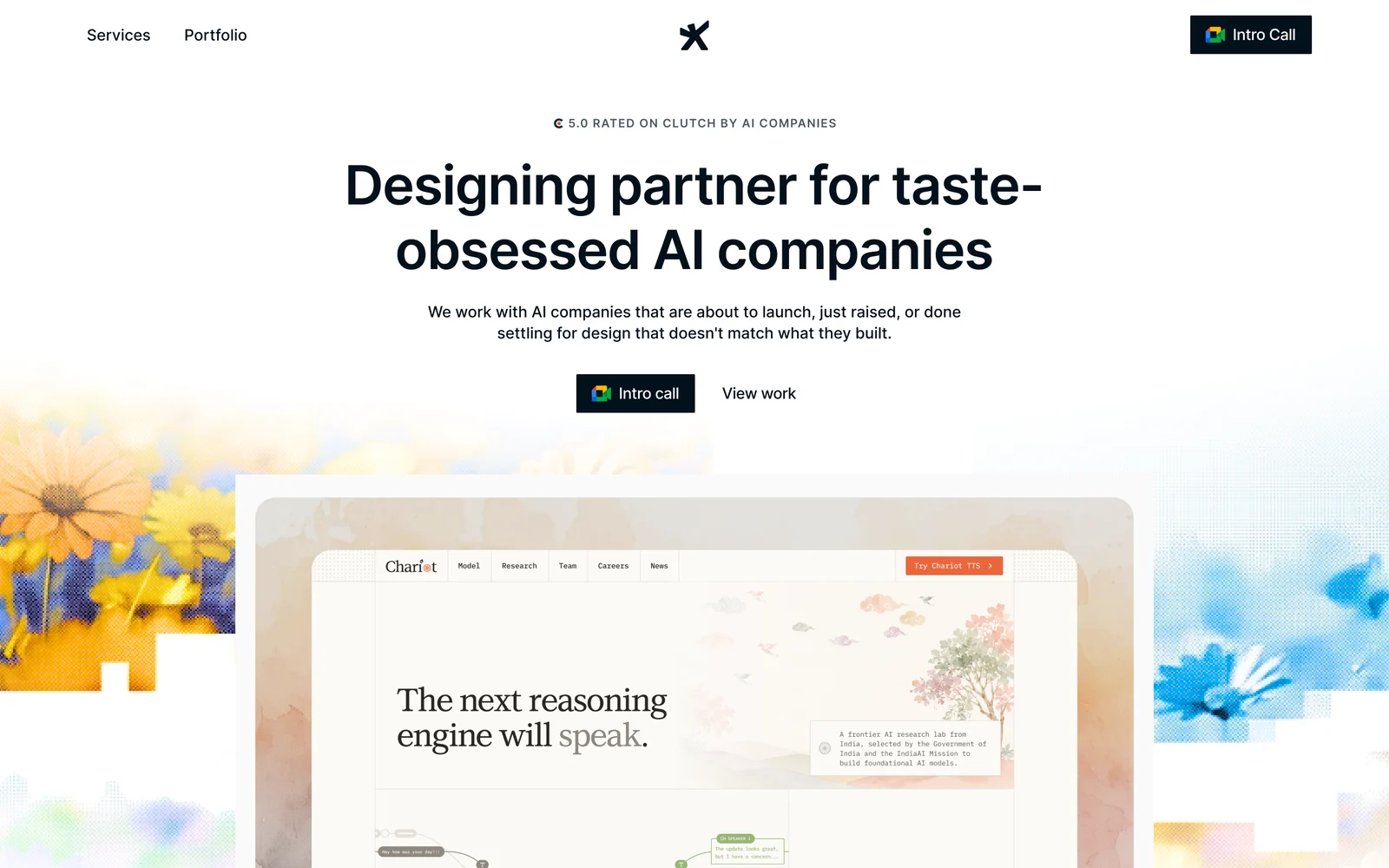
The clients are AI founders and they sit across the US, UK, and Europe, which for a British company is the relevant fact rather than an address. Studio Maydit is a web and product design studio working on both sides of that split, so the question of how a British product should sound to an American buyer is a familiar one rather than a new brief. Platform depends on the work ahead. Framer when the message will be rewritten several times as it meets a new market. Webflow when a marketing hire should own the site. Custom code when the product will not fit either. It continues into product design once the site ships.
Dualite narrowed before it grew. A repositioned ICP was decided first, everything designed afterwards served the smaller group that choice defined, and 100,000+ users arrived over seven months. UK AI companies meet this in a particular form, because the temptation is to write for the domestic market you know and the American market you want at the same time. One page cannot do both, and choosing is the work. Recent clients include Wave, PixelFlow, Mi-VAD, and 15 other AI and SaaS teams.
The monthly retainer suits a company whose positioning is still moving, which is most UK teams in their first year of selling abroad: it covers new pages, campaigns, and product design, with no long lock-in, so the site can follow what the market actually responds to. The other option is fixed scope, three to four weeks, which fits a launch or a funding date and ends with a written diagnosis of what is leaking in the product.
| Check | Finding |
|---|---|
| Based in | Remote, serving US / UK / EU |
| Platform depth | Framer, Webflow, and custom code |
| AI-sector proof | Yes. AI-native clients, published outcome on Dualite |
| Pricing | Fixed scope or monthly retainer, quoted per project |
| Team shape | Founder-led, small senior team |
| Best fit | UK teams whose site reads British to buyers who are not |
If the site has to sell while your team is asleep, it has to answer more than it currently does. Book a 30-minute call.

2. Ramotion
Ramotion has run from San Francisco since 2009 with eleven to fifty people and a published starting price, for Mozilla, Okta, Netflix, Adobe, and Xero. If your buyers are American, a studio that has spent seventeen years designing for that market knows the register you are trying to reach.
The time difference is eight hours from London, which turns most questions into next-day answers, and the AI-sector proof is partial.
| Check | Finding |
|---|---|
| Based in | San Francisco, USA |
| Founded | 2009 |
| Team size | 11-50 |
| Primary platform | Mixed |
| AI-sector proof | Partial |
| Named clients | Mozilla, Okta, Netflix, Adobe, Xero |
| Pricing | Published minimum |
| Best fit | UK companies whose whole market is in the United States |
3. Engine Digital
Engine Digital has worked from Vancouver and New York since 2002 in custom code, for Adidas, Autodesk, Goldman Sachs, and HP. Goldman Sachs and Autodesk both involve heavy review processes, so the studio is comfortable where approvals are the difficult part.
The engagements assume an internal marketing team, the AI-sector proof is partial, and neither pricing nor team size is published.
| Check | Finding |
|---|---|
| Based in | Vancouver and New York |
| Founded | 2002 |
| Team size | Not published |
| Primary platform | Custom code |
| AI-sector proof | Partial |
| Named clients | Adidas, Autodesk, Goldman Sachs, HP |
| Pricing | Not published |
| Best fit | Larger organisations with an internal team to receive the work |
4. Push Refresh
Push Refresh is a Dallas studio of one to ten people working in Framer with a published starting price, for SmithRx, Synonym, and Northern National. Framer plus a very small team means quick turnaround and a direct line to whoever is building.
Dallas is six hours behind London, capacity is limited for a site with several audiences, and no founding year is published.
| Check | Finding |
|---|---|
| Based in | Dallas, USA |
| Founded | Not published |
| Team size | 1-10 |
| Primary platform | Framer |
| AI-sector proof | Partial |
| Named clients | SmithRx, Synonym, Northern National |
| Pricing | Published minimum |
| Best fit | Focused sites where speed matters more than overlap |
5. Finsweet
Finsweet is a distributed studio based in Denver, founded in 2017, fifty-one to two hundred people, working in Webflow for Dropbox, Clay, GitHub, and Steadily. The Webflow depth is the strongest here, and being distributed usually means some European overlap in practice.
No pricing is published, so budget discussions start without an anchor, and the AI-sector proof is partial.
| Check | Finding |
|---|---|
| Based in | Denver, USA, distributed |
| Founded | 2017 |
| Team size | 51-200 |
| Primary platform | Webflow |
| AI-sector proof | Partial |
| Named clients | Dropbox, Clay, GitHub, Steadily |
| Pricing | Not published |
| Best fit | Sites carrying documentation and a lot of structured content |
6. Pixelmatters
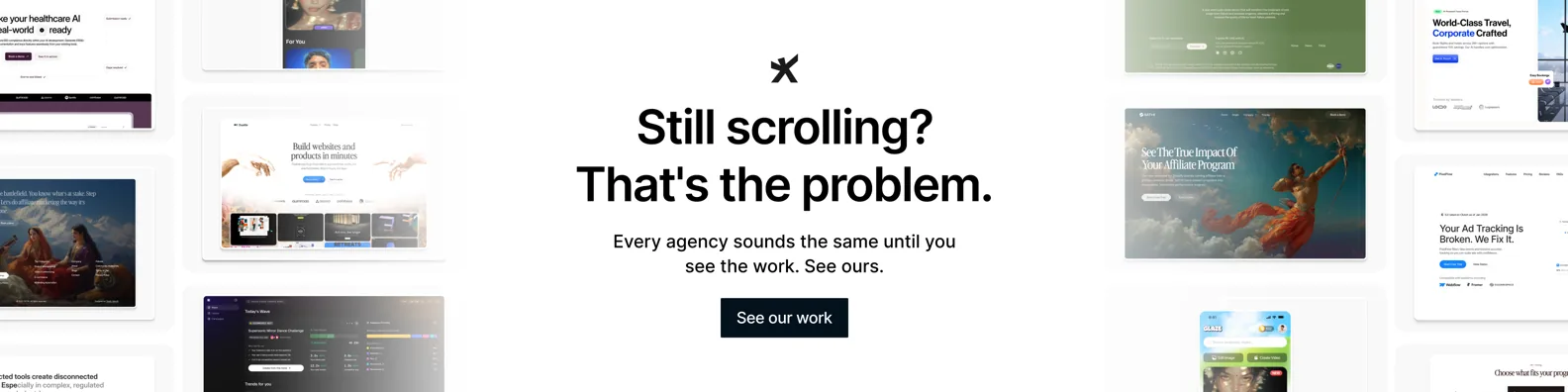
Pixelmatters is a Porto studio founded in 2013 with fifty-one to two hundred people, a published starting price, and Rubrik, Quantic, and UJET as clients. Portugal is one hour behind the UK, so the whole working day overlaps, and the studio covers design and engineering together.
The AI-sector proof is partial, and at that headcount your technical explanation reaches the designer through several other people.
| Check | Finding |
|---|---|
| Based in | Porto, Portugal |
| Founded | 2013 |
| Team size | 51-200 |
| Primary platform | Mixed |
| AI-sector proof | Partial |
| Named clients | Rubrik, Quantic, UJET |
| Pricing | Published minimum |
| Best fit | UK teams wanting a full European working day and one supplier |
7. Feels Like
Feels Like is a Los Angeles studio founded in 2023 in custom code, with AI-sector proof, for Google, Nike, LVMH, and Suno AI. Suno AI is a consumer AI product, and the craft here is high enough to change how a company is perceived.
Los Angeles is eight hours behind London, custom code means every later change goes through them, and neither team size nor pricing is published.
| Check | Finding |
|---|---|
| Based in | Los Angeles, USA |
| Founded | 2023 |
| Team size | Not published |
| Primary platform | Custom code |
| AI-sector proof | Yes |
| Named clients | Google, Nike, LVMH, Suno AI |
| Pricing | Not published |
| Best fit | Well-funded teams buying a bespoke build and a strong visual identity |
8. basement.studio
basement.studio works from Mar del Plata and Los Angeles, founded in 2018, eleven to fifty people, in custom code, with AI-sector proof and a published starting price, for Vercel, Cursor, ElevenLabs, Harvey AI, and Scale AI. Harvey AI is a legal product selling into a regulated profession, which is close to what many UK AI companies are doing.
Argentina gives four hours of afternoon overlap with the UK rather than a full day, and custom code creates a lasting dependency for edits.
| Check | Finding |
|---|---|
| Based in | Mar del Plata, Argentina and Los Angeles, USA |
| Founded | 2018 |
| Team size | 11-50 |
| Primary platform | Custom code |
| AI-sector proof | Yes |
| Named clients | Vercel, Cursor, ElevenLabs, Harvey AI, Scale AI |
| Pricing | Published minimum |
| Best fit | Technical teams wanting the strongest AI-native client list here |
9. Feely Studio
Feely Studio is a distributed European team of one to ten people with AI-sector proof and a published starting price, for Noxus, Mutiny, Luasai, and Basic Capital. European hours, AI experience, and a public number is the most practical combination on this page for a UK company.
The team is very small, so scheduling depends on their availability, and no founding year is published.
| Check | Finding |
|---|---|
| Based in | Distributed, Europe |
| Founded | Not published |
| Team size | 1-10 |
| Primary platform | Mixed |
| AI-sector proof | Yes |
| Named clients | Noxus, Mutiny, Luasai, Basic Capital |
| Pricing | Published minimum |
| Best fit | UK teams wanting senior European attention on one focused site |
10. SuperSkills
SuperSkills is a one to ten person studio in Walnut Creek with AI-sector proof and The Cut as its named client. It starts quickly and there is nobody between you and the person doing the work.
It is last for this brief on evidence and overlap. One named client, no founding year, no published pricing, and eight hours of time difference from London.
| Check | Finding |
|---|---|
| Based in | Walnut Creek, USA |
| Founded | Not published |
| Team size | 1-10 |
| Primary platform | Mixed |
| AI-sector proof | Yes |
| Named clients | The Cut |
| Pricing | Not published |
| Best fit | Teams wanting one page done fast and comfortable with little public evidence |
How to choose between them
Sort by what is actually broken.
If the copy hedges and your buyers are American, that is an editing problem before it is a design one. Ramotion or Pixelmatters, and brief it as a rewrite rather than a redesign.
If you need a full working day of overlap because decisions are moving weekly, stay in Europe. Pixelmatters or Feely Studio.
If your product sells into regulated buyers and the data story is the deal, you want a studio that has built that page before. basement.studio, whose client list includes a legal AI product.
If the site has to hold documentation and a growing library, that is structure. Finsweet.
One test before you sign. Send them your current homepage and ask which sentence an American buyer would not believe. A studio that fits this brief points at one immediately. A studio that does not will compliment the design.