
Summarize with AI


For a US-based AI startup, the ten studios worth reviewing are Studio Maydit, Pixelmatters, Finsweet, Instrument, 8020, Engine Digital, Flowout, Push Refresh, Edgar Allan, and Ramotion. Ramotion and 8020 lead this list. Ramotion has designed software from San Francisco since 2009 for Mozilla, Okta, Adobe, and Xero, with a published starting price, and 8020 has built for Wave, Superlist, Pilot.com, Vanta, and Circle, which is a run of American software companies at your stage. Instrument and Engine Digital are the wrong fit here. Both are built around clients with internal marketing departments, and neither publishes a price or a team size.
You are selling into the most crowded startup marketing environment that has ever existed, and the standard is unreasonably high.
That is the real constraint, and it is not the one founders usually name. Your buyer has seen a great deal of very good software marketing this year. The baseline they compare you against is not the average website. It is the handful of beautifully made product sites that everybody in your category has also been looking at.
Which produces the specific American problem. Everybody studies the same references, so everybody converges. The dark hero, the subtle gradient, the monospaced label, the feature grid with three icons. None of it is wrong. All of it is now invisible, because a buyer comparing four vendors sees the same page four times and remembers nothing.
There is a second thing, and it is financial. Domestic rates are high, and founders respond in one of two unhelpful ways. Either they buy far less design than the market demands because the quote was shocking, or they pay a premium for a name and receive a junior team. Neither is a price problem. Both are a scoping problem.
The third is pace. In this market the category conversation moves every few weeks, and a site written in March describes a position that was true in March. Nobody owns keeping it current, so the page slowly stops matching what the sales team says on calls.

How we picked these agencies
Five checks, all settled from public pages before anyone gets on a call.
Platform depth. What arrives, and who can change it in August? In this market the message will move several times a year, so the ability to edit without booking the agency again is worth more than any single design decision. Ask what publishing a new page costs you in month six, in time rather than money.
Proof with American software companies. Has the studio built for businesses selling into this market and growing quickly inside it? That criterion carries the most weight in this brief. It is not about recognisable logos. It is about whether a studio understands the register American buyers respond to and the pace at which a funded company here publishes.
Pricing. Is a starting number public? Domestic rates vary enormously and quoting is often deliberately opaque, so a published figure is a rare fixed point. It also lets a European studio on this list be compared honestly rather than on assumption.
Team shape. Size tells you who does the work and how many people your explanation passes through. It also predicts whether a premium name puts senior people on a startup account, which is the most common disappointment at this end of the market.
Their own site. The one brief with no client and no deadline pressure. Read it for whether they can be distinctive without being decorative, since that is the exact problem you are hiring them to solve.
An extra probe that works well here. Ask what they would do to make your site not look like the others in your category. A studio worth the money has an opinion and it is specific. A studio without one will show you a moodboard assembled from the same references you already know.
The tables below repeat what each studio publishes about itself and nothing else. No figures have been estimated or averaged, and a blank row means the studio has chosen not to state something rather than that it could not be found.
What goes wrong for US AI startups
Three failures, and the first is the cost of a shared reference set.
The site converges on the category default and disappears. The same admired sites circulate through the same group of founders and designers, so the same decisions get made independently by everyone. A buyer comparing four AI startups in an afternoon sees four dark heroes, four gradient orbs, and four three-column feature grids, and retains none of them. The test is uncomfortable and quick: cover your logo and ask whether anyone on your team could still identify the page.
The budget conversation happens before the scope conversation. Domestic rates are high enough to shock, so founders either cut scope until the project cannot succeed or pay for a premium name and get a team they never met. Both come from starting with a number instead of a decision. Settling which single page has to work, and for which buyer, makes almost every quote either obviously reasonable or obviously wrong.
Nobody owns keeping the site current. The category moves quickly here, and the sales team adapts their pitch on calls long before anyone updates a page. Six months on, the homepage argues a position the company has quietly abandoned, and new leads arrive with objections the site created. This is not a design failure and no redesign fixes it. It is an ownership gap, and the cheapest fix is a standing arrangement to publish rather than a bigger project next year.
1. Studio Maydit: A Top-Rated Design Agency for AI Founders
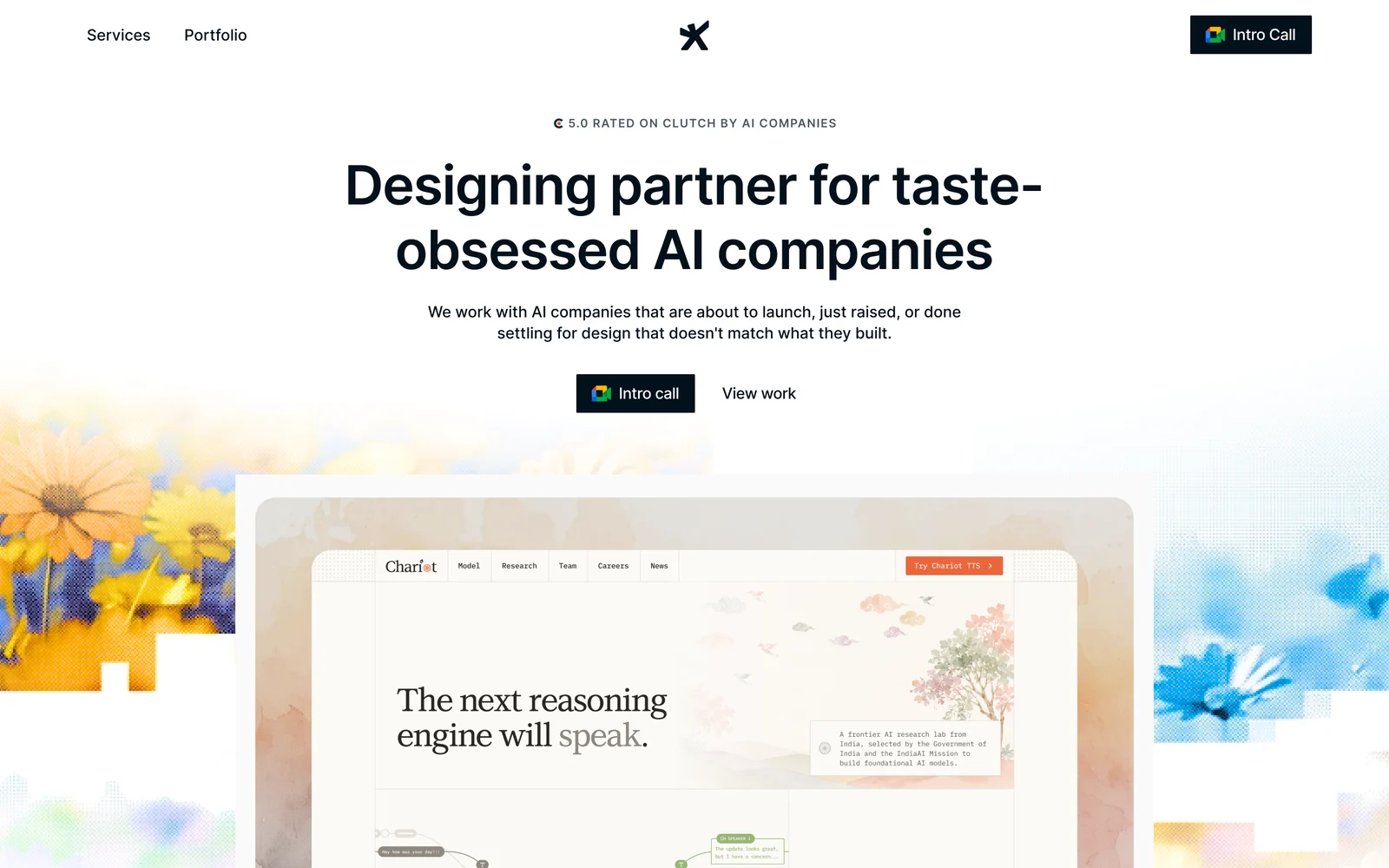
What a US AI startup usually needs after launch is not another redesign but a steady supply of pages, and that is the shape this studio is built around. Studio Maydit is a web and product design studio. Its clients are AI founders, spread across the US, UK, and Europe, which means the work is not soaked in a single market's conventions, and that outside view is useful precisely when everyone in your category is looking at the same references. Platform follows the pace: Framer when pages change weekly, Webflow when a marketing hire should own the site, custom code when the product will not fit either. The work continues into product design once a site ships.
Seven months is the span worth remembering from Dualite. Over it, the product reached 100,000+ users, and the sequence behind that is what transfers here. A repositioned ICP was agreed first, and only then did the design serve the smaller group that choice defined. American founders skip this more often than most, because the domestic market is large enough that every segment looks big enough to keep, and keeping all of them is what produces a homepage nobody remembers. Recent clients include Wave, PixelFlow, Mi-VAD, and 15 other AI and SaaS teams.
The monthly retainer exists for the ownership gap described above: new pages, campaigns, and product design on a continuing basis, with no long lock-in, so the site tracks what the sales team is actually saying this quarter. Fixed scope is the other option, three to four weeks against a launch or a funding date, ending with a written diagnosis of what is leaking in the product rather than a handover call.
| Check | Finding |
|---|---|
| Based in | Remote, serving US / UK / EU |
| Platform depth | Framer, Webflow, and custom code |
| AI-sector proof | Yes. AI-native clients, published outcome on Dualite |
| Pricing | Fixed scope or monthly retainer, quoted per project |
| Team shape | Founder-led, small senior team |
| Best fit | US teams whose homepage is indistinguishable from three competitors |
If covering your logo would make the homepage unidentifiable, that is the work. Book a 30-minute call.

2. Pixelmatters
Pixelmatters is a Porto studio founded in 2013 with fifty-one to two hundred people, a published starting price, and Rubrik, Quantic, and UJET as clients. All three are American software companies, which means a European team with a genuine record of serving this market, usually at lower rates than a comparable US studio.
Portugal is five to eight hours ahead of the US, so overlap is a morning rather than a day, and the AI-sector proof is partial.
| Check | Finding |
|---|---|
| Based in | Porto, Portugal |
| Founded | 2013 |
| Team size | 51-200 |
| Primary platform | Mixed |
| AI-sector proof | Partial |
| Named clients | Rubrik, Quantic, UJET |
| Pricing | Published minimum |
| Best fit | US teams wanting design and engineering together at European rates |
3. Finsweet
Finsweet is a distributed studio based in Denver, founded in 2017, fifty-one to two hundred people, working in Webflow for Dropbox, Clay, GitHub, and Steadily. The Webflow structure work here is the deepest on this page, which matters once your site carries docs, a changelog, and a growing library.
No pricing is published and the AI-sector proof is partial, so the budget conversation starts without a reference point.
| Check | Finding |
|---|---|
| Based in | Denver, USA, distributed |
| Founded | 2017 |
| Team size | 51-200 |
| Primary platform | Webflow |
| AI-sector proof | Partial |
| Named clients | Dropbox, Clay, GitHub, Steadily |
| Pricing | Not published |
| Best fit | Sites about to grow a lot of structured content |
4. Instrument
Instrument has run from Portland since 2005 for Nike, Microsoft, Electronic Arts, and Google. As brand work it is among the strongest on this page and it has genuine cultural reach when a company is large enough to use it.
The shape is the mismatch. These programmes assume an internal marketing and design team to receive them, the AI-sector proof is partial, and nothing is published about price or headcount.
| Check | Finding |
|---|---|
| Based in | Portland, USA |
| Founded | 2005 |
| Team size | Not published |
| Primary platform | Mixed |
| AI-sector proof | Partial |
| Named clients | Nike, Microsoft, Electronic Arts, Google |
| Pricing | Not published |
| Best fit | Later-stage companies buying a full brand programme |
5. 8020
8020 has worked from San Francisco and New York since 2014 in Webflow, for Wave, Superlist, Pilot.com, Vanta, and Circle. That client list is the most relevant here: five American software companies at or near your stage, and Webflow means your own team publishes afterwards.
Neither team size nor pricing is published, so capacity and budget are both conversations, and the AI-sector proof is partial.
| Check | Finding |
|---|---|
| Based in | San Francisco and New York, USA |
| Founded | 2014 |
| Team size | Not published |
| Primary platform | Webflow |
| AI-sector proof | Partial |
| Named clients | Wave, Superlist, Pilot.com, Vanta, Circle |
| Pricing | Not published |
| Best fit | US startups wanting a studio that has run this stage repeatedly |
6. Engine Digital
Engine Digital has worked from Vancouver and New York since 2002 in custom code, for Adidas, Autodesk, Goldman Sachs, and HP. Autodesk and Goldman Sachs both involve heavy internal review, so the studio is comfortable where getting approval is the difficult part.
For a startup the model is wrong: the engagements assume an internal team, custom code means returning for every edit, and neither price nor headcount is published.
| Check | Finding |
|---|---|
| Based in | Vancouver and New York |
| Founded | 2002 |
| Team size | Not published |
| Primary platform | Custom code |
| AI-sector proof | Partial |
| Named clients | Adidas, Autodesk, Goldman Sachs, HP |
| Pricing | Not published |
| Best fit | Large organisations with internal teams and long timelines |
7. Flowout
Flowout is a distributed Webflow studio with a published starting price, for Jasper, Kajabi, Riverside, and Sendlane. Jasper is an American AI product with a subscription business, and the productised process plus a public number means a project starts in days rather than after several calls.
Very little else is published: no founding year, no team size, and the AI-sector proof is partial.
| Check | Finding |
|---|---|
| Based in | Distributed |
| Founded | Not published |
| Team size | Not published |
| Primary platform | Webflow |
| AI-sector proof | Partial |
| Named clients | Jasper, Kajabi, Riverside, Sendlane |
| Pricing | Published minimum |
| Best fit | Teams wanting pages shipped fast at a number they already know |
8. Push Refresh
Push Refresh is a Dallas studio of one to ten people working in Framer with a published starting price, for SmithRx, Synonym, and Northern National. A very small American team means direct contact and fast turnaround, and Framer means your team publishes without engineering afterwards.
Capacity is the constraint once several pages are needed at once, no founding year is published, and the AI-sector proof is partial.
| Check | Finding |
|---|---|
| Based in | Dallas, USA |
| Founded | Not published |
| Team size | 1-10 |
| Primary platform | Framer |
| AI-sector proof | Partial |
| Named clients | SmithRx, Synonym, Northern National |
| Pricing | Published minimum |
| Best fit | One focused site built quickly with the founder in every call |
9. Edgar Allan
Edgar Allan is an Atlanta studio founded in 2014 with fifty-one to two hundred people working in Webflow, for Porsche, Duracell, and NCR. The brand systems work is strong and a studio that size can hold a large site together as content keeps arriving.
The clients are established consumer and industrial companies rather than early software, the AI-sector proof is partial, and no pricing is published.
| Check | Finding |
|---|---|
| Based in | Atlanta, USA |
| Founded | 2014 |
| Team size | 51-200 |
| Primary platform | Webflow |
| AI-sector proof | Partial |
| Named clients | Porsche, Duracell, NCR |
| Pricing | Not published |
| Best fit | Companies buying a brand system with a large site behind it |
10. Ramotion
Ramotion has operated from San Francisco since 2009 with eleven to fifty people and a published starting price, for Mozilla, Okta, Netflix, Adobe, and Xero. Seventeen years designing software Americans use daily is real evidence, the team size means senior people stay close to the work, and the published figure is unusual at this tier.
It is last on this page by ordering rather than by fit. The AI-sector proof is partial, so the particular job of explaining a model-based product would be worked out on your project rather than brought to it.
| Check | Finding |
|---|---|
| Based in | San Francisco, USA |
| Founded | 2009 |
| Team size | 11-50 |
| Primary platform | Mixed |
| AI-sector proof | Partial |
| Named clients | Mozilla, Okta, Netflix, Adobe, Xero |
| Pricing | Published minimum |
| Best fit | US startups wanting a long domestic software track record |
How to choose between them
Sort by what is actually broken.
If the site looks like everyone else in your category, you need an opinion rather than a redesign, and it is the highest-value thing here. Ramotion or Edgar Allan, and brief it as differentiation rather than refresh.
If the quotes are the obstacle, compare a European studio honestly against a domestic one before deciding you cannot afford good work. Pixelmatters, which publishes a number and has American clients.
If the site is going to carry docs, a changelog, and a growing library, that is structure and it should lead. Finsweet.
If you need a page next week and the brand can wait, buy speed at a published price. Flowout or Push Refresh.
One test before you sign. Show them your two closest competitors and ask what they would do that neither has done. A studio that fits this brief answers with something structural. A studio that does not will talk about a colour palette.