

Summarize with AI


For a venture-backed AI startup, the ten studios worth reviewing are Studio Maydit, Pixelmatters, 8020, Instrument, Flow Ninja, Finsweet, Push Refresh, Refokus, Phantom, and Trueform. 8020 and Pixelmatters lead this list. 8020 has built for Wave, Superlist, Pilot.com, Vanta, and Circle, which is a client list made almost entirely of venture-backed software companies at the stage you are at now, and Pixelmatters brings design and engineering under one roof with a published starting price. Instrument and Flow Ninja are the wrong fit here. One sells brand programmes to companies with internal marketing departments, and the other publishes no client names at all.
Money does not change what your website has to say. It changes what you can afford to get wrong.
That sounds like a small distinction and it is the whole problem. Before the round, budget forced you to choose. One audience, one claim, one page that had to work. After the round you can build the twelve-page site that speaks to enterprise buyers and developers and future hires and the next fund, and because you can, you usually do.
A site that addresses four audiences persuades none of them. Every additional group you write for makes the homepage vaguer, because the only sentences that are true for everybody are the ones that mean nothing.
The second thing that happens is timing. The redesign gets scheduled around the funding announcement, which is a date set by a press embargo rather than by anything the customer needs. So the brief becomes look bigger by the fifteenth, and looking bigger is not a goal a designer can act on usefully.
The third is subtler. Funded teams start designing for the company they expect to be in eighteen months. The site describes a platform when what exists is one good feature, and the demo call that follows has to walk the difference back.
So the useful question before you brief anyone is not what should the new site look like. It is which single buyer are we willing to be obviously right for.

How we picked these agencies
Five checks, each answerable from public material before anyone gets on a call.
Platform depth. What do you get, and who can change it next month? This matters more after a raise than before one, because your page count is about to grow. If a marketing hire lands in six weeks and every edit needs a developer, you have bought a bottleneck. Ask what happens the first time someone wants a new landing page on a Thursday.
Proof with venture-backed companies. Has the studio worked for a business that raised institutional money and had to grow fast afterwards? That is the criterion carrying the most weight in this brief, and it is not the same as having worked with big brands. A funded startup changes its story twice a year, ships pages weekly, and answers to a board. Studios trained on established companies design for stability, which is the wrong assumption about your next twelve months.
Pricing. Does a starting figure exist in public? Post-raise this cuts both ways. You are now a customer who can be quoted higher because the funding is a matter of record, so a published number is a rare fixed reference point.
Team shape. Size tells you who does the work and how many people sit between you and them. It also tells you whether the studio can absorb a request that arrives on a Friday, which after a raise is most requests.
Their own site. Nobody briefed it and nobody signed it off, so it shows what the studio believes when unconstrained. Read the writing more than the visuals.
A useful extra question for this brief. Ask a studio what they would remove from your current homepage. Studios that understand funded companies answer immediately and name a whole section. Studios that do not will offer to add something.
The tables below carry only what each studio puts on its own site. No estimates, no ranges reconstructed from elsewhere, and where a figure is missing the row records the gap rather than guessing at it.
What goes wrong for venture-backed AI startups
Three failures, and funding causes all three by removing a constraint.
The site expands to fit the budget. With money available, the scope grows from the pages you need to the pages a company your size is supposed to have. A careers page with two roles. A resources hub with three posts. A customer stories section with one story. Each looks thin, and thin sections do more damage than absent ones, because they advertise that the company is smaller than the site is pretending. Ship four pages that are complete.
Nobody chooses an audience, because now you do not have to. The homepage tries to reassure an enterprise buyer, excite a developer, impress a candidate, and satisfy an investor. Those four want contradictory things: the buyer wants proof of stability, the developer wants the technical detail that proves you are not marketing fluff, the candidate wants ambition. Written together they average out into category language that describes no product at all.
The site describes the roadmap rather than the product. Funded teams write in the future tense without noticing. The platform becomes a platform before the second product exists, and the copy promises breadth the demo cannot show. This is the failure that costs deals rather than clicks, because the gap only appears when a serious buyer is thirty minutes into an evaluation and has stopped giving you the benefit of the doubt.
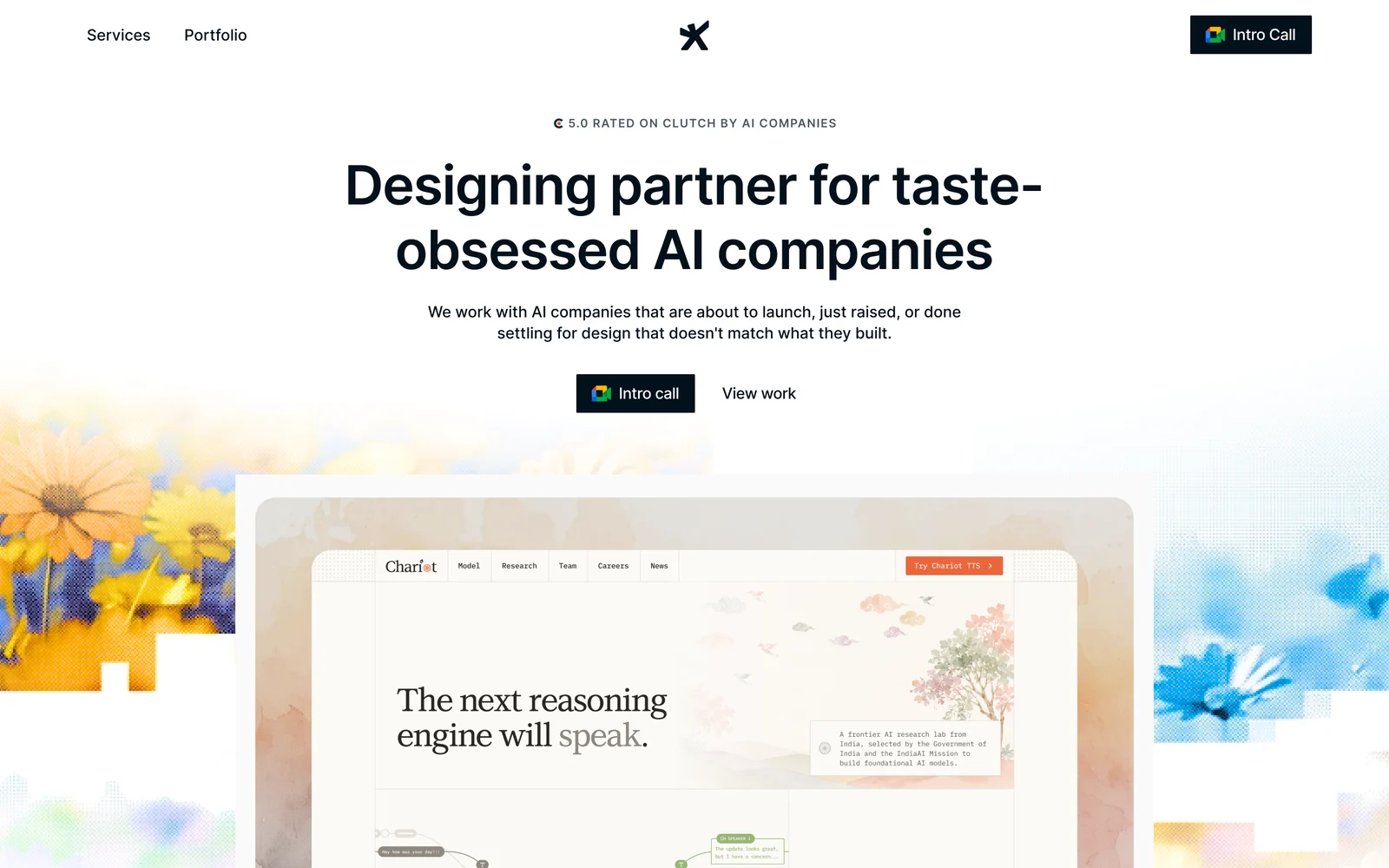
1. Studio Maydit: A Top-Rated Design Agency for AI Founders
Its clients are AI founders, spread across the US, UK, and Europe. Studio Maydit is a web and product design studio, and for a company that has just raised the relevant part is that it does not stop at the site: it continues into product design after the site ships, which is where the money usually needs to go next. Platform is a decision, not a default. Framer when a page has to change weekly. Webflow when a new marketing hire should own it without filing a ticket. Custom code when the product will not sit inside either.
Seven months is the number worth holding onto. Over that period Dualite reached 100,000+ users, and the part that transfers to a funded team is the order of operations rather than the result. A repositioned ICP came first, and only then did the design work serve the narrower group that choice created. Funding makes that choice avoidable, which is exactly why so few post-raise sites make it. Recent clients include Wave, PixelFlow, Mi-VAD, and 15 other AI and SaaS teams.
A fixed-scope project ends with a written diagnosis of what is leaking in the product, and after a raise that is usually the more valuable half, because the next quarter of growth spend runs straight through whatever is broken. The project itself is three to four weeks, which fits an announcement date. Where the story is still moving and pages are needed weekly, the monthly retainer is the better shape, covering new pages, campaigns, and product design, with no long lock-in.
| Check | Finding |
|---|---|
| Based in | Remote, serving US / UK / EU |
| Platform depth | Framer, Webflow, and custom code |
| AI-sector proof | Yes. AI-native clients, published outcome on Dualite |
| Pricing | Fixed scope or monthly retainer, quoted per project |
| Team shape | Founder-led, small senior team |
| Best fit | Funded teams whose homepage now speaks to four audiences at once |
If the new money is about to be spent driving traffic to a page that talks to everyone, start there. Book a 30-minute call.

2. Pixelmatters
Pixelmatters is a Porto studio founded in 2013 with fifty-one to two hundred people, a published starting price, and Rubrik, Quantic, and UJET as clients. Rubrik and UJET are both venture-backed software companies that grew into enterprise sales, which is the path most funded AI startups are trying to walk.
The AI-sector proof is partial, and at that size your technical explanation is relayed through several people before anyone draws a page.
| Check | Finding |
|---|---|
| Based in | Porto, Portugal |
| Founded | 2013 |
| Team size | 51-200 |
| Primary platform | Mixed |
| AI-sector proof | Partial |
| Named clients | Rubrik, Quantic, UJET |
| Pricing | Published minimum |
| Best fit | Funded teams wanting design and engineering from one studio |
3. 8020
8020 has worked from San Francisco and New York since 2014 in Webflow, for Wave, Superlist, Pilot.com, Vanta, and Circle. That is the most directly relevant client list on this page: five venture-backed software companies, several of which grew through exactly the stage you are in.
No team size and no pricing are published, so both capacity and budget have to be established in conversation, and the AI-sector proof is partial.
| Check | Finding |
|---|---|
| Based in | San Francisco and New York, USA |
| Founded | 2014 |
| Team size | Not published |
| Primary platform | Webflow |
| AI-sector proof | Partial |
| Named clients | Wave, Superlist, Pilot.com, Vanta, Circle |
| Pricing | Not published |
| Best fit | Funded startups wanting a studio that has done this stage repeatedly |
4. Instrument
Instrument has run from Portland since 2005 for Nike, Microsoft, Electronic Arts, and Google. If the goal is a brand with genuine cultural weight behind a large launch, the work here is among the best on this page.
The shape does not match this brief. Programmes at this level assume an internal marketing and design team to receive them, the AI-sector proof is partial, and nothing is published about price or headcount.
| Check | Finding |
|---|---|
| Based in | Portland, USA |
| Founded | 2005 |
| Team size | Not published |
| Primary platform | Mixed |
| AI-sector proof | Partial |
| Named clients | Nike, Microsoft, Electronic Arts, Google |
| Pricing | Not published |
| Best fit | Later-stage companies buying a full brand programme |
5. Flow Ninja
Flow Ninja is a Belgrade studio founded in 2018 with eleven to fifty people working in Webflow. The team size is a workable middle: large enough to keep several pages moving at once, small enough to reach the people building.
The evidence is unusually thin. No client names are published, no pricing is published, and the AI-sector proof is partial, which leaves almost the whole assessment to a call.
| Check | Finding |
|---|---|
| Based in | Belgrade, Serbia |
| Founded | 2018 |
| Team size | 11-50 |
| Primary platform | Webflow |
| AI-sector proof | Partial |
| Named clients | Not published |
| Pricing | Not published |
| Best fit | Teams comfortable evaluating a studio entirely through conversation |
6. Finsweet
Finsweet is a distributed studio based in Denver, founded in 2017, fifty-one to two hundred people, working in Webflow for Dropbox, Clay, GitHub, and Steadily. The Webflow depth here is the strongest on this page, and it shows in structure rather than styling, which matters once your site has a blog, a docs area, and a customer stories section.
No pricing is published and the AI-sector proof is partial, so a funded company starts the budget conversation with no external anchor.
| Check | Finding |
|---|---|
| Based in | Denver, USA, distributed |
| Founded | 2017 |
| Team size | 51-200 |
| Primary platform | Webflow |
| AI-sector proof | Partial |
| Named clients | Dropbox, Clay, GitHub, Steadily |
| Pricing | Not published |
| Best fit | Sites about to grow a lot of structured content |
7. Push Refresh
Push Refresh is a Dallas studio of one to ten people working in Framer with a published starting price, for SmithRx, Synonym, and Northern National. Framer plus a team that small means fast turnaround and direct contact, which suits a company that needs a page before an announcement.
Capacity is the constraint after a raise, when requests arrive in parallel rather than in sequence. No founding year is published and the AI-sector proof is partial.
| Check | Finding |
|---|---|
| Based in | Dallas, USA |
| Founded | Not published |
| Team size | 1-10 |
| Primary platform | Framer |
| AI-sector proof | Partial |
| Named clients | SmithRx, Synonym, Northern National |
| Pricing | Published minimum |
| Best fit | One focused site built quickly with a founder in the room |
8. Refokus
Refokus is a remote German studio founded in 2021 with eleven to fifty people, working in Webflow for Mural, BASF, Spotify, Yahoo, and BCG. Mural and Spotify are both software products that had to explain themselves to very different audiences, and the craft on display is high.
The client list runs to established brands rather than early companies, the AI-sector proof is partial, and no pricing is published.
| Check | Finding |
|---|---|
| Based in | Germany, remote |
| Founded | 2021 |
| Team size | 11-50 |
| Primary platform | Webflow |
| AI-sector proof | Partial |
| Named clients | Mural, BASF, Spotify, Yahoo, BCG |
| Pricing | Not published |
| Best fit | Funded companies wanting a visually ambitious European studio |
9. Phantom
Phantom has worked from London and Auckland since 2013 with fifty-one to two hundred people in custom code, with AI-sector proof, for Diageo, SAP, Financial Times, and Zendesk. SAP and Zendesk are enterprise software, and a custom-code studio of this size can build something genuinely bespoke.
Custom code means every future change goes back through engineering, which is the wrong shape for a company that will want new pages weekly. No pricing is published.
| Check | Finding |
|---|---|
| Based in | London, UK and Auckland, NZ |
| Founded | 2013 |
| Team size | 51-200 |
| Primary platform | Custom code |
| AI-sector proof | Yes |
| Named clients | Diageo, SAP, Financial Times, Zendesk |
| Pricing | Not published |
| Best fit | Well-funded teams wanting a bespoke build and holding engineering time |
10. Trueform
Trueform is a Swiss studio founded in 2022 working in Framer, with AI-sector proof and a published starting price, for Miro, Morning Brew, Bilt Rewards, and Gather. Framer means your team publishes without waiting on anyone, and the AI proof plus a published number is a rare combination on this page.
It sits last on evidence depth rather than quality. No team size is published and the trading history is short, which matters if you want a studio that will still be there for the next two rounds.
| Check | Finding |
|---|---|
| Based in | Wil, Switzerland |
| Founded | 2022 |
| Team size | Not published |
| Primary platform | Framer |
| AI-sector proof | Yes |
| Named clients | Miro, Morning Brew, Bilt Rewards, Gather |
| Pricing | Published minimum |
| Best fit | Teams that want to publish pages themselves from week one |
How to choose between them
Sort by what is actually broken.
If the homepage is trying to satisfy four audiences, the fix is editorial and it is the cheapest item here. 8020 or Pixelmatters, and go in expecting to delete more than you add.
If pages are the bottleneck and marketing is waiting on engineering, buy the platform freedom rather than the redesign. Trueform or Push Refresh.
If the site is about to carry documentation, customer stories, and a growing library, that is a structure problem and it should lead the brief. Finsweet.
If the product genuinely needs something bespoke that no page builder can hold, and you have engineering time to spare, Phantom or Refokus.
One test before you sign. Tell them your round and watch what happens to the proposal. A studio that fits this brief asks who the site is for. A studio that does not adds pages.