
Summarize with AI


For a venture studio, the ten firms worth reviewing are Studio Maydit, 8020, Refokus, Finsweet, Feels Like, Trueform, basement.studio, BX Studio, Phantom, and Clay. Finsweet and Clay lead this list. Finsweet has the deepest Webflow structure work here, built for Dropbox, GitHub, and Steadily, which is what a repeatable system across many company sites actually requires, and Clay has AI-sector proof, a published starting price, and experience at the scale of Stripe and Amazon. Feels Like and Phantom are the wrong fit here. Both build bespoke custom-code sites, which resets the cost and the timeline at every launch.
You are not buying a website. You are buying the method you will use for the next six.
That changes almost every criterion. A normal company hires a studio once, gets a site, and lives with it for three years. You will do this again in four months, and again after that, and the thing that matters is whether the second one is cheaper and faster than the first. If it is not, you have bought a website rather than a capability.
Most agency engagements are not designed for that. They are priced and scoped as one-offs, and each new company starts with a blank page, a fresh discovery process, and a full invoice. Four launches in, you are paying four times for four sets of the same decisions about type, spacing, and page structure.
The obvious correction is a shared template, and it is a trap of its own. Portfolio companies that all look the same read as products of a holding company rather than independent businesses, which quietly undercuts the story each of them is trying to tell to customers and to their own investors.
There is a third problem, and it sits on your own site rather than theirs. A venture studio homepage is usually trying to attract founders and reassure capital at the same time. Founders want to know what you actually do for them week to week. Capital wants portfolio evidence and a repeatable model. Those are different pages, and merging them produces one that persuades neither.

How we picked these agencies
Five checks, each answerable from public pages before anyone books a call.
Platform depth. What is handed over, and can it be reused? This is the whole question for a venture studio. A design system in a page builder that a new company can fork in a day is a completely different asset from a bespoke build that has to be recreated. Ask directly what the second project costs compared with the first, and treat a vague answer as a no.
Proof at repeatable scale. Has this studio built several related sites, or one very good one? That is the criterion carrying the most weight in this brief, and it shows up in the shape of the work rather than the portfolio. Studios that think in components and templates answer questions about structure. Studios that think in campaigns answer questions about look.
Pricing. Is a starting figure public? For a buyer who will run this repeatedly, a published number is a planning input rather than a curiosity, and studios that publish tend to have productised scopes, which is the model you want.
Team shape. Size decides capacity, and capacity matters differently for you. Two companies launching in the same quarter is normal in a venture studio and impossible for a team of three.
Their own site. Nobody briefed it, so it shows the studio's real standard. Read it for structure as much as style, since structure is the part you will be reusing.
An extra probe that works well here. Ask what they would charge for the fourth site rather than the first. Studios built for repeat work have thought about it and the number goes down. Studios that have not will quote the same figure four times.
Each table reports what a studio states on its own website, exactly as stated, with nothing filled in from elsewhere. Where a studio publishes no figure the row records that, which for a buyer planning several projects is information rather than an absence.
What goes wrong for venture studios
Three failures, and the first two are opposite errors around the same problem.
Every company starts from zero. A new portfolio company arrives, and the process begins again: discovery, moodboards, type selection, a fresh build. Nothing carries over except the agency relationship. The fourth site takes as long as the first and costs about the same, which means the studio's central advantage, doing this repeatedly and getting better at it, has been paid for and not received. The tell is that nobody can say what your second-cheapest launch cost.
Or everything is the same, and the portfolio reads as a group of subsidiaries. Overcorrecting produces one template applied nine times. Customers who see two portfolio companies notice immediately, and it damages both, because a startup that visibly comes from a factory has a harder time being taken seriously as an independent business. The line to hold is that infrastructure should be shared and identity should not: same components and structure, genuinely different typography, colour, and voice.
The studio's own site tries to recruit founders and reassure capital on the same page. These audiences want opposite things. A founder is deciding whether to give up equity for help and needs specifics about what happens in the first ninety days. An investor is assessing whether the model produces repeatable outcomes and needs portfolio evidence and a clear thesis. Written together they produce a page of abstractions about building and partnership that neither reader can act on.
1. Studio Maydit: A Top-Rated Design Agency for AI Founders
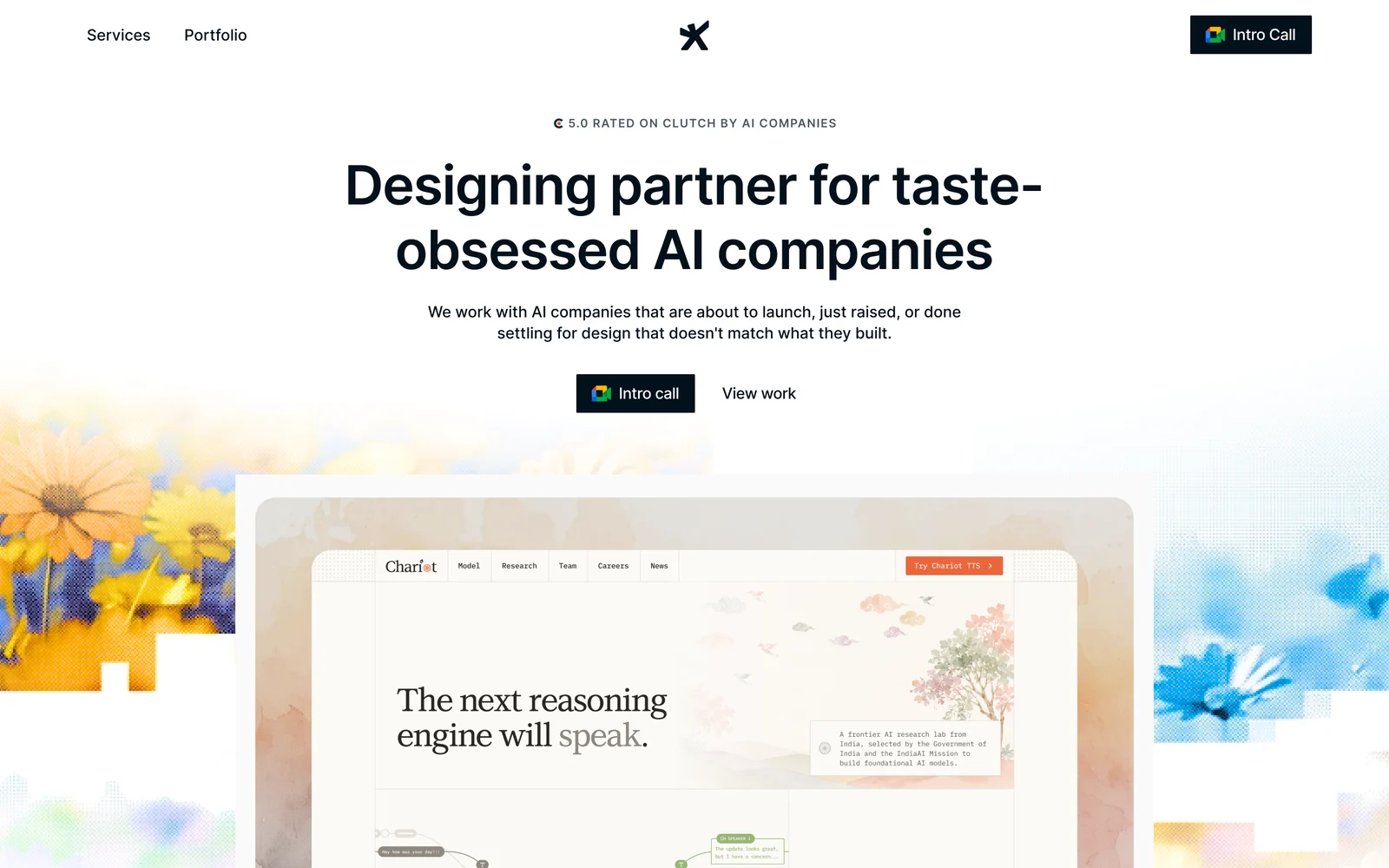
The relevant question for a venture studio is what happens on the second project, and this is a small senior team rather than a rotating cast, so what was learned on the first one stays in the room. Studio Maydit is a web and product design studio. Its clients are AI founders, spread across the US, UK, and Europe. Platform is chosen per company rather than imposed: Framer where a launch site changes weekly, Webflow where a portfolio company will hire its own marketer, custom code where a product cannot fit either. The work continues into product design after each site ships.
At Dualite the sequence ran narrow before it ran wide. A repositioned ICP was fixed first, the design work then served only that group, and 100,000+ users arrived over seven months. Venture studios watch this decision get skipped more than anyone, because a new company is genuinely open in every direction on day one and choosing a single buyer feels premature. It is the decision that makes everything after it cheaper. Recent clients include Wave, PixelFlow, Mi-VAD, and 15 other AI and SaaS teams.
Because portfolio companies launch on a rhythm rather than all at once, the monthly retainer usually fits a venture studio better: it covers new pages, campaigns, and product design, with no long lock-in, so capacity is there when two companies land in the same quarter. Fixed scope is the alternative, three to four weeks against a launch date, closing with a written diagnosis of what is leaking in the product rather than a handover meeting.
| Check | Finding |
|---|---|
| Based in | Remote, serving US / UK / EU |
| Platform depth | Framer, Webflow, and custom code |
| AI-sector proof | Yes. AI-native clients, published outcome on Dualite |
| Pricing | Fixed scope or monthly retainer, quoted per project |
| Team shape | Founder-led, small senior team |
| Best fit | Venture studios whose fourth launch still costs what the first did |
If nobody can tell you what your cheapest launch cost, that is the number to fix first. Book a 30-minute call.

2. 8020
8020 has worked from San Francisco and New York since 2014 in Webflow, for Wave, Superlist, Pilot.com, Vanta, and Circle. Five separate venture-backed software companies is close to the pattern a venture studio runs, and Webflow means a portfolio company can take ownership of its own site later.
Neither team size nor pricing is published, which makes capacity planning across several launches harder, and the AI-sector proof is partial.
| Check | Finding |
|---|---|
| Based in | San Francisco and New York, USA |
| Founded | 2014 |
| Team size | Not published |
| Primary platform | Webflow |
| AI-sector proof | Partial |
| Named clients | Wave, Superlist, Pilot.com, Vanta, Circle |
| Pricing | Not published |
| Best fit | Studios wanting a partner fluent in launching software companies |
3. Refokus
Refokus is a remote German studio founded in 2021 with eleven to fifty people, working in Webflow for Mural, BASF, Spotify, Yahoo, and BCG. The visual standard is high, and at that size two projects can run in parallel without either stalling.
The work is aimed at established brands rather than repeated early launches, the AI-sector proof is partial, and no pricing is published.
| Check | Finding |
|---|---|
| Based in | Germany, remote |
| Founded | 2021 |
| Team size | 11-50 |
| Primary platform | Webflow |
| AI-sector proof | Partial |
| Named clients | Mural, BASF, Spotify, Yahoo, BCG |
| Pricing | Not published |
| Best fit | Studios wanting a high visual standard on flagship launches |
4. Finsweet
Finsweet is a distributed studio based in Denver, founded in 2017, fifty-one to two hundred people, working in Webflow for Dropbox, Clay, GitHub, and Steadily. The Webflow depth here is the strongest on this page and it lives in structure and components, which is exactly the asset that carries from one portfolio company to the next.
No pricing is published and the AI-sector proof is partial, so a buyer planning several projects starts without a reference figure.
| Check | Finding |
|---|---|
| Based in | Denver, USA, distributed |
| Founded | 2017 |
| Team size | 51-200 |
| Primary platform | Webflow |
| AI-sector proof | Partial |
| Named clients | Dropbox, Clay, GitHub, Steadily |
| Pricing | Not published |
| Best fit | Studios building a reusable system rather than one-off sites |
5. Feels Like
Feels Like is a Los Angeles studio founded in 2023 working in custom code, with AI-sector proof, for Google, Nike, LVMH, and Suno AI. The craft is high and a flagship company in the portfolio would benefit from it.
Custom code is the wrong economics for repeated launches, since nothing forks and each build starts again. No team size and no pricing are published.
| Check | Finding |
|---|---|
| Based in | Los Angeles, USA |
| Founded | 2023 |
| Team size | Not published |
| Primary platform | Custom code |
| AI-sector proof | Yes |
| Named clients | Google, Nike, LVMH, Suno AI |
| Pricing | Not published |
| Best fit | One flagship portfolio company with a real brand budget |
6. Trueform
Trueform is a Swiss studio founded in 2022 working in Framer, with AI-sector proof and a published starting price, for Miro, Morning Brew, Bilt Rewards, and Gather. Framer plus a public number is a practical combination for launch sites, since a new company can publish its own pages from week one without engineering.
No team size is published, so parallel capacity is unknown, and the trading history is short for a multi-year supplier arrangement.
| Check | Finding |
|---|---|
| Based in | Wil, Switzerland |
| Founded | 2022 |
| Team size | Not published |
| Primary platform | Framer |
| AI-sector proof | Yes |
| Named clients | Miro, Morning Brew, Bilt Rewards, Gather |
| Pricing | Published minimum |
| Best fit | Fast launch sites each company can then run itself |
7. basement.studio
basement.studio works from Mar del Plata and Los Angeles, founded in 2018, eleven to fifty people, in custom code, with AI-sector proof and a published starting price, for Vercel, Cursor, ElevenLabs, Harvey AI, and Scale AI. That is the strongest AI-native client list on this page, and the published price is unusual for custom-code work.
Custom code still means each site is rebuilt rather than forked, which is the cost structure a venture studio is trying to escape.
| Check | Finding |
|---|---|
| Based in | Mar del Plata, Argentina and Los Angeles, USA |
| Founded | 2018 |
| Team size | 11-50 |
| Primary platform | Custom code |
| AI-sector proof | Yes |
| Named clients | Vercel, Cursor, ElevenLabs, Harvey AI, Scale AI |
| Pricing | Published minimum |
| Best fit | A technically ambitious portfolio company with engineering support |
8. BX Studio
BX Studio is a New York studio of eleven to fifty people working in Webflow, with AI-sector proof and a published starting price, for Reddit, Headspace, ASAPP, and Verifone. Webflow plus a published figure plus AI experience is a workable combination for repeated launches at a predictable cost.
No founding year is published, and the client list is larger companies, so the process may assume more of a portfolio company than a four-person team can give.
| Check | Finding |
|---|---|
| Based in | New York, USA |
| Founded | Not published |
| Team size | 11-50 |
| Primary platform | Webflow |
| AI-sector proof | Yes |
| Named clients | Reddit, Headspace, ASAPP, Verifone |
| Pricing | Published minimum |
| Best fit | Studios wanting AI proof and a known number on each launch |
9. Phantom
Phantom has worked from London and Auckland since 2013 with fifty-one to two hundred people in custom code, with AI-sector proof, for Diageo, SAP, Financial Times, and Zendesk. The capability is broad and the studio can build as well as design, which suits an ambitious single project.
For repeated launches the model does not fit. Custom code plus a large enterprise-shaped engagement is the most expensive way to run this, and no pricing is published.
| Check | Finding |
|---|---|
| Based in | London, UK and Auckland, NZ |
| Founded | 2013 |
| Team size | 51-200 |
| Primary platform | Custom code |
| AI-sector proof | Yes |
| Named clients | Diageo, SAP, Financial Times, Zendesk |
| Pricing | Not published |
| Best fit | A single large project with real engineering time behind it |
10. Clay
Clay has run from San Francisco since 2016 with fifty-one to two hundred people, AI-sector proof, and a published starting price, for Slack, Stripe, Google, Coinbase, and Amazon. The headcount means genuine parallel capacity, which is rare on this page and directly useful when two companies launch in one quarter.
It sits last on shape rather than quality. The primary platform is mixed, so what carries between projects depends on how each build is done, and a studio of that size assumes a client contact who can run a project.
| Check | Finding |
|---|---|
| Based in | San Francisco, USA |
| Founded | 2016 |
| Team size | 51-200 |
| Primary platform | Mixed |
| AI-sector proof | Yes |
| Named clients | Slack, Stripe, Google, Coinbase, Amazon |
| Pricing | Published minimum |
| Best fit | Studios running several launches at once with someone to coordinate |
How to choose between them
Sort by what is actually broken.
If every launch costs the same as the last one, you need a system rather than a site, and it should be the whole brief. Finsweet, and ask specifically what forks between projects.
If two companies are launching in the same quarter and capacity is the constraint, size matters more than anything else here. Clay or Refokus.
If portfolio companies keep coming back for small edits, buy the platform freedom instead and let each team publish for itself. Trueform or BX Studio.
If one company in the portfolio deserves a genuinely distinctive brand and has the budget for it, that is a different purchase from the rest. basement.studio or Feels Like.
One test before you sign. Ask what the fourth site would cost. A studio that fits this brief gives you a lower number and explains what carries over. A studio that does not repeats the first quote.