
Summarize with AI


For a YC-backed AI startup, the ten studios worth reviewing are Studio Maydit, Flowout, Instrument, Digidop, Flow Ninja, Ramotion, Push Refresh, Engine Digital, Pixelmatters, and Edgar Allan. Ramotion and Pixelmatters lead this list. Ramotion has designed software for Mozilla, Okta, Adobe, and Xero since 2009 and publishes a starting price, and Pixelmatters brings design and engineering together with a published price and enterprise software clients. Instrument and Engine Digital are the wrong fit here. Both build for organisations that already have internal marketing teams, and neither publishes anything about price or headcount.
Your batch has a few hundred companies in it, and a meaningful number of them describe themselves in the same shape you do.
That is not a criticism of anyone. The shape works: one sentence naming the problem, one naming the mechanism, a metric, and a call to action. It is what a good Demo Day slide looks like, and turning the slide into a homepage is the obvious move when you have a week and a launch.
The trouble is what happens next. An investor sees your slide once, in context, with you standing next to it. A customer sees your homepage cold, having already seen four companies that month with the same sentence structure and a similar-sounding metric. The format that made you memorable in a room makes you interchangeable on the open web.
There is a second thing, specific to this stage. You are about to get a traffic spike from the launch, from the batch, and from wherever the announcement lands. It arrives once, it is large relative to everything before it, and most of those people will never come back. A site that has nothing for them beyond a signup form wastes the biggest audience you will have for months.
And there is a third, quieter problem. Almost every reference in the batch comes from the same handful of admired sites, so the visual conventions converge as hard as the writing does. Looking like a YC company was useful once. It is now the baseline.

How we picked these agencies
Five checks, each settled from public material before a call is booked.
Platform depth. What do you get, and can you change it on a Sunday? At this stage the copy will be rewritten repeatedly as you talk to customers, so the ability to edit without an invoice matters more than anything visual. Ask how a new page gets added in month three.
Proof with venture-backed software companies. Has the studio worked with businesses that raised institutional money and then had to move quickly? This is the criterion that carries the most weight here. It is not about big logos. A funded startup changes its story more than once a year and publishes on short notice, and studios trained on established companies design for a stability you will not have.
Pricing. Is a starting figure published? At this stage it is also a filter on how a studio works. Publishing a number usually means productised scopes and quick starts, which is the right shape when the alternative is three discovery calls you do not have time for.
Team shape. Size determines how close you are to the person doing the work, and how quickly a change requested on Thursday appears.
Their own site. Nobody briefed it. For this brief, read it specifically for whether it sounds like everything else, because that is the exact failure you are trying to buy your way out of.
An extra question that sorts this list quickly. Ask what they would do differently from the last three AI startup sites they built. A studio worth hiring has an answer and it is specific. A studio without one is going to hand you the batch template with your logo on it.
Everything recorded in the tables comes from what each studio publishes about itself, taken as stated. There are no estimates here, and a row reading not published means the studio has chosen not to say.
What goes wrong for YC-backed AI startups
Three failures, and the first is close to universal in a batch.
The Demo Day slide gets stretched into a website. A single line, a metric, a screenshot, and a signup. It converts well for people who already know who you are, which during launch week is most of your traffic, and it converts almost nothing afterwards. A cold visitor needs to understand what the product does, who it is for, what it replaces, and why they should believe you, and none of that fits on a slide. The tell is that the homepage can be read in eleven seconds.
The site looks and reads like the other companies in the batch. The same references circulate, the same structure gets copied, and the same three adjectives appear. Within the ecosystem this is invisible because everyone is doing it. Outside it, a buyer comparing vendors sees four indistinguishable pages and picks on something else, usually price or whoever replied first. Sounding like a YC company was a signal in 2018. It is now camouflage.
Launch traffic arrives and there is nothing built to catch it. The spike comes once. Most of those visitors are not ready to buy today, and the site offers them a signup form or nothing. No way to follow the company, no piece of writing worth their time, no reason to return. Weeks later the traffic is gone and the only asset left is a number in an analytics dashboard. Building one thing worth coming back for, before the launch rather than after it, is the highest-return page on the site.
1. Studio Maydit: A Top-Rated Design Agency for AI Founders
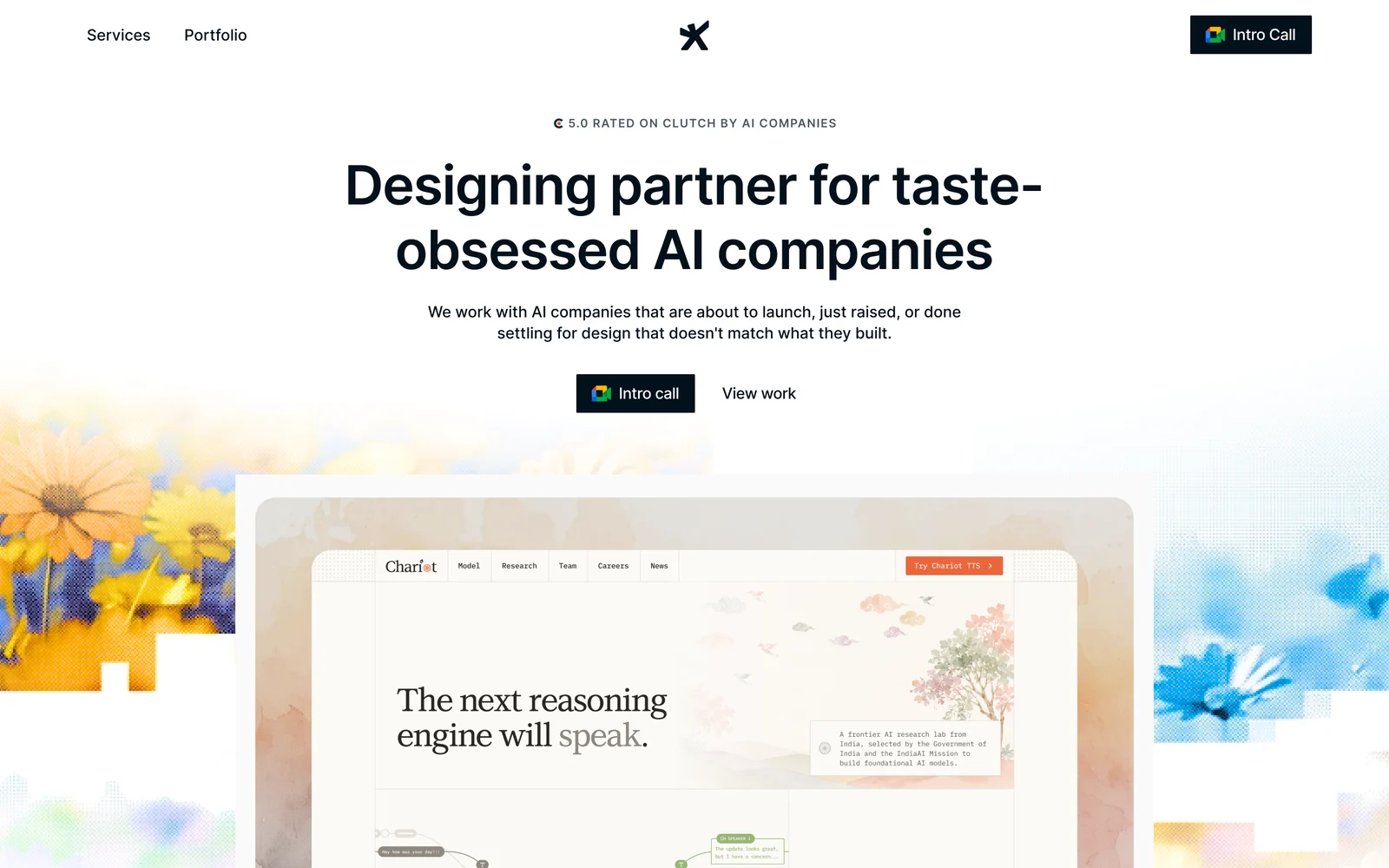
One senior team and no account layer is the shape that actually works at this stage, when a decision made on Tuesday needs to be on the site by Thursday. Studio Maydit is a web and product design studio, its clients are AI founders, and they sit across the US, UK, and Europe. Platform is picked for the year ahead rather than out of preference: Framer when the message will change monthly, which after a launch it will, Webflow when a first marketing hire should own it, and custom code when the product genuinely needs it. Work continues into product design after the site ships.
Narrowing came before growth at Dualite. A repositioned ICP was settled first, the design that followed served only that smaller group, and 100,000+ users arrived across seven months. This is the decision a batch company most often defers, because the product does work for several kinds of customer and picking one feels like leaving money behind. It is the opposite: a page written for three buyers is what leaves the money. Recent clients include Wave, PixelFlow, Mi-VAD, and 15 other AI and SaaS teams.
For a team working toward a launch date, fixed scope runs three to four weeks and ends with a written diagnosis of what is leaking in the product, which after a spike is usually the gap between arriving and understanding. Where the story is still being tested against real customers and pages are needed weekly, the monthly retainer fits better, covering new pages, campaigns, and product design, with no long lock-in.
| Check | Finding |
|---|---|
| Based in | Remote, serving US / UK / EU |
| Platform depth | Framer, Webflow, and custom code |
| AI-sector proof | Yes. AI-native clients, published outcome on Dualite |
| Pricing | Fixed scope or monthly retainer, quoted per project |
| Team shape | Founder-led, small senior team |
| Best fit | Batch companies whose homepage still reads like a Demo Day slide |
If your homepage can be read in eleven seconds, it is a slide rather than a site. Book a 30-minute call.

2. Flowout
Flowout is a distributed Webflow studio with a published starting price, working for Jasper, Kajabi, Riverside, and Sendlane. Jasper is an AI product with a subscription business behind it, and the productised process plus a public number means work can start in days rather than after a round of discovery calls.
Almost nothing else is public: no founding year, no team size, and the AI-sector proof is partial.
| Check | Finding |
|---|---|
| Based in | Distributed |
| Founded | Not published |
| Team size | Not published |
| Primary platform | Webflow |
| AI-sector proof | Partial |
| Named clients | Jasper, Kajabi, Riverside, Sendlane |
| Pricing | Published minimum |
| Best fit | Teams that need a good site quickly at a number they already know |
3. Instrument
Instrument has run from Portland since 2005 for Nike, Microsoft, Electronic Arts, and Google. The brand work is genuinely excellent and carries real cultural weight when a company is large enough to use it.
That is the mismatch. Programmes of this kind assume an internal marketing and design function on your side, the AI-sector proof is partial, and nothing is published about price or headcount.
| Check | Finding |
|---|---|
| Based in | Portland, USA |
| Founded | 2005 |
| Team size | Not published |
| Primary platform | Mixed |
| AI-sector proof | Partial |
| Named clients | Nike, Microsoft, Electronic Arts, Google |
| Pricing | Not published |
| Best fit | Established companies buying a full brand programme |
4. Digidop
Digidop is a Paris studio founded in 2021, one to ten people, working in Webflow with a published starting price, for TSE Energy, Ramify, and StreamNative. StreamNative is developer infrastructure, so the team has written for a technical reader, and a studio this small means direct contact throughout.
Capacity is thin if the site needs to grow quickly after launch, and the AI-sector proof is partial.
| Check | Finding |
|---|---|
| Based in | Paris, France |
| Founded | 2021 |
| Team size | 1-10 |
| Primary platform | Webflow |
| AI-sector proof | Partial |
| Named clients | TSE Energy, Ramify, StreamNative |
| Pricing | Published minimum |
| Best fit | Founders wanting one small European studio and a published price |
5. Flow Ninja
Flow Ninja is a Belgrade studio founded in 2018 with eleven to fifty people working in Webflow. The size is a useful middle for a company about to add pages: enough capacity to run several at once, small enough to reach whoever is building.
The public record is thin. No client names, no pricing, and partial AI-sector proof, so almost everything has to come from a call.
| Check | Finding |
|---|---|
| Based in | Belgrade, Serbia |
| Founded | 2018 |
| Team size | 11-50 |
| Primary platform | Webflow |
| AI-sector proof | Partial |
| Named clients | Not published |
| Pricing | Not published |
| Best fit | Teams willing to evaluate a studio through conversation and references |
6. Ramotion
Ramotion has operated from San Francisco since 2009 with eleven to fifty people and a published starting price, for Mozilla, Okta, Netflix, Adobe, and Xero. Seventeen years designing software people actually use is a real signal, and being in the same city as most of the batch means overlapping hours and shared context.
The AI-sector proof is partial, so the specific problem of explaining a model-based product would be worked out during your project.
| Check | Finding |
|---|---|
| Based in | San Francisco, USA |
| Founded | 2009 |
| Team size | 11-50 |
| Primary platform | Mixed |
| AI-sector proof | Partial |
| Named clients | Mozilla, Okta, Netflix, Adobe, Xero |
| Pricing | Published minimum |
| Best fit | Batch companies wanting a long software track record nearby |
7. Push Refresh
Push Refresh is a Dallas studio of one to ten people working in Framer with a published starting price, for SmithRx, Synonym, and Northern National. Framer plus a very small team is a fast combination, and your team can publish afterwards without asking anyone.
Capacity is the limit once several pages are needed at once, no founding year is published, and the AI-sector proof is partial.
| Check | Finding |
|---|---|
| Based in | Dallas, USA |
| Founded | Not published |
| Team size | 1-10 |
| Primary platform | Framer |
| AI-sector proof | Partial |
| Named clients | SmithRx, Synonym, Northern National |
| Pricing | Published minimum |
| Best fit | One focused site built fast with the founder in every call |
8. Engine Digital
Engine Digital has worked from Vancouver and New York since 2002 in custom code, for Adidas, Autodesk, Goldman Sachs, and HP. Autodesk and Goldman Sachs are both organisations where the approval process is the hard part, and the studio is comfortable there.
For a batch company the shape is wrong: the engagements assume an internal team, custom code means returning for every edit, and neither price nor headcount is published.
| Check | Finding |
|---|---|
| Based in | Vancouver and New York |
| Founded | 2002 |
| Team size | Not published |
| Primary platform | Custom code |
| AI-sector proof | Partial |
| Named clients | Adidas, Autodesk, Goldman Sachs, HP |
| Pricing | Not published |
| Best fit | Large organisations with internal teams and long timelines |
9. Pixelmatters
Pixelmatters is a Porto studio founded in 2013 with fifty-one to two hundred people, a published starting price, and Rubrik, Quantic, and UJET as clients. Rubrik and UJET both grew from venture funding into enterprise sales, which is the path you are hoping to walk, and having design and engineering in one place removes a handover.
The AI-sector proof is partial, and at that headcount your explanation of the product travels through several people first.
| Check | Finding |
|---|---|
| Based in | Porto, Portugal |
| Founded | 2013 |
| Team size | 51-200 |
| Primary platform | Mixed |
| AI-sector proof | Partial |
| Named clients | Rubrik, Quantic, UJET |
| Pricing | Published minimum |
| Best fit | Funded teams wanting design and build from a single studio |
10. Edgar Allan
Edgar Allan is an Atlanta studio founded in 2014 with fifty-one to two hundred people working in Webflow, for Porsche, Duracell, and NCR. A studio that size can hold a large site together as content grows, and the brand systems work is strong.
It is last for this brief on fit rather than quality. The clients are established consumer and industrial companies rather than early software, the AI-sector proof is partial, and no pricing is published.
| Check | Finding |
|---|---|
| Based in | Atlanta, USA |
| Founded | 2014 |
| Team size | 51-200 |
| Primary platform | Webflow |
| AI-sector proof | Partial |
| Named clients | Porsche, Duracell, NCR |
| Pricing | Not published |
| Best fit | Companies buying a brand system with a large site behind it |
How to choose between them
Sort by what is actually broken.
If the homepage is still the slide, the work is writing and it is the cheapest thing on this page to fix. Ramotion or Pixelmatters, and brief it as a rewrite rather than a new design.
If the launch is in three weeks and you need something good rather than perfect, buy speed at a known price. Flowout or Push Refresh.
If the site reads like the rest of the batch and you know it, you need craft and an opinion, not a template. Edgar Allan or Pixelmatters.
If you want one European studio with a published number and direct access, Digidop.
One test before you sign. Show them three other sites from your batch and ask what they would do differently. A studio that fits this brief names something specific and structural. A studio that does not will talk about colour.